Liquidity goes deeper than the screen. Market makers can tap the liquidity of an ETF’s underlying securities, not just the shares quoted on the exchange.
Look past average daily volume (ADV). Because ETF shares can be created and redeemed to meet demand, an ETF may be able to accommodate trades larger than its ADV suggests.
Execution matters. Using limit orders, avoiding the open and close, and working with a trading desk can help manage costs, especially for newer or thinly traded ETFs.
Low trading volume doesn’t necessarily mean low liquidity. That’s an important distinction for ETFs, particularly those that are newly launched. Volume naturally starts small while a fund builds its shareholder base. Liquidity, on the other hand, can be available from the first day of trading due to the securities an ETF holds.
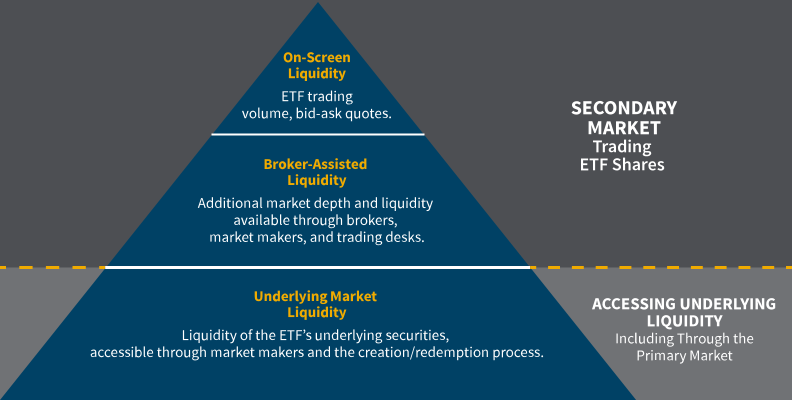
The key is understanding that an ETF’s liquidity extends beyond what investors can see on a trading screen. For advisors, it can be thought of in three levels:
the quoted prices, displayed share quantities, and trading volume visible on screen;
additional liquidity available through brokers and market makers; and
the liquidity of the ETF’s underlying securities, which market makers can tap through trading and the creation/redemption process.
Together, these levels help explain why an ETF may accommodate trades far larger than its reported daily volume.
ETF Liquidity: Looking Beyond the Screen
Source: William Blair, as of October 2026.
Why ETF Trading Volume Can Be Misleading
For individual stocks, ADV can be a useful indicator of liquidity. But ETFs are built differently. Unlike individual stocks, ETFs can create and redeem shares in response to investor demand, making their trading volume a less reliable indicator of how easily they can be bought or sold.
A company’s stock has a relatively fixed number of shares outstanding. If buyers want more shares than sellers are offering, the price must rise until enough sellers emerge. That’s why ADV can be a meaningful liquidity measure for a stock: It provides an indication of how actively shares typically change hands.
ETFs, by contrast, can create new shares when demand rises and redeem existing shares when demand falls. This flexibility means an ETF’s ability to accommodate trades isn’t limited to the shares already circulating in the market. Its trading history is a record of past activity, not necessarily a ceiling on future trading capacity.
An ETF’s liquidity isn’t limited to the shares already circulating in the market.
To understand how this works, it helps to look at the two markets that provide ETF liquidity.
The first is the secondary market, where investors buy and sell existing ETF shares through their brokers. This is the market most investors see, and its activity is reflected in ADV and the bid and ask prices displayed on screen.
The second is the primary market, where ETF shares are created and redeemed. Authorized participants, typically large broker-dealers, can exchange baskets of underlying securities (or cash) with the fund for new ETF shares, or return ETF shares in exchange for securities (or cash). This creation/redemption mechanism gives market makers access to a potential source of liquidity beyond the ETF shares already trading on the exchange, allowing them to facilitate transactions larger than the volume or share quantities displayed on-screen might suggest.
What Happens When an Advisor Places a Large Order
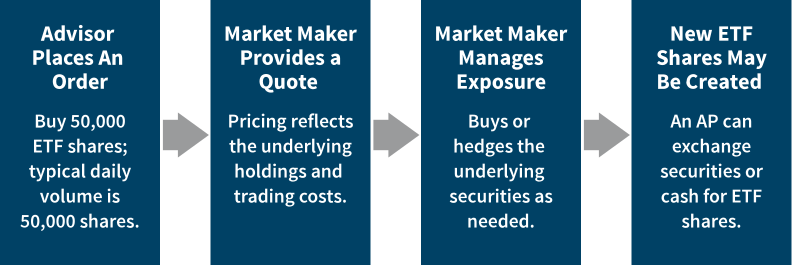
Consider an advisor who wants to buy 50,000 shares of an ETF that typically trades just 5,000 shares a day. Despite the relatively low trading volume, the advisor may be able to execute the order efficiently because the liquidity of the underlying holdings allows an authorized participant (AP) to exchange a basket of those securities for additional shares of the ETF beyond the reported trading volume. One way this can happen is illustrated below.
How ETF Liquidity Supports Large Trades
Source: William Blair, as of October 2026.
The process can also work in reverse for a large sale. The important point is that ETF liquidity providers aren’t limited to the shares already changing hands on the exchange. They can draw on the underlying markets to facilitate larger trades, with execution prices reflecting the value and trading costs of the securities the ETF holds.
The number of shares shown at the bid or ask reflects what market makers are currently quoting, not what they can accommodate.
Tips for Efficient Execution
Understanding where an ETF’s liquidity comes from is only part of the equation. How an order is placed can affect execution costs. A few practical considerations can help advisors trade more efficiently, particularly when dealing with newer or less actively traded ETFs.
Use limit orders. Limit orders establish the maximum price an investor is willing to pay or the minimum price they are willing to accept, providing protection against unexpected execution prices. Market orders, by contrast, prioritize immediate execution and may result in unfavorable fills when markets are volatile or displayed liquidity is limited.
Consider the clock. ETF spreads can be wider shortly after the U.S. market opens and near the close. For international ETFs, trading while underlying markets are open, when possible, may help reduce execution costs.
Look beyond displayed size. The number of shares shown at the bid or ask reflects what market makers are currently quoting, not necessarily the full amount they can accommodate. Larger orders may be executed through liquidity providers without materially moving the market.
Consult block trading desks and the ETF capital markets team. For larger or more complex trades, advisors can work with their broker’s block trading desk or the ETF issuer’s capital markets team to assess available liquidity, execution strategies, and potential trading costs.
What This Means for William Blair ETFs
William Blair’s active ETFs provide access to international equities, emerging markets equities, and emerging markets fixed income—asset classes in which our investment teams have decades of experience.
Although these ETFs are new, the markets in which they invest are well established. Their ability to accommodate trades depends not simply on how many ETF shares change hands each day, but also on the liquidity of their underlying holdings and prevailing market conditions.
For advisors, the takeaway is straightforward: a new ETF’s limited trading history isn’t necessarily a barrier to taking a meaningful position. Looking beyond trading volume—and understanding how to access the liquidity of the underlying holdings—can help advisors evaluate and trade new ETFs with greater confidence.
Jay Lisowski, CFA, is the global head of product strategy and development at William Blair.
Any investment or strategy mentioned herein may not be appropriate for every investor. There can be no assurance that investment objectives will be met. Products and services listed are available only to residents of this jurisdiction and may only be available to certain categories of investors. The information on this website does not constitute an offer for products or services, or a solicitation of an offer to any persons outside of this jurisdiction who are prohibited from receiving such information under applicable laws and regulations. Nothing on this webpage should be construed as advice and is therefore not a recommendation to buy or sell shares.
Please carefully consider the Funds’ investment objectives, risks, charges, and expenses before investing. This and other information is contained in the Funds’ prospectus and summary prospectus, which you may obtain by calling 1-800-742-7272. Read the prospectus and summary prospectus carefully before investing. Investing includes the risk of loss.
The William Blair Funds and William Blair ETFs are distributed by William Blair & Company, L.L.C., member FINRA/SIPC.
The William Blair SICAV is a Luxembourg investment company with variable capital registered with the Commission de Surveillance du Secteur Financier (“CSSF”) which qualifies as an undertaking for collective investment in transferable securities (“UCITS”). The Management Company of the SICAV has appointed William Blair Investment Management, LLC as the investment manager for the fund.
Please carefully consider the investment objectives, risks, charges, and expenses of the William Blair SICAV. This and other important information is contained in the prospectus and Key Investor Information Document (KIID). Read these documents carefully before investing. The information contained on this website is not a substitute for those documents or for professional external advice.
Information and opinions expressed are those of the authors and may not reflect the opinions of other investment teams within William Blair Investment Management, LLC, or affiliates. Factual information has been taken from sources we believe to be reliable, but its accuracy, completeness or interpretation cannot be guaranteed. Information is current as of the date appearing in this material only and subject to change without notice. Statements concerning financial market trends are based on current market conditions, which will fluctuate. This material may include estimates, outlooks, projections, and other forward-looking statements. Due to a variety of factors, actual events may differ significantly from those presented.
Investing involves risks, including the possible loss of principal. Equity securities may decline in value due to both real and perceived general market, economic, and industry conditions. The securities of smaller companies may be more volatile and less liquid than securities of larger companies. Investing in foreign denominated and/or domiciled securities may involve heightened risk due to currency fluctuations, and economic and political risks. These risks may be enhanced in emerging markets and frontier markets. Investing in the bond market is subject to certain risks including market, interest rate, issuer, credit, and inflation risk. High-yield, lower-rated, securities involve greater risk than higher-rated securities. Different investment styles may shift in and out of favor depending on market conditions. Diversification does not ensure against loss.
Past performance is not indicative of future returns. References to specific companies are for illustrative purposes only and should not be construed as investment advice or a recommendation to buy or sell any security.
William Blair Investment Management, LLC is an investment adviser registered with the U.S. Securities and Exchange Commission.
Issued in the United Kingdom by William Blair International, Ltd., authorized and regulated by the Financial Conduct Authority (FCA), and is only directed at and is only made available to persons falling within articles 19, 38, 47, and 49 of the Financial Services and Markets Act of 2000 (Financial Promotion) Order 2005 (all such persons being referred to as "relevant persons").
Issued in the European Economic Area (EEA) by William Blair B.V., authorized and supervised by the Dutch Authority for the Financial Markets (AFM) under license number 14006134 and also supervised by the Dutch Central Bank (DNB), registered at the Dutch Chamber of Commerce under number 82375682 and has its statutory seat in Amsterdam, the Netherlands. This material is only intended for eligible counterparties and professional clients.
Issued in Switzerland by William Blair Investment Services (Zurich) GmbH, Talstrasse 65, 8001 Zurich, Switzerland ("WBIS"). WBIS is engaged in the offering of collective investment schemes and renders further, non-regulated services in the financial sector. WBIS is affiliated with FINOS Finanzomubdsstelle Schweiz, a recognized ombudsman office where clients may initiate mediation proceedings pursuant to articles 74 et seq. of the Swiss Financial Services Act ("FinSA"). The client advisers of WBIS are registered with regservices.ch by BX Swiss AG, a client adviser registration body authorized by the Swiss Financial Market Supervisory Authority ("FINMA"). WBIS is not supervised by FINMA or any other supervisory authority or self-regulatory organization. This material is only intended for institutional and professional clients pursuant to article 4(3) to (5) FinSA.
Issued in Australia by William Blair Investment Management, LLC (“William Blair”), which is exempt from the requirement to hold an Australian financial services license under Australia's Corporations Act 2001 (Cth). William Blair is registered as an investment advisor with the U.S. Securities and Exchange Commission (“SEC”) and regulated by the SEC under the U.S. Investment Advisers Act of 1940, which differs from Australian laws. This material is intended only for wholesale clients.
Issued in Singapore by William Blair International (Singapore) Pte. Ltd. (Registration Number 201943312R), which is regulated by the Monetary Authority of Singapore under a Capital Markets Services License to conduct fund management activities. This material is intended only for institutional investors and may not be distributed to retail investors.
Issued in Canada by William Blair Investment Management, LLC, which relies on the international adviser exemption, pursuant to section 8.26 of National Instrument 31-103 in Canada.
The content contained in this site is intended as informational or educational in nature and does not constitute investment advice or a recommendation of any investment strategy or product for a particular investor. Investment advice and recommendations can be provided only after careful consideration of an investor’s objectives, guidelines, and restrictions. Investors should consult a financial professional/financial consultant or investment adviser before making any investment decisions. Investing includes the risk of loss.