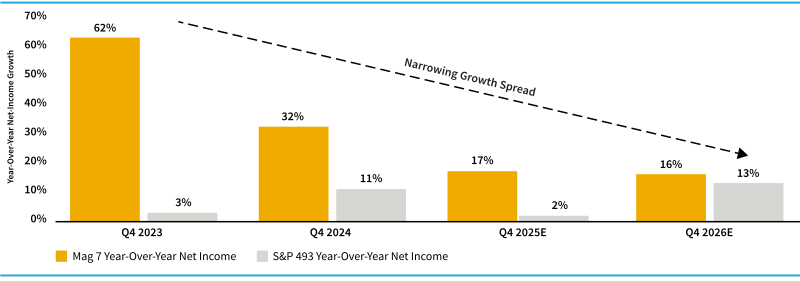
After years of mega-cap technology dominance, earnings growth across the market appears to be converging.
Investments in power, grid infrastructure, AI, robotics, and defense are creating potential opportunities across complex supply chains.
Small- and mid-cap companies within the infrastructure and industrial sectors could stand to capture incremental demand as growth diffuses beyond the largest technology platforms.
Over the past several years, equity market performance has been defined by concentration. A narrow cohort of mega-cap, technology-oriented companies has driven a disproportionate share of index returns, powered by superior earnings growth.
These businesses—built on software, cloud computing, digital advertising, e-commerce, and data infrastructure—scaled with extraordinary efficiency. And their asset-light models, global reach, and high incremental margins allowed them to compound capital at exceptionally high rates.
As digital transformation accelerated, economic gains accrued to a relatively small group of companies that controlled core layers of the digital ecosystem. Equity index construction then amplified this effect: as these firms grew, their weight in capitalization-weighted benchmarks increased, reinforcing their influence on overall market performance.
Markets, however, are dynamic. Leadership regimes can persist for long periods, but they do not last indefinitely. Signs have been emerging that growth rates across the market are beginning to converge. So, while mega-cap leaders remain compelling, we believe the relative gap in earnings acceleration between them and the broader market appears to be narrowing.
Year-Over-Year Net-Income Growth: Magnificent 7 vs. Rest of Market
Sources: FactSet, Morgan Stanley Research, and William Blair, as of October 31, 2025. The Magnificent 7 (Mag 7) consists of: Alphabet, Amazon, Apple, Meta Platforms, Microsoft, NVIDIA, and Tesla. E refers to estimated. Estimates represent consensus expectations. Due to a variety of factors, actual events may differ significantly from the estimates or outlooks presented.
From Digital Dominance to Physical Expansion
We believe a key driver of this shift is the evolving nature of growth itself. The previous cycle was dominated by IP-driven expansion, but we believe the next phase of growth may be more physically grounded and capital-intensive, shaped by power generation, transmission networks, manufacturing facilities, robotics, and advanced compute infrastructure.
This distinction matters because physical investment distributes economic benefits differently, activating complex supply chains.
For example, constructing a new data center requires land development, electrical equipment, transformers, cooling systems, construction services, steel, semiconductors, and grid interconnections. In this scenario, each incremental dollar of investment circulates across a broad ecosystem of suppliers, contractors, and service providers.
A key driver of this market shift is the evolving nature of growth itself.
Five Themes Driving the Next Investment Cycle
We believe small- and mid-cap companies, which are often embedded deep within larger companies’ supply chains, may have the opportunity to capture incremental demand that was less accessible during the platform-dominated era. Below are five thematic currents we believe underpin this evolution.
Theme 1: Power and Energy Infrastructure
The buildout of power and energy infrastructure has become a defining priority as AI adoption accelerates electricity demand. Data centers, particularly those optimized for AI training and inference, require substantial and reliable power. We believe meeting this demand will involve not only utilities and power producers but also equipment manufacturers and engineering firms.
Theme 2: Grid Modernization
Grid modernization and reliability upgrades appear to be becoming structural imperatives as well. As economies electrify and integrate new energy sources, infrastructure that was built decades ago stands to be upgraded to ensure reliability and resilience. This process will likely require sustained investment in advanced transmission systems, smart grid technologies, and distributed energy integration to support long-term system stability and growth.
Theme 3: The Expansion of AI Infrastructure
We believe the universe of AI beneficiaries is broader than it first appeared. The expansion of compute infrastructure depends on an extensive ecosystem, inclusive of semiconductor fabrication, specialty materials, networking equipment, cooling technologies, and construction. Over time, AI-driven productivity gains and large-scale infrastructure investment could cascade across industrial automation, logistics, energy, real estate, and other capital-intensive sectors, broadening the economic impact well beyond the platform companies that deploy these systems.
Theme 4: Robotics and Physical AI
Advances in robotics and automation are also extending the reach of AI into the physical world. What began as a digital transformation is increasingly influencing factories, warehouses, and logistics systems. This convergence of AI-powered software and machinery could expand the range of beneficiaries to include industrial automation companies, precision manufacturers, and engineering specialists, for instance.
Theme 5: National Security
At the same time, national security considerations seem to be reshaping fiscal priorities. Heightened geopolitical tensions have prompted many governments to increase defense spending and expand beyond traditional hardware to include autonomous systems, cyber capabilities, and secure communications. This shift could direct capital toward a broader industrial base, including manufacturers, component suppliers, and specialized technology providers.
We believe the universe of AI beneficiaries is broader than it first appeared.
A Broader Foundation for Market Leadership
Taken together, we believe these developments suggest that market leadership may be poised to broaden as growth opportunities diffuse across sectors and capitalizations.
Small- and mid-cap companies, particularly those tied to infrastructure and capital goods spending, may find themselves supported by durable, multiyear investment cycles.
However, this does not imply the obsolescence of mega-cap leaders, which remain central to innovation. Rather, it points toward a more balanced environment in which leadership is less narrowly defined and growth contributions are more evenly distributed.
Traditionally cyclical industries, long characterized by earnings volatility and sensitivity to economic swings, could begin to assume features of structural growth industries if underpinned by factors such as durable policy support, secular growth trends, and national strategic priorities.
Investment Implications
We believe this evolving backdrop argues for a reassessment of concentration risk and opportunity breadth. Periods of narrow leadership can often reward passive exposure to capitalization-weighted indices, but a market regime characterized by broadening growth may reward a more selective approach that looks beyond the largest companies.
Diversification, in this context, becomes more than a risk management tool. We believe it becomes a way of capturing multiple engines of expansion.
We believe this evolving backdrop argues for a reassessment of concentration risk and opportunity breadth.
Looking ahead, the expected transition to better market breadth will likely not occur in a single quarter, nor do we believe it will unfold in a straight line. As growth drivers become more diffuse, the architecture of stock market returns may shift accordingly.
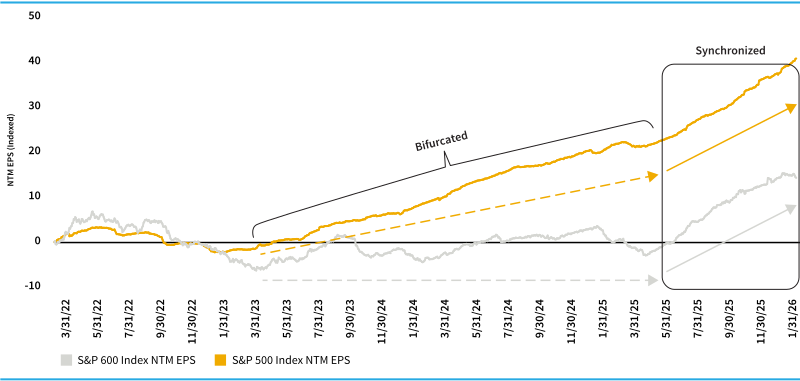
Small- and Large-Cap Earnings Growth Has Become Less Bifurcated
Sources: FactSet and William Blair, as of February 28, 2026. NTM EPS refers to next 12 months’ earnings per share. Large-cap equities are represented by the S&P 500 Index, a capitalization-weighted index designed to measure the performance of approximately 500 large-cap U.S. publicly traded companies. Small-cap equities are represented by the S&P 600 Index, which is designed to track the small-cap market segment. A direct investment in an unmanaged index is not possible.
For investors willing to look beyond the familiar leaders of the past decade, we believe the next cycle may offer wider, more balanced investment opportunities than markets have provided in recent years.
Arun Sharma is a portfolio manager on William Blair's U.S. growth and core equity team.
Subscribe Now
Want the latest insights on the economy and other forces shaping the investment landscape?
Subscribe to our Investing Insights newsletter.
Any investment or strategy mentioned herein may not be appropriate for every investor. There can be no assurance that investment objectives will be met. Products and services listed are available only to residents of this jurisdiction and may only be available to certain categories of investors. The information on this website does not constitute an offer for products or services, or a solicitation of an offer to any persons outside of this jurisdiction who are prohibited from receiving such information under applicable laws and regulations. Nothing on this webpage should be construed as advice and is therefore not a recommendation to buy or sell shares.
Please carefully consider the Funds’ investment objectives, risks, charges, and expenses before investing. This and other information is contained in the Funds’ prospectus and summary prospectus, which you may obtain by calling 1-800-742-7272. Read the prospectus and summary prospectus carefully before investing. Investing includes the risk of loss.
The William Blair Funds and William Blair ETFs are distributed by William Blair & Company, L.L.C., member FINRA/SIPC.
The William Blair SICAV is a Luxembourg investment company with variable capital registered with the Commission de Surveillance du Secteur Financier (“CSSF”) which qualifies as an undertaking for collective investment in transferable securities (“UCITS”). The Management Company of the SICAV has appointed William Blair Investment Management, LLC as the investment manager for the fund.
Please carefully consider the investment objectives, risks, charges, and expenses of the William Blair SICAV. This and other important information is contained in the prospectus and Key Investor Information Document (KIID). Read these documents carefully before investing. The information contained on this website is not a substitute for those documents or for professional external advice.
Information and opinions expressed are those of the authors and may not reflect the opinions of other investment teams within William Blair Investment Management, LLC, or affiliates. Factual information has been taken from sources we believe to be reliable, but its accuracy, completeness or interpretation cannot be guaranteed. Information is current as of the date appearing in this material only and subject to change without notice. Statements concerning financial market trends are based on current market conditions, which will fluctuate. This material may include estimates, outlooks, projections, and other forward-looking statements. Due to a variety of factors, actual events may differ significantly from those presented.
Investing involves risks, including the possible loss of principal. Equity securities may decline in value due to both real and perceived general market, economic, and industry conditions. The securities of smaller companies may be more volatile and less liquid than securities of larger companies. Investing in foreign denominated and/or domiciled securities may involve heightened risk due to currency fluctuations, and economic and political risks. These risks may be enhanced in emerging markets and frontier markets. Investing in the bond market is subject to certain risks including market, interest rate, issuer, credit, and inflation risk. High-yield, lower-rated, securities involve greater risk than higher-rated securities. Different investment styles may shift in and out of favor depending on market conditions. Diversification does not ensure against loss.
Past performance is not indicative of future returns. References to specific companies are for illustrative purposes only and should not be construed as investment advice or a recommendation to buy or sell any security.
William Blair Investment Management, LLC is an investment adviser registered with the U.S. Securities and Exchange Commission.
Issued in the United Kingdom by William Blair International, Ltd., authorized and regulated by the Financial Conduct Authority (FCA), and is only directed at and is only made available to persons falling within articles 19, 38, 47, and 49 of the Financial Services and Markets Act of 2000 (Financial Promotion) Order 2005 (all such persons being referred to as "relevant persons").
Issued in the European Economic Area (EEA) by William Blair B.V., authorized and supervised by the Dutch Authority for the Financial Markets (AFM) under license number 14006134 and also supervised by the Dutch Central Bank (DNB), registered at the Dutch Chamber of Commerce under number 82375682 and has its statutory seat in Amsterdam, the Netherlands. This material is only intended for eligible counterparties and professional clients.
Issued in Switzerland by William Blair Investment Services (Zurich) GmbH, Talstrasse 65, 8001 Zurich, Switzerland ("WBIS"). WBIS is engaged in the offering of collective investment schemes and renders further, non-regulated services in the financial sector. WBIS is affiliated with FINOS Finanzomubdsstelle Schweiz, a recognized ombudsman office where clients may initiate mediation proceedings pursuant to articles 74 et seq. of the Swiss Financial Services Act ("FinSA"). The client advisers of WBIS are registered with regservices.ch by BX Swiss AG, a client adviser registration body authorized by the Swiss Financial Market Supervisory Authority ("FINMA"). WBIS is not supervised by FINMA or any other supervisory authority or self-regulatory organization. This material is only intended for institutional and professional clients pursuant to article 4(3) to (5) FinSA.
Issued in Australia by William Blair Investment Management, LLC (“William Blair”), which is exempt from the requirement to hold an Australian financial services license under Australia's Corporations Act 2001 (Cth). William Blair is registered as an investment advisor with the U.S. Securities and Exchange Commission (“SEC”) and regulated by the SEC under the U.S. Investment Advisers Act of 1940, which differs from Australian laws. This material is intended only for wholesale clients.
Issued in Singapore by William Blair International (Singapore) Pte. Ltd. (Registration Number 201943312R), which is regulated by the Monetary Authority of Singapore under a Capital Markets Services License to conduct fund management activities. This material is intended only for institutional investors and may not be distributed to retail investors.
Issued in Canada by William Blair Investment Management, LLC, which relies on the international adviser exemption, pursuant to section 8.26 of National Instrument 31-103 in Canada.
The content contained in this site is intended as informational or educational in nature and does not constitute investment advice or a recommendation of any investment strategy or product for a particular investor. Investment advice and recommendations can be provided only after careful consideration of an investor’s objectives, guidelines, and restrictions. Investors should consult a financial professional/financial consultant or investment adviser before making any investment decisions. Investing includes the risk of loss.