References to specific companies are for illustrative purposes only and are not intended and should not be interpreted as recommendations to purchase or sell such securities. The securities discussed do not represent all securities purchased, sold, or recommended for clients. It should not be assumed that any investment in the securities referenced was or will be profitable. The holdings mentioned comprise the following percentages of the William Blair Large Cap Growth Fund as of September 30, 2025: Alphabet: 3.6%; Amazon: 6.2%; Apple: 9.4%; Intuit: 2.1%; Meta: 4.8%; Microsoft: 13.3%; Oracle: 1.9%; ServiceNow: 2.1%; and Tyler Technologies: 1.5%. Companies discussed but not listed were not held by the Fund. Holdings are subject to change without notice.
We believe AI’s growth is grounded in real-world adoption, with companies using it to improve productivity, automate tasks, and enhance decision making.
Large companies are predominantly funding substantial AI-related capex from internal free cash flow.
We believe investors should focus on durable beneficiaries of AI while avoiding purely speculative bets.
Over the past several years, AI has driven a powerful investment cycle, and companies viewed as AI leaders have seen their stock prices move higher. While today’s AI enthusiasm shares some characteristics with prior technology-related bubbles such as elevated market concentration and valuations among perceived winners, we view this cycle as more grounded.
However, as the AI landscape continues to evolve, companies viewed as winners today may not hold that position in the future. Often, the most transformative beneficiaries are those not yet on investors’ radar. For example, during the early stages of the internet buildout in the late 1990s, almost no one was focused on Alphabet or Netflix, and Meta Platforms had yet to form as a company, yet each went on to benefit from the development of the internet.
We believe our quality growth investment approach, with a focus on identifying structurally advantaged companies through rigorous bottom-up research, provides the foundation to help identify the potential winners today—and in the future—as AI adoption continues to advance.
A More Durable AI Cycle
The current AI buildout is supported by meaningful technological advances and real-world adoption, suggesting a more durable foundation for growth. However, there will likely be periods of consolidation along the way.
We believe maintaining balance in our large-cap growth portfolio, participating selectively where we see fundamentals supporting growth and valuation supporting future stock performance, is a prudent approach.
In this nascent stage, AI technologies are already being deployed to improve productivity, automate processes, and enhance decision-making across a wide range of industries, including healthcare, manufacturing, software, and financial services. The scale of corporate investment and the tangible business benefits being realized suggest that while investor sentiment is elevated, it is not entirely disconnected from fundamentals.
The current AI buildout is supported by meaningful technological advances and real-world adoption, suggesting a more durable foundation for growth.
Why This Doesn’t Look Like 1999
We view the current environment as distinct from the internet bubble of 1999. Today’s companies investing in the buildout of AI infrastructure are mostly generating substantial free cash flow and funding growth organically. In contrast, the 1999 internet bubble was fueled largely by capital markets, with many businesses reliant on external financing and unsustainable business models that were not generating a profit.
Back in the late 1990s, a large amount of capital was being used to install dark fiber, which refers to the large volume of unused fiber-optic cables laid during the early internet buildout—capacity that far exceeded actual demand. While this overbuild of capacity eventually proved useful, it initially led to poor returns on invested capital as telecom companies poured billions into infrastructure that sat idle for many years. Eventually, the capital markets shut down, driven by higher interest rates and lack of near-term revenues. This dynamic, coupled with low returns from these investments, became problematic.
In contrast, today’s AI cycle is seeing the opposite dynamic. Graphic processing units (GPUs), which are the foundation used for AI workloads, have been deployed at or near full utilization since day one, generating immediate productivity and revenue for AI developers and hyperscalers (i.e., large data center companies).
The comparison highlights a key difference between past and present technology investment cycles. Dark fiber was a case of supply racing ahead of demand, whereas modern AI infrastructure is a case of demand pulling supply forward, supporting higher initial returns on capital deployed.
We view the current environment as distinct from the internet bubble of 1999.
In addition, the current investment cycle appears more durable, supported by companies that are generally profitable and reinvesting internally generated cash flow to support future growth. That said, select companies are accessing the capital markets to fund some of their AI-related growth initiatives—a dynamic we are closely monitoring.
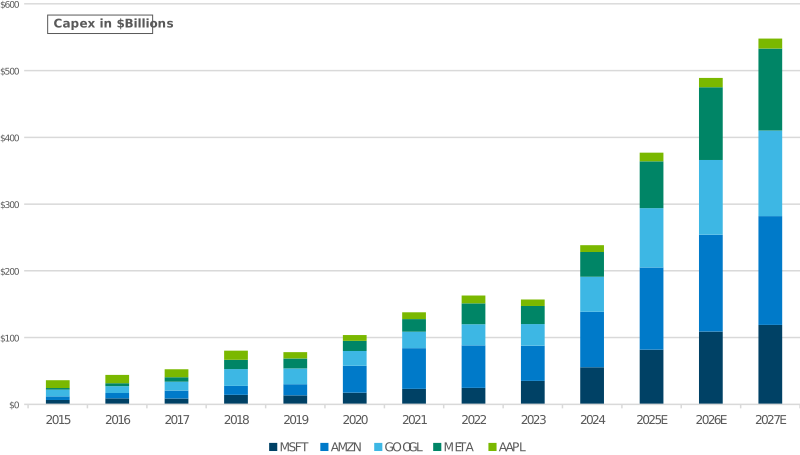
The chart below highlights the capital expenditure (capex) growth among major hyperscalers investing in AI infrastructure. Recent earnings commentary suggests these figures could continue to increase.
AI Investments Are Driving Higher Capex
Capex for several mega-cap companies is projected to increase due to investments in AI, but these companies have the free cash flow to organically support growth investments.
Sources: SEC filings, FactSet Consensus Estimates, and William Blair, as of November 13, 2025. No consensus estimates for Apple (AAPL) in calendar year 2026 through calendar year 2027. AAPL’s fiscal year 2026 capex dollar estimate rolled forward to calendar year 2026 through calendar year 2027.
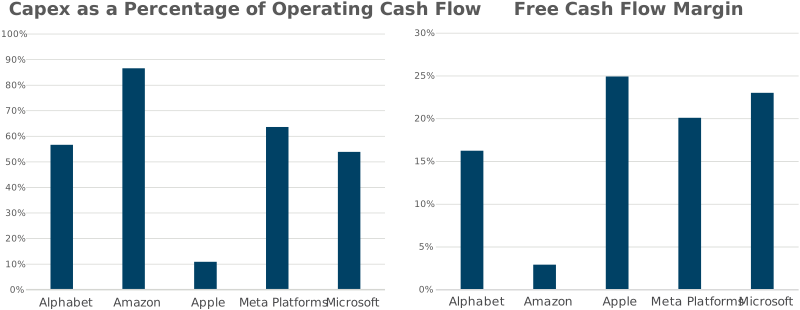
Capex Capacity and Free Cash Flow Strength
Despite sizable capex commitments, these companies have free cash flow margins near 20%, underscoring their financial strength and ability to support ongoing investment.
Sources: FactSet and William Blair, as of November 12, 2025. 2025 calendar year FactSet consensus estimate.
Our Balanced Approach to AI Exposure
Our quality growth philosophy seeks to identify companies with sustainable business models, strong balance sheets, and solid financial returns—companies that we believe are well positioned to benefit from the long-term opportunities created by the evolution of AI.
Companies integrating AI to help strengthen existing franchises—by improving customer engagement, operational efficiency, or product innovation—fit more closely with our investment philosophy than those whose valuations rely primarily on AI-related narratives and speculation.
We believe our large-cap growth portfolio reflects a balanced approach to investing in companies with AI exposure. For example, in the software industry, the portfolio has exposure to established AI leaders such as Microsoft, which is a key beneficiary of the ongoing buildout of AI infrastructure and enterprise adoption.
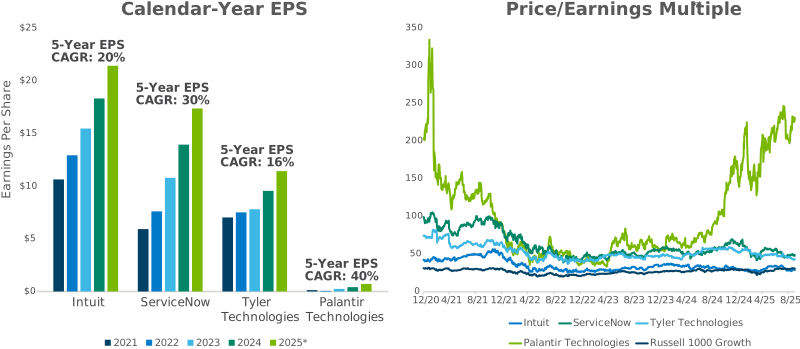
But at the same time, we own underappreciated software companies including ServiceNow, Tyler Technologies, and Intuit. We believe these businesses have durable growth profiles and opportunities to integrate AI into their platforms over time, but on a year-to-date basis, they have lagged the market despite solid fundamentals and strong earnings growth.
Our large-cap growth portfolio reflects a balanced approach to investing in companies with AI exposure.
We believe the companies mentioned above currently offer a more attractive risk/reward profile than a company such as Palantir Technologies. While Palantir Technologies has developed compelling technology, the stock appears priced for perfection, trading at roughly 230x earnings and 100x sales—levels that leave little margin for execution risk.
Large-Cap Growth Software—Underappreciated Opportunities in Our Portfolio
While the market has favored direct AI beneficiaries, several high-quality software businesses have been overlooked. We see compelling opportunities among high-quality companies with strong fundamentals and durable growth whose stocks trade at far more attractive valuations than stocks such as Palantir Technologies.
Sources: FactSet and William Blair, as of September 30, 2025. *FactSet Consensus Estimate. **NTM price/earnings. Past performance is not indicative of future returns. The Russell 1000 Growth Index measures the performance of the large-cap growth segment of the U.S. equity universe. It includes Russell 1000 companies with higher price-to-book ratios and higher forecasted growth rates. A direct investment in an unmanaged index is not possible.
Conclusion
We believe AI represents a transformative and enduring theme, but one that will experience cycles of enthusiasm and consolidation along the way. As disciplined quality growth investors, we don’t attempt to time those cycles. Instead, we focus on distinguishing between durable beneficiaries versus merely speculative participants in the market. Our approach remains firmly anchored in identifying structurally advantaged growth companies with strong fundamentals and durable long-term growth potential.
Jim Golan, CFA, partner, is a portfolio manager on William Blair’s U.S. growth and core equity team.
References to specific companies are for illustrative purposes only and are not intended and should not be interpreted as recommendations to purchase or sell such securities. The securities discussed do not represent all securities purchased, sold, or recommended for clients. It should not be assumed that any investment in the securities referenced was or will be profitable. The holdings mentioned comprise the following percentages of the William Blair Large Cap Growth strategy’s representative portfolio as of September 30, 2025: Alphabet: 3.6%; Amazon: 6.2%; Apple: 9.4%; Intuit: 2.1%; Meta: 5.7%; Microsoft: 13.3%; Oracle: 1.9%; ServiceNow: 2.1%; and Tyler Technologies: 1.5%. Companies discussed but not listed were not held by the strategy. Holdings are subject to change without notice.
Subscribe Now
Want the latest insights on the economy and other forces shaping the investment landscape?
Subscribe to our Investing Insights newsletter.
Any investment or strategy mentioned herein may not be appropriate for every investor. There can be no assurance that investment objectives will be met. Products and services listed are available only to residents of this jurisdiction and may only be available to certain categories of investors. The information on this website does not constitute an offer for products or services, or a solicitation of an offer to any persons outside of this jurisdiction who are prohibited from receiving such information under applicable laws and regulations. Nothing on this webpage should be construed as advice and is therefore not a recommendation to buy or sell shares.
Please carefully consider the William Blair Funds’ investment objectives, risks, charges, and expenses before investing. This and other information is contained in the Funds’ prospectus and summary prospectus, which you may obtain by calling 1-800-742-7272. Read the prospectus and summary prospectus carefully before investing. Investing includes the risk of loss.
The William Blair Funds are distributed by William Blair & Company, L.L.C., member FINRA/SIPC.
The William Blair SICAV is a Luxembourg investment company with variable capital registered with the Commission de Surveillance du Secteur Financier (“CSSF”) which qualifies as an undertaking for collective investment in transferable securities (“UCITS”). The Management Company of the SICAV has appointed William Blair Investment Management, LLC as the investment manager for the fund.
Please carefully consider the investment objectives, risks, charges, and expenses of the William Blair SICAV. This and other important information is contained in the prospectus and Key Investor Information Document (KIID). Read these documents carefully before investing. The information contained on this website is not a substitute for those documents or for professional external advice.
Information and opinions expressed are those of the authors and may not reflect the opinions of other investment teams within William Blair Investment Management, LLC, or affiliates. Factual information has been taken from sources we believe to be reliable, but its accuracy, completeness or interpretation cannot be guaranteed. Information is current as of the date appearing in this material only and subject to change without notice. Statements concerning financial market trends are based on current market conditions, which will fluctuate. This material may include estimates, outlooks, projections, and other forward-looking statements. Due to a variety of factors, actual events may differ significantly from those presented.
Investing involves risks, including the possible loss of principal. Equity securities may decline in value due to both real and perceived general market, economic, and industry conditions. The securities of smaller companies may be more volatile and less liquid than securities of larger companies. Investing in foreign denominated and/or domiciled securities may involve heightened risk due to currency fluctuations, and economic and political risks. These risks may be enhanced in emerging markets and frontier markets. Investing in the bond market is subject to certain risks including market, interest rate, issuer, credit, and inflation risk. High-yield, lower-rated, securities involve greater risk than higher-rated securities. Different investment styles may shift in and out of favor depending on market conditions. Diversification does not ensure against loss.
Past performance is not indicative of future returns. References to specific companies are for illustrative purposes only and should not be construed as investment advice or a recommendation to buy or sell any security.
William Blair Investment Management, LLC is an investment adviser registered with the U.S. Securities and Exchange Commission.
Issued in the United Kingdom by William Blair International, Ltd., authorized and regulated by the Financial Conduct Authority (FCA), and is only directed at and is only made available to persons falling within articles 19, 38, 47, and 49 of the Financial Services and Markets Act of 2000 (Financial Promotion) Order 2005 (all such persons being referred to as "relevant persons").
Issued in the European Economic Area (EEA) by William Blair B.V., authorized and supervised by the Dutch Authority for the Financial Markets (AFM) under license number 14006134 and also supervised by the Dutch Central Bank (DNB), registered at the Dutch Chamber of Commerce under number 82375682 and has its statutory seat in Amsterdam, the Netherlands. This material is only intended for eligible counterparties and professional clients.
Issued in Switzerland by William Blair Investment Services (Zurich) GmbH, Talstrasse 65, 8001 Zurich, Switzerland ("WBIS"). WBIS is engaged in the offering of collective investment schemes and renders further, non-regulated services in the financial sector. WBIS is affiliated with FINOS Finanzomubdsstelle Schweiz, a recognized ombudsman office where clients may initiate mediation proceedings pursuant to articles 74 et seq. of the Swiss Financial Services Act ("FinSA"). The client advisers of WBIS are registered with regservices.ch by BX Swiss AG, a client adviser registration body authorized by the Swiss Financial Market Supervisory Authority ("FINMA"). WBIS is not supervised by FINMA or any other supervisory authority or self-regulatory organization. This material is only intended for institutional and professional clients pursuant to article 4(3) to (5) FinSA.
Issued in Australia by William Blair Investment Management, LLC (“William Blair”), which is exempt from the requirement to hold an Australian financial services license under Australia's Corporations Act 2001 (Cth). William Blair is registered as an investment advisor with the U.S. Securities and Exchange Commission (“SEC”) and regulated by the SEC under the U.S. Investment Advisers Act of 1940, which differs from Australian laws. This material is intended only for wholesale clients.
Issued in Singapore by William Blair International (Singapore) Pte. Ltd. (Registration Number 201943312R), which is regulated by the Monetary Authority of Singapore under a Capital Markets Services License to conduct fund management activities. This material is intended only for institutional investors and may not be distributed to retail investors.
Issued in Canada by William Blair Investment Management, LLC, which relies on the international adviser exemption, pursuant to section 8.26 of National Instrument 31-103 in Canada.
The content contained in this site is intended as informational or educational in nature and does not constitute investment advice or a recommendation of any investment strategy or product for a particular investor. Investment advice and recommendations can be provided only after careful consideration of an investor’s objectives, guidelines, and restrictions. Investors should consult a financial professional/financial consultant or investment adviser before making any investment decisions. Investing includes the risk of loss.