EM corporate credit delivered another solid year in 2025, and while spreads are tight, attractive yields and a broad opportunity set continue to support the asset class.
From commodity dynamics to rising technology sector funding needs, several structural forces are influencing how investors should approach EM corporate debt.
We believe careful credit analysis, issuer engagement, and security selection remain essential to capturing potential value while managing risk.
In 2025, emerging markets (EM) corporate credit delivered another solid year, with index returns of 8.7%. The asset class outperformed developed markets (DM) corporate credit across all ratings except CCCs, although it underperformed an exceptional year in EM sovereign debt.
We highlight five themes we believe must be evaluated to better navigate the EM corporate debt universe in the coming year.
Theme 1: The Commodities Opportunity Set in EM Corporate Debt
The significant rally in metals, particularly precious, continues to grab headlines, while crude oil markets remain volatile as they price the uncertain impacts of geopolitical events. When we invest in commodity issuers, it is important to understand what our universe offers and how commodity prices actually affect a company’s credit quality and its bond valuations.
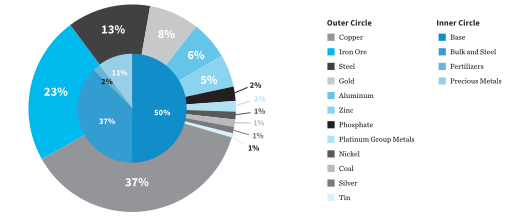
The metals and mining sector accounts for 6% of the J.P. Morgan Corporate Emerging Market Bond Index (CEMBI) Broad Diversified (BD)[1]. This sector includes large-cap, integrated, multi-metal, and multi-mine issuers as well as smaller companies that are less diversified by product and asset base. One can get exposure to mature, world-class mining operations but also to growing businesses with smaller footprints. Parsing the sector by metal is nuanced as mines often market and bundle byproducts within their core operations.
Metals and Mining Sector Breakdown in CEMBI BC
Sources: J.P. Morgan CEMBI BD and William Blair, as of December 31, 2025.
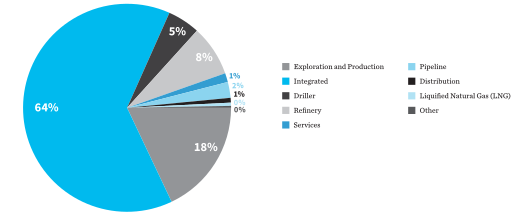
A breakdown of the oil and gas sector reveals a universe not purely driven by volatility in oil prices. Almost two-thirds of the 11% sector weight in the index can be classified as integrated oil companies. These are large issuers that operate across the hydrocarbon value chain, not only exploring and producing oil and natural gas but also transporting it, refining it, producing petrochemicals, and distributing fuels. Every step in this value chain balances the direct oil-price risk, creating a more stable sector than headline prices would indicate.
Oil and Gas Sector Breakdown In CEMBI BD
Sources: J.P. Morgan CEMBI BD and William Blair, as of December 31, 2025.
Commodity prices are the top-line input into an issuer’s financial profile, but just like in a pinball machine, the path to credit quality is not direct. High commodity prices undoubtedly grow revenues, but it is the issuer’s usage of cash flows that needs to be analyzed.
It is also worth noting that a majority of the upside in commodity prices accrues to shareholders' equity while bond spread returns can be bounded by relative value considerations. This is not to say that high commodity prices don’t tend to improve the credit quality of issuers, but rather that it is up to diligent investors to understand the ultimate impact on credit risk.
Conversely, bond prices have more convexity[2] as prices slide. This mostly occurs when oil prices hit the perceived full-cycle cost[3] of the issuer and viability of operations is questioned. A company’s flexibility to withstand lower price periods ultimately defines where on the credit quality spectrum the pin ball ultimately lands.
We believe understanding this opportunity set, as well as the reality of how commodity prices affect individual issuers, is crucial to our positioning in commodity corporate credit investments.
Theme 2: Private Issuers in EM Corporate Debt
Lately, growth in private credit has garnered considerable interest in the markets. Adding a different source of capital for issuers is positive, yet headline-grabbing defaults, significant fund markdowns, and comments suggesting weak underwriting standards can put a dent in the perceived low volatility of these investments. The periodic nature of pricing can also mask increases in credit risk and lead to stepwise (sometimes shocking) adjustments, while the ability to renegotiate agreements in times of credit stress could muffle underlying default trends.
We see two potential paths in private credit: one where investors are essentially company insiders, with deeper and more timely access to information than public investors, leading to improved diligence and thus not posing a macro risk to markets; and another where private credit has become a way for issuers to access deep, fast, and less demanding pools of capital, where concerns about the state of the asset class are then warranted.
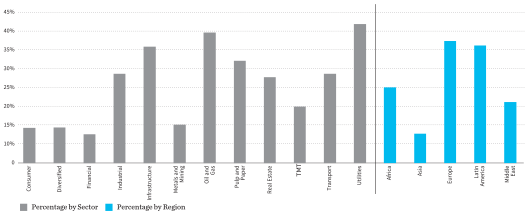
Private credit in EMs is still nascent and extracting the use of private credit by EM issuers is complex, so we take a different approach. By analyzing private issuers in the index, we can get a sense of the risk of private markets in EM corporate debt. Major categories of private issuers in our universe can be defined as privately held issuers, unconsolidated (solo or joint) ventures of public companies, and project finance special purpose vehicles.
When private issuers access public markets, they can be perceived as less transparent, although they must abide by the same disclosures and requirements as public issuances. Over time, if engaging appropriately with the investment community, private issuers can overcome this perception, creating a potential opportunity for investors.
We believe analytical access and company transparency is indispensable for appropriate investment diligence, and we engage with issuers to encourage them down this path.
Percentage of Private Issuers Across EM Corporate Credit
Sources: J.P. Morgan CEMBI BD and William Blair, as of December 31, 2025.
Theme 3: The Global Rise of Technology Sector Issuance
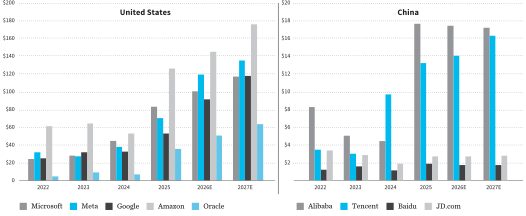
The hype surrounding AI not only affects corporate credit markets through the impact on an issuer’s productivity and operations but also the financing needed for its growth. Hyperscaler capex estimates rose throughout 2025, with expectations of more than $600 billion in 2026 across the major firms[4] and further future growth. In addition, supply estimates for 2026 are upward of $220 billion, or about 12% of total U.S. investment-grade (IG) issuance forecasts.
Massive cash generation from these companies will likely cover the majority of investment needs and shareholder returns (such as dividends and buybacks), yet it is prudent to consider what effects this issuance growth could have on our universe. We see three potential impacts affecting EM corporates: relative value, marginal crossover investor interest, and growth in EM technology issuance.
First, fixed-income valuation and portfolio management rely on the concept of relative value, where one instrument’s cash flow stream (coupons and principal), plus the uncertainty/volatility of this stream, is compared to another. If a significant amount of high-rated technology sector debt is issued, causing spreads to widen, then it is likely that other high-rated sectors will be affected by relative value comparisons, creating a waterfall of spread adjustments across ratings categories.
Second, crossover investors are market participants that typically invest in an asset class, but for a myriad of reasons will tactically or strategically allocate capital to another, crossing over into nondedicated areas. It is possible that significant U.S. technology sector issuance could make these investors reconsider allocations to some EMs.
Lastly, while capex from large Chinese technology issuers (such as Alibaba, Tencent, Baidu, and JD.com) in our universe is mildly increasing, their funding models look quite different compared to the United States. Chinese tech firms have much lower capex intensity for now and rely heavily on domestic onshore Chinese renminbi (CNY) markets, convertible bonds, banks, and policy lenders for funding. Our analysis suggests Chinese tech issuance is unlikely to experience a surge similar to that of the U.S. sector, and diversified domestic markets can absorb it.
AI Is Driving Higher Technology Sector Capex (In Billions)
Sources: Bloomberg and William Blair, as of January 30, 2026.
Theme 4: Index Evolution and How Change Matters Over Time
Officially launched in 2007 (but backfilled to 2001), the CEMBI family of indices provides a widely used investment universe and performance benchmarks for EM corporate debt investors.
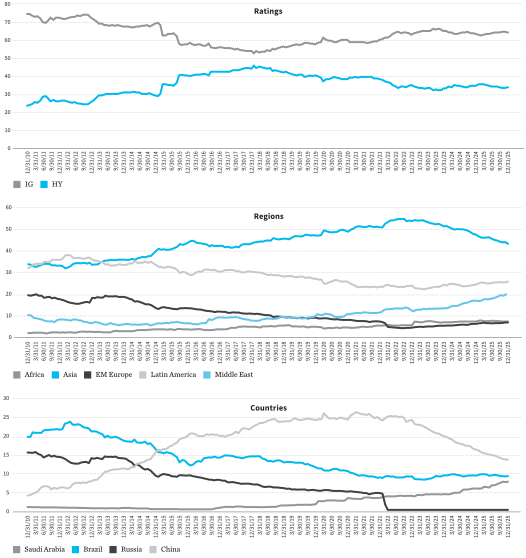
While the majority of peer funds are benchmarked to the J.P. Morgan CEMBI BD, the investable universe is better defined using the J.P. Morgan CEMBI Broad[5], which currently comprises 729 issuers across 52 countries, with $1.2 trillion in market value. When looking at this index, its evolution is evident.
One can look at this progression from several angles. On a ratings basis, the high-yield (HY) component of the index peaked in 2018 at 44%. Since then, HY-rated issuer weights have declined to 34%, implying the IG component is now 66%. This ratings evolution should be considered for accurate historical spread and yield comparisons. It is the A-rated component that has experienced the largest growth while both BBs and Bs have declined more than 5%. This improvement in index ratings should be considered for appropriate historical analysis.
Country weights, and therefore regional weights, have also changed over time. The biggest outlier is the decline in Asia, which peaked at 62% and is now at 44%. Latin America also declined, having peaked at 44% in 2011, and is currently 27%.
Of note, emerging Europe is now only 5% of the index, peaking at almost 25% in 2008, with the decrease predominantly driven by Russia’s exit from the index in 2022. Offsetting these declines is the rise of the Middle East, now 20% of the index, more than doubling in the last 10 years.
But the most notable weight change by country has been China. China’s weight in the index peaked at 27% in mid-2021 and has fallen to 14%. Greater China, which includes Hong Kong and Macau, was 36% of the index and is presently 26%. In Latin America, Brazil’s debt boom in 2012 took the country weight to 25% but has been relatively stable at almost 10% since 2020.
When doing historical spread and yield analysis, we are keenly aware of index evolution and make the appropriate adjustments. Understanding our investable universe and its evolution is key to generating potential outperformance.
CEMBI Index Evolution
Sources: J.P. Morgan CEMBI Broad and William Blair, as of December 31, 2025.
Theme 5: Valuation and Dispersion of Returns
As we begin 2026, index level spreads appear historically low, suggesting low-risk premia in EM corporate credit and lower forward-looking returns. Further analysis is warranted.
Total returns in fixed income can be divided into two components: the risk-free return and the spread return. Since inception, returns for the U.S. dollar asset class have been approximately 6%, evenly split between risk-free (or Treasury rate) and excess return (or spread return).
With the duration of the asset class at four years, we currently see the risk-free yield at 3.8% and the spread at over 200 basis points (bps) for an index yield of 5.8%.
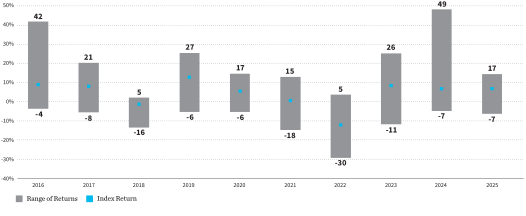
The breadth of instruments in the EM corporate credit asset class provides significant dispersion around average yearly returns. Chart 6 shows the range of returns with the index across time. We further analyze and rank returns by issuer and decile.
This return dispersion allows for true active management to add value above the beta of an asset class, and the larger the range the more opportunity for active management.
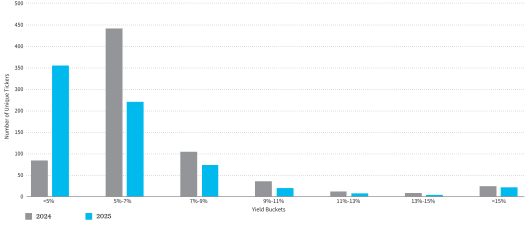
It is evident that almost half of index issuers began 2026 with a yield below 5%. But it is also evident that there is a significant opportunity set of issuers yielding between 5% and 9%. Appropriately, navigating this still plentiful space could provide potential above-index returns without taking on excessive credit or unnecessary idiosyncratic risks.
Decile Dispersion In EM Corporate Credit
Sources: J.P. Morgan CEMBI BD and William Blair, as of December 31, 2025. Range of returns, with top and bottom decile average return highlighted. Past performance is not indicative of future returns. A direct investment in an unmanaged index is not possible.
Comparing Yield Dispersion In 2024 and 2025
Sources: J.P. Morgan CEMBI BD and William Blair, as of December 31, 2025.
Luis Olguin, CFA, is a portfolio manager on William Blair’s emerging markets debt team.
[1] The J.P. Morgan CEMBI BD is a market capitalization-weighted index that tracks the total returns of U.S. dollar-denominated debt instruments issued by corporate entities in EM countries. (Index information has been obtained from sources believed to be reliable but J.P. Morgan does not warrant its completeness or accuracy. The indices are used with permission. The indices may not be copied, used, or distributed without J.P. Morgan’s prior written approval. Copyright 2025, JPMorgan Chase & Co. All rights reserved.) Index performance is provided for illustrative purposes only. Indices are unmanaged and do not incur fees or expenses. A direct investment in an unmanaged index is not possible. [2]A nonlinear curved relationship between two variables that denotes acceleration. [3]Full-cycle cost includes finding and development costs, operating expenses, royalties, taxes, cost of capital, and overhead. [4]Includes Bloomberg estimates for Microsoft, Meta, Google, Amazon, and Oracle. [5] The J.P. Morgan CEMBI Broad is a widely used benchmark that measures the performance of U.S. dollar-denominated corporate bonds issued by entities in EM countries.
Subscribe Now
Want the latest insights on the economy and other forces shaping the investment landscape?
Subscribe to our Investing Insights newsletter.
Any investment or strategy mentioned herein may not be appropriate for every investor. There can be no assurance that investment objectives will be met. Products and services listed are available only to residents of this jurisdiction and may only be available to certain categories of investors. The information on this website does not constitute an offer for products or services, or a solicitation of an offer to any persons outside of this jurisdiction who are prohibited from receiving such information under applicable laws and regulations. Nothing on this webpage should be construed as advice and is therefore not a recommendation to buy or sell shares.
Please carefully consider the William Blair Funds’ investment objectives, risks, charges, and expenses before investing. This and other information is contained in the Funds’ prospectus and summary prospectus, which you may obtain by calling 1-800-742-7272. Read the prospectus and summary prospectus carefully before investing. Investing includes the risk of loss.
The William Blair Funds are distributed by William Blair & Company, L.L.C., member FINRA/SIPC.
The William Blair SICAV is a Luxembourg investment company with variable capital registered with the Commission de Surveillance du Secteur Financier (“CSSF”) which qualifies as an undertaking for collective investment in transferable securities (“UCITS”). The Management Company of the SICAV has appointed William Blair Investment Management, LLC as the investment manager for the fund.
Please carefully consider the investment objectives, risks, charges, and expenses of the William Blair SICAV. This and other important information is contained in the prospectus and Key Investor Information Document (KIID). Read these documents carefully before investing. The information contained on this website is not a substitute for those documents or for professional external advice.
Information and opinions expressed are those of the authors and may not reflect the opinions of other investment teams within William Blair Investment Management, LLC, or affiliates. Factual information has been taken from sources we believe to be reliable, but its accuracy, completeness or interpretation cannot be guaranteed. Information is current as of the date appearing in this material only and subject to change without notice. Statements concerning financial market trends are based on current market conditions, which will fluctuate. This material may include estimates, outlooks, projections, and other forward-looking statements. Due to a variety of factors, actual events may differ significantly from those presented.
Investing involves risks, including the possible loss of principal. Equity securities may decline in value due to both real and perceived general market, economic, and industry conditions. The securities of smaller companies may be more volatile and less liquid than securities of larger companies. Investing in foreign denominated and/or domiciled securities may involve heightened risk due to currency fluctuations, and economic and political risks. These risks may be enhanced in emerging markets and frontier markets. Investing in the bond market is subject to certain risks including market, interest rate, issuer, credit, and inflation risk. High-yield, lower-rated, securities involve greater risk than higher-rated securities. Different investment styles may shift in and out of favor depending on market conditions. Diversification does not ensure against loss.
Past performance is not indicative of future returns. References to specific companies are for illustrative purposes only and should not be construed as investment advice or a recommendation to buy or sell any security.
William Blair Investment Management, LLC is an investment adviser registered with the U.S. Securities and Exchange Commission.
Issued in the United Kingdom by William Blair International, Ltd., authorized and regulated by the Financial Conduct Authority (FCA), and is only directed at and is only made available to persons falling within articles 19, 38, 47, and 49 of the Financial Services and Markets Act of 2000 (Financial Promotion) Order 2005 (all such persons being referred to as "relevant persons").
Issued in the European Economic Area (EEA) by William Blair B.V., authorized and supervised by the Dutch Authority for the Financial Markets (AFM) under license number 14006134 and also supervised by the Dutch Central Bank (DNB), registered at the Dutch Chamber of Commerce under number 82375682 and has its statutory seat in Amsterdam, the Netherlands. This material is only intended for eligible counterparties and professional clients.
Issued in Switzerland by William Blair Investment Services (Zurich) GmbH, Talstrasse 65, 8001 Zurich, Switzerland ("WBIS"). WBIS is engaged in the offering of collective investment schemes and renders further, non-regulated services in the financial sector. WBIS is affiliated with FINOS Finanzomubdsstelle Schweiz, a recognized ombudsman office where clients may initiate mediation proceedings pursuant to articles 74 et seq. of the Swiss Financial Services Act ("FinSA"). The client advisers of WBIS are registered with regservices.ch by BX Swiss AG, a client adviser registration body authorized by the Swiss Financial Market Supervisory Authority ("FINMA"). WBIS is not supervised by FINMA or any other supervisory authority or self-regulatory organization. This material is only intended for institutional and professional clients pursuant to article 4(3) to (5) FinSA.
Issued in Australia by William Blair Investment Management, LLC (“William Blair”), which is exempt from the requirement to hold an Australian financial services license under Australia's Corporations Act 2001 (Cth). William Blair is registered as an investment advisor with the U.S. Securities and Exchange Commission (“SEC”) and regulated by the SEC under the U.S. Investment Advisers Act of 1940, which differs from Australian laws. This material is intended only for wholesale clients.
Issued in Singapore by William Blair International (Singapore) Pte. Ltd. (Registration Number 201943312R), which is regulated by the Monetary Authority of Singapore under a Capital Markets Services License to conduct fund management activities. This material is intended only for institutional investors and may not be distributed to retail investors.
Issued in Canada by William Blair Investment Management, LLC, which relies on the international adviser exemption, pursuant to section 8.26 of National Instrument 31-103 in Canada.
The content contained in this site is intended as informational or educational in nature and does not constitute investment advice or a recommendation of any investment strategy or product for a particular investor. Investment advice and recommendations can be provided only after careful consideration of an investor’s objectives, guidelines, and restrictions. Investors should consult a financial professional/financial consultant or investment adviser before making any investment decisions. Investing includes the risk of loss.