Easing global monetary conditions and improving macro fundamentals continued to support performance across emerging markets (EM) local rates and currencies.
We favor markets offering attractive real yields, reform momentum, and credible policy frameworks.
Selectivity remains essential, with preference for countries such as Brazil and Hungary and parts of frontier Africa, while remaining cautious on markets facing stretched valuations or fiscal and political uncertainty.
Despite rising concerns about potential impacts from global trade tensions driven by U.S. policies and ongoing geopolitical conflicts, we believe the fundamental backdrop for local currency EM debt remains resilient, and this resilience should persist into 2026. We believe investors are underestimating the potential for further monetary easing, and attractive valuations suggest room for currency appreciation as the U.S. dollar remains overvalued. We expect EM currencies to perform well against the dollar and currencies of other developed markets.
A Solid Quarter
EMs extended their upward trajectory in the fourth quarter, capping off a strong 2025.
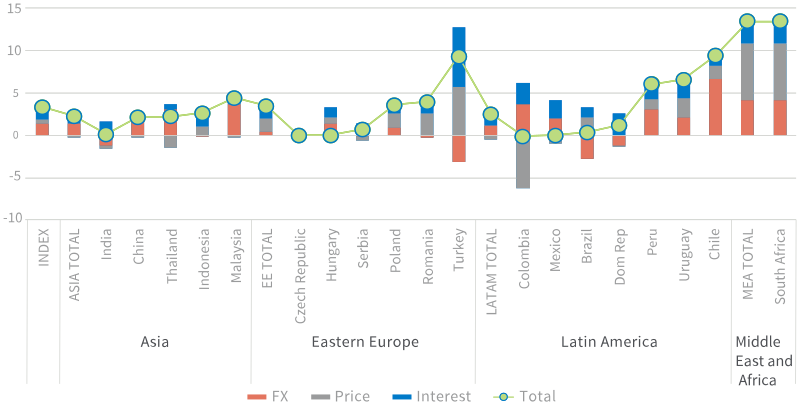
The J.P. Morgan Government Bond Index-Emerging Markets Global Diversified (GBI-EM Global Diversified) returned 3.34%, of which 1.34% resulted from EM currency appreciation against the U.S. dollar. Local bonds also performed well, gaining 0.53% in price terms with average yields declining by 6 basis points (bps) across the index.
Regionally, Africa delivered standout performance (+13.41%), followed by Europe (+3.45%), Latin America (+2.47%), and Asia (+2.28%).
EMD Local Currency Bonds and Currencies Posted Gains in Fourth Quarter 2025
Sources: U.S. Treasury, J.P. Morgan, and Bloomberg, as of December 31, 2025. Index is the J.P. Morgan Government Bond Index—Emerging Markets Global Diversified (GBIEM-GD), which tracks local currency government bonds issued by EMs. A direct investment in an unmanaged index is not possible.
Largest Active Positions
Below, we outline our positioning across rates and currencies by country at the end of December 2025.
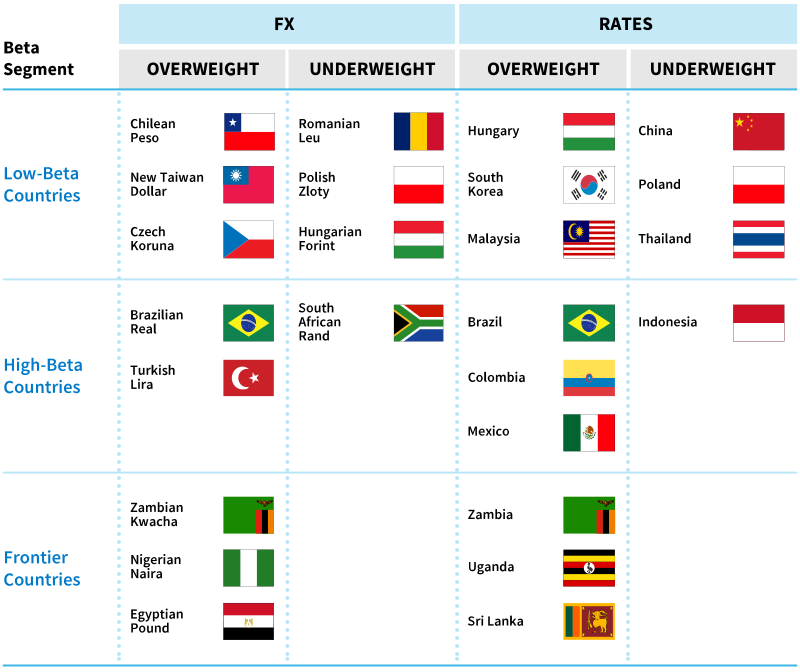
Beta-Bucket Approach: Top Exposures
To effectively allocate capital and budget risk across a large and diverse group of countries, we employ a proprietary grouping methodology. Countries are each assigned a beta bucket based on market beta and local capital-market considerations. Liquid markets are classified as high or low beta, and less-liquid, idiosyncratically risky countries are assigned a frontier grouping. This enables us to make relative value and asset-allocation decisions according to risk profile rather than by region or other common characteristics.
Source: William Blair, as of December 31, 2025. Beta buckets are based on the team’s qualitative and quantitative analysis. Risk buckets are provided for illustrative purposes only and are not intended as investment advice or as projections of future returns. Overweights/underweights may vary between vehicles.
Low-Beta Bucket
The low‑beta bucket consists of higher‑income, more advanced EMs with stronger credit quality. Their rate markets tend to depend primarily on inflation expectations, monetary policy, fiscal discipline, and market liquidity conditions. Currencies in this group typically trade with lower volatility and often move in line with global majors, while limited excess yield or term premium provides only modest compensation during periods of broader EM volatility. Benchmark exposures can often be efficiently replicated using derivatives.
Hungary: While Hungarian fiscal consolidation remains gradual, the deficit is projected to narrow slightly in 2026 and debt ratios are expected to stabilize, aided by EU funding inflows. We remain selective given election-related spending risks but see value in Hungarian government bonds (HGBs) relative to regional peers.
South Korea: We entered a five-year receiver as a macro hedge to reduce overall duration underweight coming from low-beta Asia.
Malaysia: We added a duration long position on strong seasonal demand by institutional investors and local pension funds. Strong performance of the Malaysian ringgit, the prospect of U.S. Federal Reserve (Fed) rate cuts, and a potential overnight policy rate cut by Bank Negara Malaysia add further impetus for duration to perform in medium term.
China: We went neutral the Chinese renminbi on the People’s Bank of China’s willingness to appreciate the currency as pressure builds up on an inexpensive valuation in real effective exchange rate (REER) terms and seasonal exporters selling U.S. dollars. We also hold a sizable short-duration position in China rates, driven by our cautious assessment of local bonds, especially the long end, where low yields and weak carry are compounded by central government anti-involution policies aimed at reducing deflationary risk.
Poland: We remain underweight Polish rates and the zloty. While the state assets fund (SAFE) support will cover a share of the 2026 borrowing needs, issuance plans remain broadly unchanged. Fiscal consolidation prospects remain weak amid political uncertainty, and valuations appear stretched following strong performance earlier in the year.
Thailand: We are underweight Thailand duration because valuations are unappealing. Rate cuts are already priced in, but financial stability concerns may lead to fewer central bank cuts than are currently priced in.
Chile: We are overweight the peso on supportive copper prices and potential for market-friendly policies under the new government. We have a cash underweight to local bonds in favor of higher-yielding regional peers.
The Taiwan central bank is expected to raise policy rates in light of solid potential growth in 2026 and the need to safeguard financial stability,
Taiwan: We maintain a long New Taiwan dollar position funded by a Singapore dollar short, supported by the economy’s strong and enduring structural trends in the technology sector. However, we expect this to remain a volatile trade given two-way equity market flows. Meanwhile, the Taiwan central bank is expected to raise policy rates in light of solid potential growth in 2026 and the need to safeguard financial stability, ensuring that the current accommodative stance does not persist longer than appropriate.
Czech Republic: We maintain an overweight in the Czech koruna based on favorable valuations and improving macro fundamentals. The koruna benefited from resilient domestic demand and a stable inflation profile, while positioning remained constructive amid expectations for policy normalization. Real money accounts continued to add duration selectively, and Czech koruna exposure offered attractive carry relative to regional peers. We remain constructive but mindful of positioning risks should global volatility rise.
Romania: We maintain our underweight position in the Romanian leu as structural vulnerabilities persist despite the conclusion of the election cycle. The current account deficit remains wide, reflecting weak external competitiveness and strong domestic demand, while inflation is still elevated. Financing needs are set to rise due to higher debt redemptions. Although the budget deficit is expected to narrow, execution risks remain high, and fiscal consolidation progress is limited. These factors, combined with currency overvaluation, reinforce our cautious stance on the leu.
High-Beta Bucket
High‑beta markets represent EMs at a more intermediate stage of development, where local assets are more sensitive to global macro forces such as commodity cycles, shifts in risk sentiment, or developments in China. In these countries, the total return profile of local bonds is often dominated by foreign exchange (FX) performance, often with a higher correlation between currency and rate movements than low‑beta markets.
Brazil: We are overweight rates and the Brazilian real. Brazil has one of the highest real interest rates in the benchmark index, which has supported portfolio flows into the country. Growth is expected to moderate in 2026, with inflation expectations for 2026 at 4.06%. Lower Fed rates should give the central bank more scope to cut next year, which should help anchor expectations.
Colombia: We are neutral on the Colombian peso as valuations appear stretched given a challenging macro backdrop and political uncertainty heading into elections. We are overweight local rates, however, as the curve is steep. Valuations are attractive as the market has already priced in multiple rate hikes.
We are underweight the Mexican peso on concerns about economic activity deteriorating and remittances from the U.S. falling.
Mexico: We are overweight duration in Mexico on slowing growth, further rate cuts, and well-anchored inflation expectations. We also hold an overweight position in Pemex bonds as the government increases direct support for the company, which should lead to narrower spreads to the sovereign. We are underweight the peso on concerns about economic activity deteriorating and remittances from the U.S. falling.
Turkey: Our overweight position in Turkish local assets delivered mixed results in the fourth quarter. Domestic demand showed resilience, and inflation continued to ease, allowing the central bank to start reducing rates while maintaining an overall tight policy stance. Progress on disinflation is encouraging, but expectations remain elevated, and structural vulnerabilities persist. High real yields continue to attract flows, yet geopolitical risks limit upside, reinforcing a cautious approach even as local bonds offer carry appeal.
South Africa: We are underweight the South African rand primarily due to stretched valuations following a strong rally supported by global risk appetite. The rand’s appreciation has been driven by favorable external conditions and carry demand, which we believe may not be sustainable if risk sentiment changes. While South Africa’s policy framework is credible, structural fiscal challenges and political uncertainty reinforce our cautious stance.
Indonesia: We are underweight rates on weaker tax revenues, slower growth, higher deficit, weaker governance, higher supply risk, and tight valuation.
Frontier Bucket
Our frontier bucket includes countries in the early stages of developing local bond markets and tradable FX markets. These economies typically face higher inflation uncertainty and elevated FX pass-through, which can limit investor appetite for longer maturities or fixed‑rate issuance. Frontier currencies are often pegged to or tightly managed against the U.S. dollar, and local yields tend to be higher. Using robust credit analysis to understand these countries can help us uncover compelling opportunities.
Zambia: We maintain our overweight in Zambia local rates and the Zambian kwacha as macro fundamentals remain supportive. Disinflation has reinforced expectations for a stable monetary stance and improving real yields. The government made progress on fiscal consolidation and debt restructuring, which helped sustain investor confidence. Strong domestic demand, improved terms and trade, and credible policy signals underpin our constructive view. Attractive carry and scope for curve bull steepening further support our positioning.
Strong FX reserves and oil-related foreign direct investment (FDI) inflows underpin confidence in the Ugandan shilling.
Uganda: We remain constructive on Uganda local currency assets, maintaining long-dated bond positions on attractive real yields. Election-related uncertainty appears contained, with policy continuity expected and International Monetary Fund (IMF) program discussions set to resume post-election. The fiscal 2025/26 budget implies a modest reduction in domestic issuance, supported by external financing, which should help stabilize yields. Strong FX reserves and oil-related foreign direct investment (FDI) inflows underpin confidence in the Ugandan shilling, reinforcing our positive stance.
Sri Lanka: Strong remittances and the resumption of FDI continue to provide healthy inflows, helping offset U.S. dollar demand from the central bank as it rebuilds FX reserves and as the current account surplus narrows amid rising import needs. While local rates still offer attractive carry, weaker investor sentiment following Cyclone Ditwah has increased the risk of further Sri Lankan rupee depreciation, compounded by higher import bills and a widening trade deficit. Our fund has accordingly increased its hedging on Sri Lankan rupee exposure.
Nigeria: We maintain our overweight in Nigerian naira as reform momentum continued in the fourth quarter. The removal of fuel subsidies and downstream deregulation improved fiscal transparency, while FX market liberalization narrowed the gap between official and parallel rates, supporting currency stability. Tax reforms and digitization efforts strengthened revenue mobilization, and Nigeria’s removal from the Financial Action Task Force grey list marked a significant governance milestone. IMF endorsement of the reform framework reinforces confidence, though fiscal execution risks and inflation pressures remain. These factors underpin our constructive stance on local currency exposure.
Egypt: We maintain our overweight in the Egyptian pound, supported by structural reforms and improving external financing conditions under IMF guidance. During the fourth quarter, the central bank began a cautious easing cycle as inflation moderated and FX stability improved, signaling the start of policy normalization after a prolonged period of exceptionally high real rates. Fiscal consolidation efforts continued, alongside progress on subsidy rationalization and revenue mobilization, reinforcing macro stability. Attractive carry and improving fundamentals underpin our constructive stance, though we remain mindful of positioning risks and the need for gradual policy adjustment.
Lewis Jones, CFA, FRM is a portfolio manager on William Blair's emerging markets debt team.
Any investment or strategy mentioned herein may not be appropriate for every investor. There can be no assurance that investment objectives will be met. Products and services listed are available only to residents of this jurisdiction and may only be available to certain categories of investors. The information on this website does not constitute an offer for products or services, or a solicitation of an offer to any persons outside of this jurisdiction who are prohibited from receiving such information under applicable laws and regulations. Nothing on this webpage should be construed as advice and is therefore not a recommendation to buy or sell shares.
Please carefully consider the William Blair Funds’ investment objectives, risks, charges, and expenses before investing. This and other information is contained in the Funds’ prospectus and summary prospectus, which you may obtain by calling 1-800-742-7272. Read the prospectus and summary prospectus carefully before investing. Investing includes the risk of loss.
The William Blair Funds are distributed by William Blair & Company, L.L.C., member FINRA/SIPC.
The William Blair SICAV is a Luxembourg investment company with variable capital registered with the Commission de Surveillance du Secteur Financier (“CSSF”) which qualifies as an undertaking for collective investment in transferable securities (“UCITS”). The Management Company of the SICAV has appointed William Blair Investment Management, LLC as the investment manager for the fund.
Please carefully consider the investment objectives, risks, charges, and expenses of the William Blair SICAV. This and other important information is contained in the prospectus and Key Investor Information Document (KIID). Read these documents carefully before investing. The information contained on this website is not a substitute for those documents or for professional external advice.
Information and opinions expressed are those of the authors and may not reflect the opinions of other investment teams within William Blair Investment Management, LLC, or affiliates. Factual information has been taken from sources we believe to be reliable, but its accuracy, completeness or interpretation cannot be guaranteed. Information is current as of the date appearing in this material only and subject to change without notice. Statements concerning financial market trends are based on current market conditions, which will fluctuate. This material may include estimates, outlooks, projections, and other forward-looking statements. Due to a variety of factors, actual events may differ significantly from those presented.
Investing involves risks, including the possible loss of principal. Equity securities may decline in value due to both real and perceived general market, economic, and industry conditions. The securities of smaller companies may be more volatile and less liquid than securities of larger companies. Investing in foreign denominated and/or domiciled securities may involve heightened risk due to currency fluctuations, and economic and political risks. These risks may be enhanced in emerging markets and frontier markets. Investing in the bond market is subject to certain risks including market, interest rate, issuer, credit, and inflation risk. High-yield, lower-rated, securities involve greater risk than higher-rated securities. Different investment styles may shift in and out of favor depending on market conditions. Diversification does not ensure against loss.
Past performance is not indicative of future returns. References to specific companies are for illustrative purposes only and should not be construed as investment advice or a recommendation to buy or sell any security.
William Blair Investment Management, LLC is an investment adviser registered with the U.S. Securities and Exchange Commission.
Issued in the United Kingdom by William Blair International, Ltd., authorized and regulated by the Financial Conduct Authority (FCA), and is only directed at and is only made available to persons falling within articles 19, 38, 47, and 49 of the Financial Services and Markets Act of 2000 (Financial Promotion) Order 2005 (all such persons being referred to as "relevant persons").
Issued in the European Economic Area (EEA) by William Blair B.V., authorized and supervised by the Dutch Authority for the Financial Markets (AFM) under license number 14006134 and also supervised by the Dutch Central Bank (DNB), registered at the Dutch Chamber of Commerce under number 82375682 and has its statutory seat in Amsterdam, the Netherlands. This material is only intended for eligible counterparties and professional clients.
Issued in Switzerland by William Blair Investment Services (Zurich) GmbH, Talstrasse 65, 8001 Zurich, Switzerland ("WBIS"). WBIS is engaged in the offering of collective investment schemes and renders further, non-regulated services in the financial sector. WBIS is affiliated with FINOS Finanzomubdsstelle Schweiz, a recognized ombudsman office where clients may initiate mediation proceedings pursuant to articles 74 et seq. of the Swiss Financial Services Act ("FinSA"). The client advisers of WBIS are registered with regservices.ch by BX Swiss AG, a client adviser registration body authorized by the Swiss Financial Market Supervisory Authority ("FINMA"). WBIS is not supervised by FINMA or any other supervisory authority or self-regulatory organization. This material is only intended for institutional and professional clients pursuant to article 4(3) to (5) FinSA.
Issued in Australia by William Blair Investment Management, LLC (“William Blair”), which is exempt from the requirement to hold an Australian financial services license under Australia's Corporations Act 2001 (Cth). William Blair is registered as an investment advisor with the U.S. Securities and Exchange Commission (“SEC”) and regulated by the SEC under the U.S. Investment Advisers Act of 1940, which differs from Australian laws. This material is intended only for wholesale clients.
Issued in Singapore by William Blair International (Singapore) Pte. Ltd. (Registration Number 201943312R), which is regulated by the Monetary Authority of Singapore under a Capital Markets Services License to conduct fund management activities. This material is intended only for institutional investors and may not be distributed to retail investors.
Issued in Canada by William Blair Investment Management, LLC, which relies on the international adviser exemption, pursuant to section 8.26 of National Instrument 31-103 in Canada.
The content contained in this site is intended as informational or educational in nature and does not constitute investment advice or a recommendation of any investment strategy or product for a particular investor. Investment advice and recommendations can be provided only after careful consideration of an investor’s objectives, guidelines, and restrictions. Investors should consult a financial professional/financial consultant or investment adviser before making any investment decisions. Investing includes the risk of loss.