Resilient fundamentals: Growth has surprised to the upside as trade between emerging markets (EMs) has expanded, access to multilateral and bilateral funding remained steady, and debt dynamics, external balances, and credit risks were broadly stable.
Risk-supportive technicals: There has been limited net new issuance with renewed inflows to the asset class.
Fair valuations: Yields are compelling relative to long‑term averages, and we continue to find more attractive opportunities in high yield than investment grade.
Despite heightened concerns around global trade tensions driven by U.S. policy and ongoing geopolitical conflicts, we believe EM fundamentals remain resilient, and we expect this backdrop to continue in 2026.
Specifically, EM growth is projected to be roughly 3.7% on a gross domestic product (GDP)-weighted basis (broadly in line with 2025), supporting stable fiscal positions and debt-to-GDP ratios across most countries. At the same time, benign inflation should allow continued monetary easing, while AI-related productivity gains provide an additional tailwind to growth.
External accounts stand out as a key strength. Persistent capital inflows, robust foreign direct investment, and healthy current account balances underpin solid balance-of-payments positions. Although U.S. tariffs rose sharply in 2025, their impact proved less severe than initially feared, and EMs are increasingly insulated as intra-EM trade now exceeds half of total trade. This reduced reliance on advanced economies should help EMs weather softer developed-market growth, keeping default risk contained and fundamentals constructive.
Reduced reliance on advanced economies should help EMs weather softer developed-market growth.
Technical conditions remain supportive. We believe net new issuance should stay below historical averages, aided by ongoing bilateral and multilateral funding, while underallocation among global investors leaves room for higher EM exposure in 2026. Valuations are constructive: hard-currency spreads are tight but all-in yields remain elevated, with scope for further compression—especially in high yield—alongside lower U.S. Treasury yields, supporting benchmark returns.
We continue to see opportunities in select EM corporates and frontier markets. We believe frontier debt is supported by high real yields, improving external balances, and selective room for further rate cuts, while EM corporates may offer spread pickup over sovereigns.
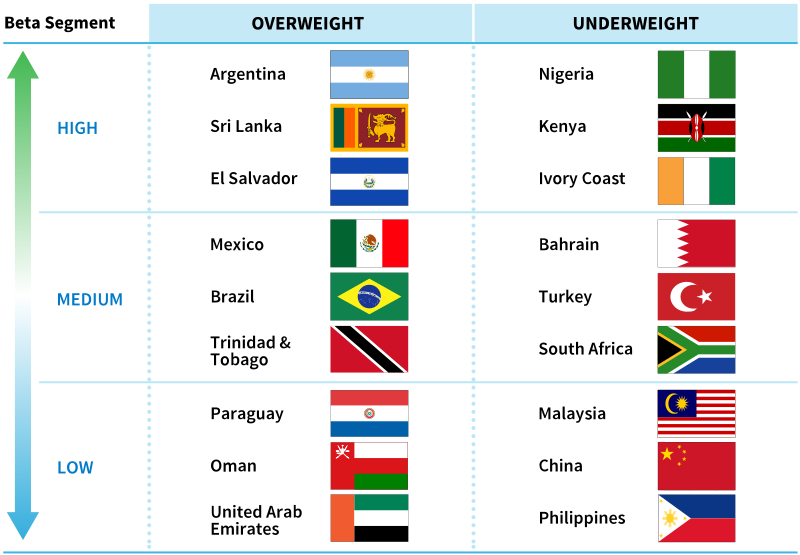
Below, we break down some of our largest active hard currency positions in each beta bucket.
Beta-Bucket Approach: Select Active Positions
To allocate capital and budget risk effectively across a large and diverse set of countries, we use a proprietary grouping framework.
Rather than organizing by region, we classify issuers into low-, medium-, and high‑beta buckets. We believe this approach captures true risk profiles given the wide range of development levels within regions and allows for fairer comparisons and more optimal portfolio construction.
Risk budgets are allocated dynamically: When our top‑down scores are more positive, we increase exposure to high‑beta countries. Portfolio‑level exposure is monitored and adjusted continuously to maintain an optimal risk/return balance.
Source: William Blair, as of December 2025. Beta buckets are based on the team’s qualitative and quantitative analysis. Risk buckets are provided for illustrative purposes only and are not intended as investment advice or as projections of future returns. Overweights/underweights may vary between vehicles.
High-Beta Bucket
The largest overweight positions on a spread duration basis were in Argentina, Sri Lanka, and El Salvador. Conversely, the largest underweight positions were in Nigeria, Kenya, and Ivory Coast.
Argentina (overweight): We believe Argentina remains on a positive fundamental trajectory following the midterm results and policy direction, and prefer amortizing bonds, which are shorter duration. We also hold a position in the Province of Buenos Aires, as well as GDP warrants.
Sri Lanka (overweight): Improving GDP growth, lower oil prices, and declining domestic interest rates support our overweight to Sri Lanka’s macro-linked bonds (SRILAN MLBs). While cyclone-related infrastructure damage in the fourth quarter created near-term costs, the stronger foundation built in recent years supports continued pricing of an intermediate upside, with momentum building toward a higher upside as MLB trigger mechanisms come into play.
El Salvador remains on an improving trajectory.
El Salvador (overweight): El Salvador remains on an improving trajectory, assuming it continues on the policy path agreed upon with the International Monetary Fund (IMF), and we like the shape of its yield curve.
Nigeria (underweight): Valuations are tight and we expect oil price dynamics to be less supportive. While there has been strong monetary policy reform, with the improved functioning of the exchange rate forming a key improvement to the macroeconomic backdrop, the fiscal outlook remains more complex, with low revenue mobilization a key structural weakness.
Kenya (underweight): We believe Kenya is likely to remain an exception to the fiscal consolidation trend in Sub-Saharan Africa. The draft 2026 medium-term budget plan signals continued fiscal pressures and limited scope for aggressive deficit reduction ahead of the 2027 elections, with authorities leaning on public-private partnerships and arrears paydown for stimulus. While growth is resilient, inflation stable, and external buffers adequate, fiscal vulnerabilities and political risks ahead of the 2027 elections argue for a defensive stance.
Ivory Coast (underweight): Fundamentals are strong, and the October 2025 presidential election was orderly, with the incumbent securing a comfortable victory. While domestic banks have some exposure to Senegalese local currency debt, rating agencies view the exposure as relatively small and do not see Senegal’s debt-solvency concerns as a risk to the banking sector. That said, valuations are tight and a restructuring could indirectly impact the region.
Medium-Beta Bucket
The largest overweight positions on a spread duration basis were in Mexico, Brazil, and Trinidad and Tobago. Conversely, the largest underweight positions were in Bahrain, Turkey, and South Africa.
Mexico (overweight): We remain overweight Pemex, as we believe it is well supported by the sovereign and has very attractive valuations versus the sovereign. We are overweight the Mexican sovereign based on valuations and maintain corporation positions.
Brazil (overweight): We have a bias toward corporate positions as we see better opportunities following the strong sovereign performance in the second half of 2025. Current exposure includes oil and gas via an independent producer and an issuer tied to the Petrobras ecosystem, alongside an environmental services issuer.
Trinidad and Tobago (overweight): Despite a declining fundamental trajectory, initial conditions remain strong, as Trinidad and Tobago has significant wealth in their Heritage and Stabilization Fund. Valuations are also appealing relative to peers.
We are underweight Bahrain as we see more attractive opportunities elsewhere in the GCC universe.
Bahrain (underweight): Regional geopolitical volatility remains elevated, and fiscal-reform momentum has been limited despite persistent structural challenges. Lower oil prices have reduced fiscal flexibility, while valuations remain tight relative to fundamentals, offering little margin for error. With supply still heavy after recent issuance and limited progress on debt sustainability, we see more attractive opportunities elsewhere in the Gulf Cooperation Council (GCC) universe.
Turkey (underweight): Valuations have tightened significantly, limiting upside on a risk-adjusted basis. While inflation is expected to moderate by the end of 2026 and we believe growth should stabilize around 3%, elevated refinancing costs and high real rates continue to pressure corporate balance sheets. Ongoing policy-credibility concerns and geopolitical risks add uncertainty, reinforcing our cautious stance despite recent improvements in external accounts and reserve buffers.
South Africa (underweight): Persistent fiscal vulnerabilities and structural challenges continue to weigh on our outlook. Despite attractive nominal yields, weak growth prospects, rising debt-service costs, and ongoing state-owned enterprise concerns limit appeal. Political uncertainty ahead of the 2026 local elections and limited progress on fiscal consolidation further dampen sentiment, leaving spreads vulnerable to volatility with little compensation for underlying risks.
Low-Beta Bucket
The largest overweight positions on a spread duration basis were in Paraguay, Oman, and United Arab Emirates. Conversely, the largest underweight positions were in Malaysia, China, and the Philippines.
Paraguay (overweight): Valuations are attractive relative to low-beta peers and fundamentals are solid. The country’s debt-to-GDP ratio remains low, and the country has a strong history of low fiscal deficits. S&P also upgraded Paraguay to investment grade in December 2025.
Oman (overweight): Despite recent oil-price volatility, Oman stands out as a defensive play in the region thanks to its strong commitment to fiscal discipline and debt reduction. Its authorities have demonstrated credible progress on structural reforms, and valuations remain attractive relative to regional peers, reinforcing our constructive stance. Thus, we believe the country’s fundamental credit-improvement story remains firmly intact.
The UAE continues to benefit from robust economic diversification.
United Arab Emirates (overweight): The UAE continues to benefit from robust economic diversification, strong external buffers, and proactive fiscal management. These factors underpin credit stability and offer resilience against regional volatility. We like corporates and smaller emirates, where valuations are compelling compared to Abu Dhabi.
Malaysia (underweight): Valuations are tight. We hold selective overweight exposure in quasi-sovereign bonds on more attractive valuations relative to the sovereign bonds in the index.
China (underweight): Valuations are tight in sovereign and quasi-sovereign bonds, though we hold selective corporate bonds at attractive valuations and positive credit trajectories.
Philippines (underweight): We have valuation concerns relative to the Philippines’ peers. Macroeconomic fundamentals are broadly stable, but a weaker growth outlook and intermittent geopolitical tensions in the South China Sea with China have weighed on risk sentiment without materially disrupting financial market stability.
Marco Ruijer, CFA, is a portfolio manager on William Blair’s emerging markets debt team.
Any investment or strategy mentioned herein may not be appropriate for every investor. There can be no assurance that investment objectives will be met. Products and services listed are available only to residents of this jurisdiction and may only be available to certain categories of investors. The information on this website does not constitute an offer for products or services, or a solicitation of an offer to any persons outside of this jurisdiction who are prohibited from receiving such information under applicable laws and regulations. Nothing on this webpage should be construed as advice and is therefore not a recommendation to buy or sell shares.
Please carefully consider the William Blair Funds’ investment objectives, risks, charges, and expenses before investing. This and other information is contained in the Funds’ prospectus and summary prospectus, which you may obtain by calling 1-800-742-7272. Read the prospectus and summary prospectus carefully before investing. Investing includes the risk of loss.
The William Blair Funds are distributed by William Blair & Company, L.L.C., member FINRA/SIPC.
The William Blair SICAV is a Luxembourg investment company with variable capital registered with the Commission de Surveillance du Secteur Financier (“CSSF”) which qualifies as an undertaking for collective investment in transferable securities (“UCITS”). The Management Company of the SICAV has appointed William Blair Investment Management, LLC as the investment manager for the fund.
Please carefully consider the investment objectives, risks, charges, and expenses of the William Blair SICAV. This and other important information is contained in the prospectus and Key Investor Information Document (KIID). Read these documents carefully before investing. The information contained on this website is not a substitute for those documents or for professional external advice.
Information and opinions expressed are those of the authors and may not reflect the opinions of other investment teams within William Blair Investment Management, LLC, or affiliates. Factual information has been taken from sources we believe to be reliable, but its accuracy, completeness or interpretation cannot be guaranteed. Information is current as of the date appearing in this material only and subject to change without notice. Statements concerning financial market trends are based on current market conditions, which will fluctuate. This material may include estimates, outlooks, projections, and other forward-looking statements. Due to a variety of factors, actual events may differ significantly from those presented.
Investing involves risks, including the possible loss of principal. Equity securities may decline in value due to both real and perceived general market, economic, and industry conditions. The securities of smaller companies may be more volatile and less liquid than securities of larger companies. Investing in foreign denominated and/or domiciled securities may involve heightened risk due to currency fluctuations, and economic and political risks. These risks may be enhanced in emerging markets and frontier markets. Investing in the bond market is subject to certain risks including market, interest rate, issuer, credit, and inflation risk. High-yield, lower-rated, securities involve greater risk than higher-rated securities. Different investment styles may shift in and out of favor depending on market conditions. Diversification does not ensure against loss.
Past performance is not indicative of future returns. References to specific companies are for illustrative purposes only and should not be construed as investment advice or a recommendation to buy or sell any security.
William Blair Investment Management, LLC is an investment adviser registered with the U.S. Securities and Exchange Commission.
Issued in the United Kingdom by William Blair International, Ltd., authorized and regulated by the Financial Conduct Authority (FCA), and is only directed at and is only made available to persons falling within articles 19, 38, 47, and 49 of the Financial Services and Markets Act of 2000 (Financial Promotion) Order 2005 (all such persons being referred to as "relevant persons").
Issued in the European Economic Area (EEA) by William Blair B.V., authorized and supervised by the Dutch Authority for the Financial Markets (AFM) under license number 14006134 and also supervised by the Dutch Central Bank (DNB), registered at the Dutch Chamber of Commerce under number 82375682 and has its statutory seat in Amsterdam, the Netherlands. This material is only intended for eligible counterparties and professional clients.
Issued in Switzerland by William Blair Investment Services (Zurich) GmbH, Talstrasse 65, 8001 Zurich, Switzerland ("WBIS"). WBIS is engaged in the offering of collective investment schemes and renders further, non-regulated services in the financial sector. WBIS is affiliated with FINOS Finanzomubdsstelle Schweiz, a recognized ombudsman office where clients may initiate mediation proceedings pursuant to articles 74 et seq. of the Swiss Financial Services Act ("FinSA"). The client advisers of WBIS are registered with regservices.ch by BX Swiss AG, a client adviser registration body authorized by the Swiss Financial Market Supervisory Authority ("FINMA"). WBIS is not supervised by FINMA or any other supervisory authority or self-regulatory organization. This material is only intended for institutional and professional clients pursuant to article 4(3) to (5) FinSA.
Issued in Australia by William Blair Investment Management, LLC (“William Blair”), which is exempt from the requirement to hold an Australian financial services license under Australia's Corporations Act 2001 (Cth). William Blair is registered as an investment advisor with the U.S. Securities and Exchange Commission (“SEC”) and regulated by the SEC under the U.S. Investment Advisers Act of 1940, which differs from Australian laws. This material is intended only for wholesale clients.
Issued in Singapore by William Blair International (Singapore) Pte. Ltd. (Registration Number 201943312R), which is regulated by the Monetary Authority of Singapore under a Capital Markets Services License to conduct fund management activities. This material is intended only for institutional investors and may not be distributed to retail investors.
Issued in Canada by William Blair Investment Management, LLC, which relies on the international adviser exemption, pursuant to section 8.26 of National Instrument 31-103 in Canada.
The content contained in this site is intended as informational or educational in nature and does not constitute investment advice or a recommendation of any investment strategy or product for a particular investor. Investment advice and recommendations can be provided only after careful consideration of an investor’s objectives, guidelines, and restrictions. Investors should consult a financial professional/financial consultant or investment adviser before making any investment decisions. Investing includes the risk of loss.