June 30, 2026 | U.S. Value Equity
Out of Favor, Not Out of Opportunity

Portfolio Manager

Head of the U.S. Value Equity Team, Portfolio Manager
June 30, 2026 | U.S. Value Equity
Portfolio Manager
Head of the U.S. Value Equity Team, Portfolio Manager
Want the latest insights on the economy and other forces shaping the investment landscape?
Subscribe to our Investing Insights newsletter.

he last decade has been defined by a remarkably narrow set of leaders. Larger companies have consistently outperformed smaller ones, expensive stocks have become more expensive, and investors have increasingly gravitated toward a shrinking group of market leaders.
For small-cap value investors, the result has been a prolonged and challenging cycle. But beneath the surface, market structure, benchmark composition, and investor behavior have changed in ways that may be creating opportunities rather than eliminating them.
While recent history has favored size, momentum, and passive flows, we believe the long-term drivers of small-cap investing remain intact. In fact, many of the conditions that have made the asset class challenging today may ultimately lay the foundation for future outperformance.
The past decade has been defined by an extraordinary period of large-cap outperformance. As shown in the chart below, small-cap stocks have lagged large caps in 9 of the last 12 calendar years, with meaningful periods of underperformance concentrated in recent years. While market leadership has periodically rotated throughout history, the current cycle stands out for both its duration and magnitude.
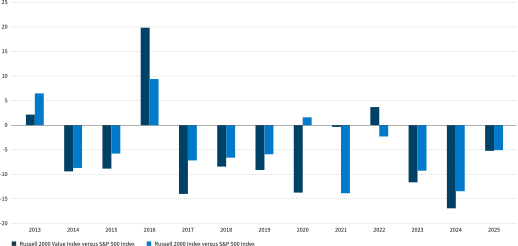
Sources: FactSet and William Blair, as of December 31, 2025. Past performance is not indicative of future returns. A direct investment in an index is not possible.
The effects of this environment have extended beyond the relative performance of large- and small-cap benchmarks. Within the small-cap universe itself, investors and active managers have increasingly migrated toward larger companies in search of outperformance.
The chart below illustrates this trend using the Russell 2500 Value Index, our small- and mid-cap (SMID-cap) strategy benchmark, segmented by market-capitalization cohorts. The results are striking: the largest companies in the index—those with market capitalizations above $10 billion—have generated substantially stronger returns than their smaller counterparts.
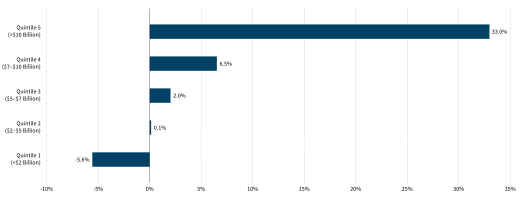
Sources: FactSet and William Blair, year-to-date data as of March 31, 2026. Past performance is not indicative of future returns. Index performance is provided for illustrative purposes only. Indices are unmanaged, do not incur fees or expenses, and cannot be invested in directly.
This dynamic has had important implications for portfolio construction across the asset class. The average market capitalization of the Russell 2000 Value Index is approximately $3 billion. Yet many small-cap managers today maintain portfolios with average market capitalizations in the $5 billion to $10 billion range. In our view, this reflects a decade-long tendency among market participants to move up the capitalization spectrum as large-cap leadership persisted. In many cases, portfolios marketed as small cap increasingly resemble SMID-cap or even mid-cap strategies.
We seek to invest at or modestly below the benchmark’s average market capitalization.
In contrast, our approach has remained consistent throughout this period. We seek to invest at or modestly below the benchmark’s average market capitalization, reflecting our belief that clients allocate to small-cap strategies to gain exposure to that segment of the market rather than to larger companies that have already benefited from significant investor attention.
Valuations further highlight the extent of this divergence. Historically, higher-quality and larger-cap companies have commanded valuation premiums. However, the performance differential observed over the last decade has been accompanied by a substantial expansion of those premiums. The largest companies within the small-cap universe are not only the strongest performers, but also among the most expensive. Conversely, smaller-cap companies currently trade at significant discounts on both an absolute and relative basis. Despite attractive valuations and, in many cases, stronger prospective return profiles, investor flows and market leadership have remained concentrated in larger companies. In our view, this imbalance has created one of the more compelling opportunity sets for disciplined small-cap investors in many years.
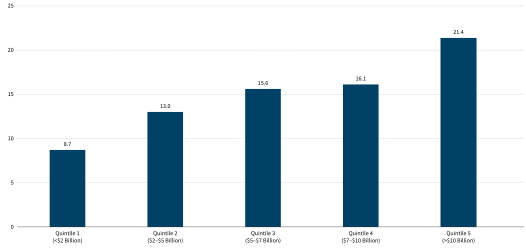
Sources: FactSet and William Blair, as of December 31, 2025. Shows median last-12-months (LTM) P/E ratio. Past performance is not indicative of future returns. Index performance is provided for illustrative purposes only. Indices are unmanaged, do not incur fees or expenses, and cannot be invested in directly.
The challenges facing small-cap investors today extend beyond a decade of large-cap dominance. The Russell 2000 Index itself has changed meaningfully over time. While many investors continue to view the index as representative of the traditional small-cap opportunity set, the underlying composition of the benchmark has evolved significantly.
One of the clearest indicators of this evolution is profitability. Twenty years ago, approximately 20% of index constituents were unprofitable. Today, that figure has risen to roughly 40%. While other equity benchmarks have also experienced an increase in unprofitable companies, the shift within small caps has been substantially more pronounced. As a result, investors seeking high-quality businesses are working within a much smaller subset of the index than in prior decades.
The average market capitalization of the Russell 2000 has increased from approximately $1 billion in 2005 to roughly $4.5 billion today.
The benchmark has also become meaningfully larger over time. The average market capitalization of the Russell 2000 has increased from approximately $1 billion in 2005 to roughly $4.5 billion today. As the largest companies within the index have consistently outperformed, investors and managers have increasingly gravitated toward these larger constituents. The result is a small-cap universe increasingly dominated by "large small caps," raising the possibility that some investors are receiving more mid-cap exposure than they realize within ostensibly small-cap portfolios.
We believe the impact of these shifts has been amplified by the growing influence of passive investment vehicles. Unlike active managers, passive strategies are required to own benchmark constituents regardless of profitability, valuation, or business quality. As passive ownership has expanded, an increasing amount of capital has flowed indiscriminately into index constituents, including lower-quality companies that many quality-oriented active managers either cannot or choose not to own. Passive flows have become an increasingly important driver of small-cap price discovery, contributing to benchmark distortions and creating a more challenging environment for fundamentally driven investors.

Sources: FactSet as of December 31, 2025 (for unprofitable companies and average weighted market cap) and Avantis Investors as of 2025 (for AUM in passive strategies). Indices are unmanaged, do not incur fees or expenses, and cannot be invested in directly. Unprofitable companies and average weighed market cap refer to the Russell 2000 Index.
The changing composition of the benchmark has coincided with an unusually narrow pattern of market leadership. Over the past several years, performance has been concentrated among a relatively small group of larger, more expensive, and often less profitable companies.
Narrow leadership has favored unprofitable companies. The impact was particularly evident over the past year, when unprofitable companies dramatically outperformed profitable peers. Not only was the magnitude of the outperformance significant, but the breadth was unusual. Across nearly every major sector, unprofitable businesses generated stronger returns than profitable competitors. While market leadership broadened somewhat earlier this year, narrow leadership remains an important feature of today’s market environment.
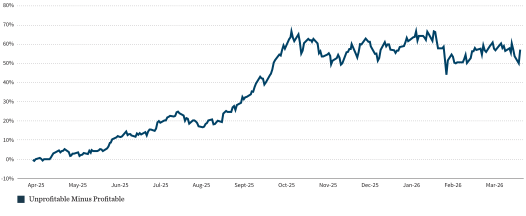
Sources: FactSet and William Blair, as of March 31, 2026. Past performance is not indicative of future returns. Index performance is provided for illustrative purposes only. Data is for the Russell 2000 Value Index. Indices are unmanaged, do not incur fees or expenses, and cannot be invested in directly.
The largest small caps have become even larger. The definition of “small cap” has changed over time. As shown in the chart below, the largest company remaining in the Russell 2000 today is significantly larger than the largest constituent in prior decades. Recent peaks have exceeded $60 billion in market capitalization—levels that would have been difficult to imagine historically for a small-cap benchmark. This trend reflects investors’ increasing preference for larger companies and highlights how market leadership has become concentrated among the biggest names within the small-cap universe.
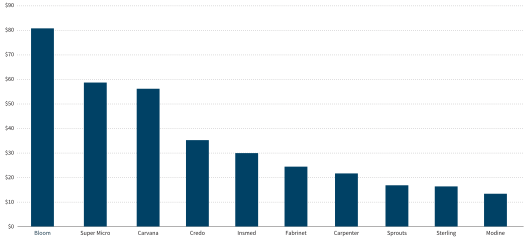
Sources: FactSet and William Blair, as of April 30, 2026. Indices are unmanaged, do not incur fees or expenses, and cannot be invested in directly.
Taken together, recent market leadership has been concentrated in a relatively small segment of the opportunity set: larger companies, trading at higher valuations, with weaker profitability characteristics. Such conditions bear resemblance to other periods in market history when investor enthusiasm became increasingly concentrated in a narrow group of securities.
At the same time, the structure of equity markets has undergone a significant transformation. The market participants that drive price discovery today are very different from those that dominated 10 or 20 years ago.
The rise of ETFs and other passive vehicles has fundamentally altered trading dynamics. In many cases, capital flows into a sector, theme, or index result in purchases across all constituents, regardless of company fundamentals. Whether a stock is attractively valued, highly profitable, or fundamentally challenged becomes secondary to its inclusion in the benchmark.
Retail participation has further reinforced these trends, while a growing share of daily trading activity is now driven by large multi-manager hedge funds and quantitative strategies. These firms often operate with much shorter investment horizons than traditional long-only investors, frequently focusing on catalysts such as earnings announcements, revisions, trading flows, and other near-term events rather than long-duration business fundamentals.
Market inefficiencies can persist longer than they have historically.
As a result, fundamental long-only investors represent a significantly smaller share of market activity than they did two decades ago, accounting for roughly 50% of U.S. equity trading volume in 2005 compared with approximately 15% today.[1] The marginal buyer is increasingly a quantitative strategy, multi-manager portfolio manager (“pod shop”) or retail investor rather than a traditional fundamental investor. Historically, large active managers played a central role in establishing prices based on company fundamentals and long-term prospects. Today, price discovery is increasingly driven by passive flows, systematic strategies, and short-term trading activity rather than long-term assessments of intrinsic value.
For long-term investors, this creates both challenges and opportunities. Market inefficiencies can persist longer than they have historically, particularly when flows rather than fundamentals drive performance. At the same time, periods of narrow leadership and indiscriminate buying can create attractive opportunities among overlooked companies whose valuations increasingly diverge from their underlying business fundamentals.
Periods of prolonged market leadership can create pressure to abandon investment disciplines that have historically generated long-term results. We believe that would be a mistake.
While the challenges facing small-cap value investors over the past decade have been significant, changing strategies late in the cycle carries its own risks. Investors who allocate to small-cap value do so with the expectation that managers will remain disciplined and consistent through changing market environments, not simply follow prevailing market trends.
Importantly, our conviction in the asset class remains intact. Small-cap investing continues to offer a fertile environment for active management and fundamental research. Relative to larger-cap markets, small-cap companies generally receive less analyst coverage, attract fewer institutional investors, and offer greater opportunities for differentiated insights. Access to management teams is often stronger, and market inefficiencies can be more pronounced. These characteristics may create opportunities for active investors to identify businesses whose intrinsic value is not fully reflected in market prices.
Today’s valuation environment further strengthens that opportunity. As discussed previously, valuation disparities across the small-cap universe have reached historically elevated levels. While valuation alone is rarely a catalyst, history suggests that periods of extreme dislocation eventually normalize—and when they do, the resulting re-rating can be significant.
We also see several potential cyclical and structural tailwinds emerging for the asset class. Small-cap stocks have historically performed well during periods of improving economic growth, easing monetary conditions, and accelerating merger-and-acquisition activity. We believe early signs of improvement are beginning to emerge in several of these areas. In addition, themes such as domestic manufacturing investment, supply-chain reshoring, and infrastructure spending could provide incremental support for many small-cap businesses.
Perhaps most importantly, the current cycle is exceptionally mature by historical standards. The period of large-cap outperformance now extends roughly 12 years, making it substantially longer than previous leadership cycles. While market timing is impossible, history suggests that leadership eventually rotates, often when consensus expectations are most firmly entrenched. We believe it is important to remain positioned for that eventual shift rather than attempting to chase the areas that have already experienced the greatest appreciation.
In the meantime, our focus remains on controlling what we can control. We continue to invest in our research capabilities, refine our investment process, strengthen our team, and evaluate every aspect of portfolio construction and decision-making. Market environments evolve, and successful investment organizations must evolve as well. Our objective is not simply to endure a challenging cycle, but to emerge from it stronger, better positioned, and prepared to capitalize when the opportunity set broadens once again.
Mark Goodman, CFA, is a portfolio manager on William Blair's U.S. value equity team.
Matthew Fleming, CFA, partner, is the head of William Blair’s U.S. value equity team, on which he also serves as a portfolio manager.
[1] Sources: CME Group, CBOE Global Markets, Goldman Sachs Prime Services, OFR multi-manager data, J.P. Morgan/ARC Group retail flow research, Claude, and William Blair, as of December 31, 2025. Volume shares estimated; methodology varies by source.
Any investment or strategy mentioned herein may not be appropriate for every investor. There can be no assurance that investment objectives will be met. Products and services listed are available only to residents of this jurisdiction and may only be available to certain categories of investors. The information on this website does not constitute an offer for products or services, or a solicitation of an offer to any persons outside of this jurisdiction who are prohibited from receiving such information under applicable laws and regulations. Nothing on this webpage should be construed as advice and is therefore not a recommendation to buy or sell shares.
Please carefully consider the William Blair Funds’ investment objectives, risks, charges, and expenses before investing. This and other information is contained in the Funds’ prospectus and summary prospectus, which you may obtain by calling 1-800-742-7272. Read the prospectus and summary prospectus carefully before investing. Investing includes the risk of loss.
The William Blair Funds are distributed by William Blair & Company, L.L.C., member FINRA/SIPC.
The William Blair SICAV is a Luxembourg investment company with variable capital registered with the Commission de Surveillance du Secteur Financier (“CSSF”) which qualifies as an undertaking for collective investment in transferable securities (“UCITS”). The Management Company of the SICAV has appointed William Blair Investment Management, LLC as the investment manager for the fund.
Please carefully consider the investment objectives, risks, charges, and expenses of the William Blair SICAV. This and other important information is contained in the prospectus and Key Investor Information Document (KIID). Read these documents carefully before investing. The information contained on this website is not a substitute for those documents or for professional external advice.
Information and opinions expressed are those of the authors and may not reflect the opinions of other investment teams within William Blair Investment Management, LLC, or affiliates. Factual information has been taken from sources we believe to be reliable, but its accuracy, completeness or interpretation cannot be guaranteed. Information is current as of the date appearing in this material only and subject to change without notice. Statements concerning financial market trends are based on current market conditions, which will fluctuate. This material may include estimates, outlooks, projections, and other forward-looking statements. Due to a variety of factors, actual events may differ significantly from those presented.
Investing involves risks, including the possible loss of principal. Equity securities may decline in value due to both real and perceived general market, economic, and industry conditions. The securities of smaller companies may be more volatile and less liquid than securities of larger companies. Investing in foreign denominated and/or domiciled securities may involve heightened risk due to currency fluctuations, and economic and political risks. These risks may be enhanced in emerging markets and frontier markets. Investing in the bond market is subject to certain risks including market, interest rate, issuer, credit, and inflation risk. High-yield, lower-rated, securities involve greater risk than higher-rated securities. Different investment styles may shift in and out of favor depending on market conditions. Diversification does not ensure against loss.
Past performance is not indicative of future returns. References to specific companies are for illustrative purposes only and should not be construed as investment advice or a recommendation to buy or sell any security.
William Blair Investment Management, LLC is an investment adviser registered with the U.S. Securities and Exchange Commission.
Issued in the United Kingdom by William Blair International, Ltd., authorized and regulated by the Financial Conduct Authority (FCA), and is only directed at and is only made available to persons falling within articles 19, 38, 47, and 49 of the Financial Services and Markets Act of 2000 (Financial Promotion) Order 2005 (all such persons being referred to as "relevant persons").
Issued in the European Economic Area (EEA) by William Blair B.V., authorized and supervised by the Dutch Authority for the Financial Markets (AFM) under license number 14006134 and also supervised by the Dutch Central Bank (DNB), registered at the Dutch Chamber of Commerce under number 82375682 and has its statutory seat in Amsterdam, the Netherlands. This material is only intended for eligible counterparties and professional clients.
Issued in Switzerland by William Blair Investment Services (Zurich) GmbH, Talstrasse 65, 8001 Zurich, Switzerland ("WBIS"). WBIS is engaged in the offering of collective investment schemes and renders further, non-regulated services in the financial sector. WBIS is affiliated with FINOS Finanzomubdsstelle Schweiz, a recognized ombudsman office where clients may initiate mediation proceedings pursuant to articles 74 et seq. of the Swiss Financial Services Act ("FinSA"). The client advisers of WBIS are registered with regservices.ch by BX Swiss AG, a client adviser registration body authorized by the Swiss Financial Market Supervisory Authority ("FINMA"). WBIS is not supervised by FINMA or any other supervisory authority or self-regulatory organization. This material is only intended for institutional and professional clients pursuant to article 4(3) to (5) FinSA.
Issued in Australia by William Blair Investment Management, LLC (“William Blair”), which is exempt from the requirement to hold an Australian financial services license under Australia's Corporations Act 2001 (Cth). William Blair is registered as an investment advisor with the U.S. Securities and Exchange Commission (“SEC”) and regulated by the SEC under the U.S. Investment Advisers Act of 1940, which differs from Australian laws. This material is intended only for wholesale clients.
Issued in Singapore by William Blair International (Singapore) Pte. Ltd. (Registration Number 201943312R), which is regulated by the Monetary Authority of Singapore under a Capital Markets Services License to conduct fund management activities. This material is intended only for institutional investors and may not be distributed to retail investors.
Issued in Canada by William Blair Investment Management, LLC, which relies on the international adviser exemption, pursuant to section 8.26 of National Instrument 31-103 in Canada.


The content contained in this site is intended as informational or educational in nature and does not constitute investment advice or a recommendation of any investment strategy or product for a particular investor. Investment advice and recommendations can be provided only after careful consideration of an investor’s objectives, guidelines, and restrictions. Investors should consult a financial professional/financial consultant or investment adviser before making any investment decisions. Investing includes the risk of loss.
Copyright © 2026 William Blair. William Blair is a registered trademark of William Blair & Company, L.L.C. “William Blair” refers to William Blair Investment Management, LLC and affiliates.

