The AI infrastructure buildout is one of the largest capital investment cycles in modern history, supported by annual capital expenditure (capex) already in the hundreds of billions: Hyperscalers (including Microsoft, Alphabet, Amazon, Meta, and Oracle) are collectively expected to spend nearly $700 billion on capex in 2026 alone, with much of this investment going to the buildout of AI infrastructure to support the growing demand for AI compute.
For active managers, the investment opportunity extends well beyond the hyperscalers themselves: The AI supply chain encompasses five distinct layers (semiconductors, networking, power/energy, cooling, and physical construction), each with compelling growth drivers and companies positioned to benefit from what we view as durable, structural demand.
Over the past several years, the AI investment narrative has largely been focused on a small cohort of hyperscale technology companies, whose stock prices have generally appreciated in anticipation of the productivity and revenue benefits that AI is expected to generate.
However, we believe this concentration of attention has obscured a broader opportunity that spans the AI supply chain.
Setting the Stage: The Scale of the AI Buildout
Over the past several years, major hyperscalers have announced robust capex commitments. Microsoft, Alphabet, Amazon, Meta Platforms, and Oracle have collectively signaled intentions to deploy hundreds of billions of dollars annually into AI-related infrastructure, encompassing data center construction, semiconductor procurement, networking equipment, and power infrastructure.[1]
Crucially, management teams at each of these companies have emphasized that these commitments are multiyear in nature, not discretionary spending that can be quickly curtailed. These capex commitments are viewed as strategic investments amidst a generational platform shift driven by the buildout and usage of AI. As the chart below highlights, capex spending of large hyperscalers is expected to approach $700 billion in 2026 alone.
Hyperscaler Capex Spend (In Billions)
Source: William Blair, as of 3/31/2026.
What distinguishes this capex cycle from prior waves of technology investment, such as the dot-com buildout of the late 1990s and the cloud migration of the 2010s, is the convergence of several simultaneous factors:
The compute intensity of training and inference workloads is orders of magnitude greater than prior enterprise software applications. AI training typically requires massive datasets, specialized talent, and expensive computing infrastructure, which can limit participation to a small group of big tech companies and well-resourced firms. AI inference, by contrast, is cheaper and easier to deploy, so many more companies can use AI in their products and operations. The shift from AI training to AI inference is broadening access across a wider range of enterprises and users, expanding the addressable market significantly.
The energy requirements of AI data centers are creating physical infrastructure bottlenecks that will likely take years, not months, to resolve.
Geopolitical pressures are driving the onshoring of semiconductor manufacturing and supply chain diversification, adding a structural layer of demand on top of AI spending.
In addition, data centers have expanded rapidly in recent years, with an estimated 8,800 facilities expected to be operational on a global basis by the end of 2026.[2] That total spans more than 170 countries and is led by the United States, which accounts for nearly half of all installations.
The expected growth trajectory through the end of the decade is significant as well. ABI Research projects that more than 10,000 data centers will be operational by 2030, with the number of hyperscale facilities, which are large-scale campuses operated by cloud and AI companies, growing to more than 3,200.[3]
Critically, raw facility count understates the scale of expansion; global data center capacity is projected to reach approximately 200 gigawatts (GW)[4] by 2030, nearly doubling from current levels as roughly 100 GW of new capacity comes online over the next five years.[5]
To put that into context, the amount of additional electrical power capacity that new data centers may require between now and 2030, on top of the roughly 100 GW already in operation today, is roughly equivalent to the entire electricity-generating capacity of Germany. That is enough electricity to power about 75 million average U.S. homes continuously.
We believe the capital required to build, power, and connect this infrastructure represents a significant and durable opportunity across the AI supply chain. While the buildout is already underway, the more important concern for investors is identifying which companies are best positioned to capture a disproportionate share of that spend.
The amount of additional electrical power capacity that new data centers may require between now and 2030, on top of the roughly 100 GW already in operation today, is roughly equivalent to the entire electricity-generating capacity of Germany.
The Enabler Ecosystem: Mapping Elements of the AI Supply Chain
The AI infrastructure supply chain can be understood as a set of distinct but interdependent layers. Each presents a different risk/return profile, competitive dynamic, and demand drivers. Below, we look at five distinct layers of the AI supply chain that play a critical role in the buildout of data centers and AI.
1. Semiconductors and Components
At the foundation of the AI infrastructure buildout sits the semiconductor layer, or the chips and components that make AI physically possible. The most visible of these are graphics processing units (GPUs), which are specialized processors that were originally designed for video games but turned out to be exceptionally well suited to the type of math that AI models require. Running AI workloads at scale demands enormous numbers of these chips: a single large data center can house tens of thousands of GPUs, each consuming as much power as a household appliance running continuously.
While Nvidia has captured the lion's share of investor attention as the dominant GPU supplier, the investment opportunity in this layer extends well beyond a single company. Every GPU requires a supporting cast of components to function. Power management chips regulate how electricity is delivered and converted within a server; as chips have grown more powerful and power-hungry, the sophistication and cost of this power delivery system have grown with them.
High-bandwidth memory (HBM) solves a different problem: a GPU can only process data as fast as it can be retrieved from memory, so the chips that store and supply that data are just as important as the processor itself. Demand for HBM has consistently outrun supply since the AI buildout accelerated.
The most consequential longer-term development is that some of the largest technology companies—Amazon, Google, Microsoft, and Meta—have each begun designing their own custom chips, tailored specifically to their workloads rather than relying entirely on off-the-shelf GPUs. This is creating a new and growing source of demand that flows through a broader network of semiconductor suppliers: chip designers, specialized manufacturers, and advanced packaging providers that bring each new generation of silicon from design to production.
2. Networking and Connectivity
As AI workloads scale, the bandwidth requirements between compute nodes, across data centers, and out to end-users are growing exponentially, and copper-based electrical interconnects are increasingly unable to meet the speed, distance, and power efficiency demands of modern AI infrastructure.
Thus, the ongoing shift from AI training, which is largely contained within a single facility, to AI inference, which requires low-latency connectivity across distributed infrastructure, is expected to further accelerate demand for high-bandwidth connectivity (i.e. fiber optic cable) at scale.
Data Centers and Servers Need to Be Connected
Pictured: data center server (left) and data center connectors (right).
3. Power and Energy Infrastructure
Perhaps the most underappreciated bottleneck in the AI buildout is power. A modern AI data center can consume as much electricity as a small city, and the global power grid, particularly in the United States and Europe, was not designed to absorb this level of incremental demand.
We believe this creates compelling investment opportunities across the power value chain. Some examples include industrial gas companies whose specialty gases are essential to semiconductor fabrication and cooling; electrical equipment manufacturers that produce transformers, switchgear, and power distribution systems; and the broader grid modernization ecosystem.
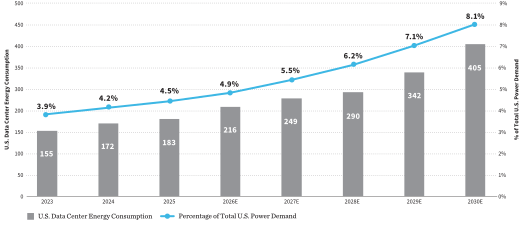
In addition, the nuclear energy renaissance, driven by hyperscalers seeking reliable, carbon-free baseload power, adds another dimension to this theme. In the United States alone, estimates point to approximately 200 terawatt-hours (TWh) in new electricity demand from data centers through 2030.
To put this into context, a single large nuclear power plant generates roughly 8 to 10 TWh per year, so 200 TWh would require the output of approximately 25 nuclear plants running continuously—enough energy to power roughly 18 million average U.S. homes for an entire year.
U.S. Data Center Energy Consumption (TWh)
Sources: McKinsey, BofA Global Research, and William Blair, as of 3/31/2026.
4. Cooling and Thermal Management
The thermal density of modern AI compute clusters, driven by the power consumption of high-end GPUs, is pushing traditional air-cooled data center designs to their physical limits. Liquid cooling, including direct liquid cooling and immersion cooling, is transitioning from a niche solution to a mainstream requirement.
Liquid cooling is a thermal management method that uses liquid (typically water or a coolant fluid) to absorb and carry away heat from computer hardware, such as GPUs and CPUs, more efficiently than traditional air cooling. It works by circulating coolant through pipes or plates directly attached to heat-generating components. Direct liquid cooling brings the coolant into close contact with the chip or component itself (for example, through cold plates mounted directly on processors) allowing for very efficient, targeted heat removal. Immersion cooling takes this a step further by submerging entire servers or hardware components directly into a thermally conductive, electrically non-conductive liquid (such as dielectric fluid).
We believe companies with proprietary liquid cooling technology and established hyperscaler relationships are positioned to benefit from what amounts to a likely upgrade cycle across the global data center installed base.
5. Physical Infrastructure
The physical construction of AI data centers is itself a multibillion-dollar annual opportunity. Unlike traditional commercial construction, AI data center development requires specialized expertise in high-density electrical systems, precision cooling infrastructure, and the site development that precedes any building, which includes grading, utilities, foundations, and access roads.
Companies with proven track records, deep customer relationships with hyperscalers, and vertically integrated capabilities across site development and electrical contracting are winning an outsized share of this work and building backlogs that may provide multiyear revenue visibility.
A modern AI data center can consume as much electricity as a small city.
Competitive Dynamics and Defensible Moats
Not all positions in the AI infrastructure supply chain are created equal. A rigorous investment framework requires distinguishing between companies with durable competitive advantages and those whose near-term revenue growth reflects cyclical demand rather than structural positioning.
Companies that have competitive advantages within the AI supply chain share several attributes.
Proprietary technology: Proprietary technology is difficult to replicate and deeply integrated into customer workflows, and semiconductor companies embed their value not just in silicon but in software ecosystems. For instance, a dominant GPU platform can accumulate over a decade of developer entrenchment, meaning hyperscalers and AI labs build their entire training infrastructure around it. This typically leads to the switching cost of moving to an alternative measured in years of re-engineering rather than dollars per chip.
Long-term contracts: In addition, long-term contracts can help provide revenue visibility and insulate companies from commodity-like pricing pressure. Industrial gas suppliers, for example, operate under multidecade, on-site contracts tied to the productive life of an asset, securing recurring revenue streams that are difficult for customers to exit. This dynamic is important as liquid nitrogen and carbon dioxide emerge as critical cooling inputs for the high-density server racks and AI computing infrastructure that emit intense heat within data centers.
Scale advantages and customer concentration: Scale advantages accrue to suppliers across the AI value chain that then become entrenched in their customers’ operations through deep integration, co-development, and the sheer cost of switching at volume. Hyperscalers are the clearest example: they tend to consolidate their supply chains around a small number of trusted vendors, and custom ASIC and networking silicon suppliers become structurally embedded once a hyperscaler co-develops a chip architecture around its platform. The design cycle then runs two to three years, and the switching cost effectively becomes a full product generation. Hyperscalers' preference to consolidate around a handful of trusted vendors means the incumbent supplier rarely faces a competitive rebid.
Geographic and regulatory moats: Permitting timelines and grid interconnection queues can create meaningful barriers to entry for new competitors, particularly in data center buildouts. Aggregate suppliers, for example, benefit from the near-impossibility of permitting new quarries near high-growth data center corridors. Crushed stone cannot be economically shipped more than roughly 50 miles, so an existing permitted quarry in a supply-constrained market represents a durable, location-specific advantage that no new entrant can replicate regardless of capital.
We believe investors should be cautious about supply chain positions where the competitive differentiation is primarily price-based; where product cycles are short and customer switching costs are low; or where the end-market is exposed to a single hyperscaler's capital allocation decisions.
Risks to Monitor
A balanced assessment of the AI infrastructure opportunity requires acknowledging the risks that could cause disruptions over time:
Hyperscaler capex moderation: A slowdown in AI infrastructure spending, whether driven by macroeconomic deterioration, disappointing AI monetization, or shifts in capital allocation priorities, represents the most significant risk to the demand outlook across the supply chain.
Technology substitution: The rapid pace of AI model innovation could render certain hardware architectures obsolete faster than expected, disrupting incumbent suppliers in the semiconductor and networking layers.
Geopolitical and supply chain risk: Concentration of advanced semiconductor manufacturing in Taiwan and South Korea creates vulnerability to geopolitical disruption, while export control regimes continue to evolve in ways that could impact addressable markets.
Portfolio Construction Implications
For equity investors, the AI supply chain offers compelling opportunities to gain diversified exposure to this powerful long-term growth driver while balancing the concentration risk inherent in owning the hyperscalers themselves.
These opportunities span the market-cap spectrum, from large-cap infrastructure leaders that offer balance sheet strength and contracted revenue visibility, to smaller, specialized companies that often occupy critical but less-visible areas of the supply chain.
We believe a thoughtful allocation across company sizes can capture both the durability of established players and the differentiated positioning of emerging specialists throughout the supply chain.
Several principles can help guide portfolio construction within this theme:
Diversify across supply chain layers: A portfolio with exposure across multiple layers of the supply chain can be less vulnerable to disruption at any single layer than one concentrated in a single segment.
Prioritize moat quality over growth rate: We believe the companies most likely to generate durable returns are those with defensible competitive positions, not simply the fastest near-term growers.
Balance early-stage optionality with revenue visibility: Some of the most interesting opportunities may carry higher uncertainty but also higher potential upside. Pairing these with businesses that have strong contracted backlog creates a more balanced risk profile.
Closing Thoughts
We believe the AI infrastructure buildout represents a significant multiyear investment cycle. While the hyperscalers will remain central to this story, the companies enabling the buildout—across areas such as semiconductors, power, networking, cooling, and construction, just to name a few—represent a broad and dynamic opportunity set that we believe warrants attention.
While the infrastructure buildout continues to unfold, selectivity in exposure will remain important. We believe AI infrastructure spend will not grow in a straight line, and competitive positioning will separate durable winners from cyclical participants.
[1]References to specific securities and their issuers are for illustrative purposes only. William Blair may or may not own any securities of the issuers referenced and, if such securities are owned, no representation is being made that such securities will continue to be held. The securities referenced do not represent all of the securities purchased, sold, or recommended for advisory clients. It should not be assumed that any investment in the securities referenced was or will be profitable. [2] Source: ABI Research. [3] Source: ABI Research. [4] GW refer to power capacity: specifically the amount of electricity a data center can draw to run its servers, cooling systems, and other infrastructure. It is the standard unit the industry uses to measure data center scale because it captures both the size and the intensity of a facility more accurately than square footage alone. [5] Source: JLL.
Subscribe Now
Want the latest insights on the economy and other forces shaping the investment landscape?
Subscribe to our Investing Insights newsletter.
Any investment or strategy mentioned herein may not be appropriate for every investor. There can be no assurance that investment objectives will be met. Products and services listed are available only to residents of this jurisdiction and may only be available to certain categories of investors. The information on this website does not constitute an offer for products or services, or a solicitation of an offer to any persons outside of this jurisdiction who are prohibited from receiving such information under applicable laws and regulations. Nothing on this webpage should be construed as advice and is therefore not a recommendation to buy or sell shares.
Please carefully consider the William Blair Funds’ investment objectives, risks, charges, and expenses before investing. This and other information is contained in the Funds’ prospectus and summary prospectus, which you may obtain by calling 1-800-742-7272. Read the prospectus and summary prospectus carefully before investing. Investing includes the risk of loss.
The William Blair Funds are distributed by William Blair & Company, L.L.C., member FINRA/SIPC.
The William Blair SICAV is a Luxembourg investment company with variable capital registered with the Commission de Surveillance du Secteur Financier (“CSSF”) which qualifies as an undertaking for collective investment in transferable securities (“UCITS”). The Management Company of the SICAV has appointed William Blair Investment Management, LLC as the investment manager for the fund.
Please carefully consider the investment objectives, risks, charges, and expenses of the William Blair SICAV. This and other important information is contained in the prospectus and Key Investor Information Document (KIID). Read these documents carefully before investing. The information contained on this website is not a substitute for those documents or for professional external advice.
Information and opinions expressed are those of the authors and may not reflect the opinions of other investment teams within William Blair Investment Management, LLC, or affiliates. Factual information has been taken from sources we believe to be reliable, but its accuracy, completeness or interpretation cannot be guaranteed. Information is current as of the date appearing in this material only and subject to change without notice. Statements concerning financial market trends are based on current market conditions, which will fluctuate. This material may include estimates, outlooks, projections, and other forward-looking statements. Due to a variety of factors, actual events may differ significantly from those presented.
Investing involves risks, including the possible loss of principal. Equity securities may decline in value due to both real and perceived general market, economic, and industry conditions. The securities of smaller companies may be more volatile and less liquid than securities of larger companies. Investing in foreign denominated and/or domiciled securities may involve heightened risk due to currency fluctuations, and economic and political risks. These risks may be enhanced in emerging markets and frontier markets. Investing in the bond market is subject to certain risks including market, interest rate, issuer, credit, and inflation risk. High-yield, lower-rated, securities involve greater risk than higher-rated securities. Different investment styles may shift in and out of favor depending on market conditions. Diversification does not ensure against loss.
Past performance is not indicative of future returns. References to specific companies are for illustrative purposes only and should not be construed as investment advice or a recommendation to buy or sell any security.
William Blair Investment Management, LLC is an investment adviser registered with the U.S. Securities and Exchange Commission.
Issued in the United Kingdom by William Blair International, Ltd., authorized and regulated by the Financial Conduct Authority (FCA), and is only directed at and is only made available to persons falling within articles 19, 38, 47, and 49 of the Financial Services and Markets Act of 2000 (Financial Promotion) Order 2005 (all such persons being referred to as "relevant persons").
Issued in the European Economic Area (EEA) by William Blair B.V., authorized and supervised by the Dutch Authority for the Financial Markets (AFM) under license number 14006134 and also supervised by the Dutch Central Bank (DNB), registered at the Dutch Chamber of Commerce under number 82375682 and has its statutory seat in Amsterdam, the Netherlands. This material is only intended for eligible counterparties and professional clients.
Issued in Switzerland by William Blair Investment Services (Zurich) GmbH, Talstrasse 65, 8001 Zurich, Switzerland ("WBIS"). WBIS is engaged in the offering of collective investment schemes and renders further, non-regulated services in the financial sector. WBIS is affiliated with FINOS Finanzomubdsstelle Schweiz, a recognized ombudsman office where clients may initiate mediation proceedings pursuant to articles 74 et seq. of the Swiss Financial Services Act ("FinSA"). The client advisers of WBIS are registered with regservices.ch by BX Swiss AG, a client adviser registration body authorized by the Swiss Financial Market Supervisory Authority ("FINMA"). WBIS is not supervised by FINMA or any other supervisory authority or self-regulatory organization. This material is only intended for institutional and professional clients pursuant to article 4(3) to (5) FinSA.
Issued in Australia by William Blair Investment Management, LLC (“William Blair”), which is exempt from the requirement to hold an Australian financial services license under Australia's Corporations Act 2001 (Cth). William Blair is registered as an investment advisor with the U.S. Securities and Exchange Commission (“SEC”) and regulated by the SEC under the U.S. Investment Advisers Act of 1940, which differs from Australian laws. This material is intended only for wholesale clients.
Issued in Singapore by William Blair International (Singapore) Pte. Ltd. (Registration Number 201943312R), which is regulated by the Monetary Authority of Singapore under a Capital Markets Services License to conduct fund management activities. This material is intended only for institutional investors and may not be distributed to retail investors.
Issued in Canada by William Blair Investment Management, LLC, which relies on the international adviser exemption, pursuant to section 8.26 of National Instrument 31-103 in Canada.
The content contained in this site is intended as informational or educational in nature and does not constitute investment advice or a recommendation of any investment strategy or product for a particular investor. Investment advice and recommendations can be provided only after careful consideration of an investor’s objectives, guidelines, and restrictions. Investors should consult a financial professional/financial consultant or investment adviser before making any investment decisions. Investing includes the risk of loss.




.svg)
.jpg)