Beneath the market volatility, leadership shifted toward tangible sectors tied to infrastructure, defense, and industrial buildout in the first quarter.
The AI transition is as much about displacement as it is about innovation, with clear parallels to past structural disruptions.
We believe current geopolitical events are reinforcing the shift toward tangible investment themes.
The first quarter of 2026 was so volatile that reviewing headline index performance sheds little light on economic fundamentals or market leadership. U.S. public equities declined by 3.9%[1]. Developed market (DM) equities fared little better, shrinking by a more modest 0.8%[2], underperforming their emerging markets (EM) brethren, which were flat[3]. Small caps outperformed large caps[4], and global fixed income slumped[5].
Heading into 2026, we expected the continued focus on gaining geostrategic autonomy—fueled by the proliferation of AI technologies—to power equity markets around the world. Our central thesis of “the revenge of the tangibles” focuses on next-generation defense, the electric tech stack, robotics, autonomous transport, and AI infrastructure buildout to drive economic growth and investment returns.
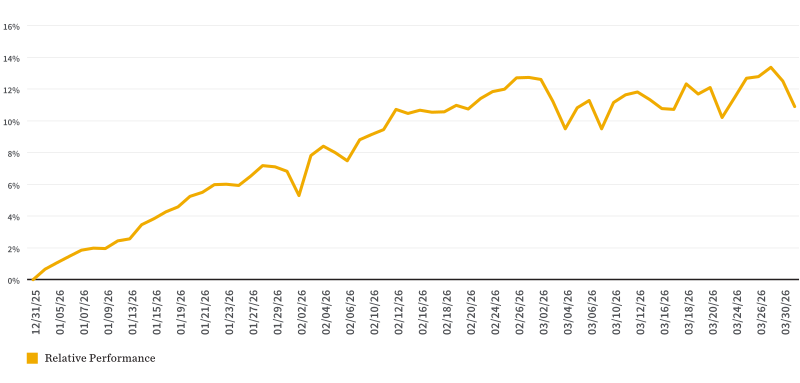
Investing in “the revenge of the tangibles” delivered outsized gains in the first quarter. Companies that derive at least 20% of their revenue from the abovementioned end-markets yield a universe of just under 2,000 names, which outperformed the broad MSCI All Country World Index (ACWI)[6] by more than 10% in the opening months of this year.
Relative Q1 Performance: Revenge of the Tangibles vs. MSCI ACWI IMI
Source: Bloomberg, FactSet, and William Blair analysis, as of March 31, 2026. Relative performance measures the return of the “revenge of the tangibles” universe vs. the MSCI ACWI IMI over the same period.
Global Strength Meets AI Repricing
Global equities posted double-digit returns in the first two months of the year, while U.S. markets were busy digesting the implications of the unfolding AI rollout on existing software businesses.
For a decade, “capital-light good, capital-heavy bad” has been close to gospel: zero marginal cost, network effects, scaling laws, and high incremental margins. Some of this remains true, with new intangible models coming into view.
Yet the transition inevitably involves outright destruction, as many legacy software offerings were clunky, offering partial, often difficult-to-implement solutions. If AI removes some of these frictions, the associated products may no longer need to exist, or their price will be reduced to their marginal value.
In other words, AI has escaped the lab and is diffusing. We believe software companies must adopt and adapt and do so quickly and decisively.
Furthermore, some companies are buying back stock with shareholders’ money, some are building “agents” to help with complexity within existing offerings, and many are sitting on the sidelines. A recent sell-side software analyst summed up the attitude of many software executives when he said, “This isn’t fair; it didn’t used to be like this.”
A Parallel from the Newspaper Era
While watching the current debate on software, we are reminded of the early 2000s debate over newspapers. Then, as now, stock prices moved well ahead of earnings downgrades: consensus forward estimates remained basically flat between 2002 and 2007, even as stock prices declined by 60%. But by 2011, earnings forecasts converged on stock prices, and both settled at about 10% of the 2002 average.
Management rhetoric then followed a familiar script.
Reframe as cyclical, not structural: During the advertising slump in 2007 and 2008, Gary Pruitt, then-CEO of newspaper publisher The McClatchy Company, said that a “significant portion” of the current troubles the industry faced were “cyclical.” The company went on to file Chapter 11 bankruptcy in February 2020.
Claim “hard-to-replicate moat”: Mike Reed, the CEO of GateHouse Media, which filed Chapter 11 in 2013, said in the company’s first quarter 2009 earnings release, “We view our exclusive local content as our greatest asset and as our sustainable competitive advantage.”
Argue scale will fix it: Dennis J. FitzSimons, who was the CEO of Tribune Company in 2003, said at the time, “Tribune will be bigger and in the top tier of its core broadcasting and newspaper businesses 24 months from now, as scale will be increasingly important in a fragmented marketplace.” The company filed for Chapter 11 in December 2008.
Emphasize current returns: Craig Dubow, who led Gannett Company before and during a restructuring between 2008 and 2010, said at the time the company’s core publishing business continued to generate significant cash flow even as print revenues declined. And Aaron Kushner, who became CEO of Freedom Communications after it filed for Chapter 11 in 2009, said that “We were profitable last year. … We will be profitable this year, profitable next year and profitable the following year.”
Move from denial to anger to acceptance: Real-estate investor Sam Zell was quoted saying, “I’m sick and tired of listening to everyone talk about and commiserate over the end of newspapers. They ain’t ended and they’re not going to end. I think they have a great future,” after completing the $8.2 billion leveraged Tribune Company buyout. Soon after Tribune’s bankruptcy, however, Zell offered a mea culpa during an April 2009 Bloomberg Television interview. He said, “The definition if you bought something and it’s now worth a great deal less, is you made a mistake. And I’m more than willing to say that I made a mistake. I was too optimistic in terms of the newspaper’s ability to preserve its position.” Zell added that the newspaper model in its current form did not work and needed to be acknowledged as such.
The Impact of the Iran War
And then came the Iran war. Oil prices shot up 60% to 70% between the start of the conflict through March 31, 2026, depending on the exact grade of crude. The U.S. dollar firmed slightly, and U.S. equities outperformed their DM and EM brethren. The U.S. economy is an oil and gas exporter and as such is relatively insulated from the negative impact of scarce energy supplies.
The Iran war also interrupted the debate on software: between November 2025 and February 2026, software underperformed the S&P 500 Index[7] by 30%, but in March 2026, it performed in line with the broad index.
The latest military conflict in the Middle East has reinforced the case for accelerated defense spending by all those who can afford it, not to mention the rebuilding of U.S. military stockpiles.
And just as with prior episodes of high fossil energy prices, this one will accelerate the transition away from oil and gas. The more things change…
Hugo Scott‐Gall, partner, is the head of William Blair’s global equity team, on which he also serves as a portfolio manager.
[1] The MSCI USA IMI is a broad equity index designed to represent the performance of the entire U.S. stock market across all size segments. [2] The MSCI World ex USA IMI is a broad global equity index that measures the performance of DMs outside the United States. [3] The MSCI Emerging Markets IMI is a broad equity index that tracks the performance of EM stocks across all company sizes. [4] The MSCI ACWI Small Cap Index measures the performance of small-cap stocks across both DMs and EMs worldwide. [5] The Bloomberg Global Aggregate Bond Index is a widely used benchmark for global investment-grade fixed-income markets. [6] The MSCI ACWI is a broad global stock market index that measures the performance of publicly traded equities across the world. [7] The S&P 500 Index is a stock market index that tracks the performance of 500 of the largest publicly traded companies in the United States.
Subscribe Now
Want the latest insights on the economy and other forces shaping the investment landscape?
Subscribe to our Investing Insights newsletter.
Any investment or strategy mentioned herein may not be appropriate for every investor. There can be no assurance that investment objectives will be met. Products and services listed are available only to residents of this jurisdiction and may only be available to certain categories of investors. The information on this website does not constitute an offer for products or services, or a solicitation of an offer to any persons outside of this jurisdiction who are prohibited from receiving such information under applicable laws and regulations. Nothing on this webpage should be construed as advice and is therefore not a recommendation to buy or sell shares.
Please carefully consider the Funds’ investment objectives, risks, charges, and expenses before investing. This and other information is contained in the Funds’ prospectus and summary prospectus, which you may obtain by calling 1-800-742-7272. Read the prospectus and summary prospectus carefully before investing. Investing includes the risk of loss.
The William Blair Funds and William Blair ETFs are distributed by William Blair & Company, L.L.C., member FINRA/SIPC.
The William Blair SICAV is a Luxembourg investment company with variable capital registered with the Commission de Surveillance du Secteur Financier (“CSSF”) which qualifies as an undertaking for collective investment in transferable securities (“UCITS”). The Management Company of the SICAV has appointed William Blair Investment Management, LLC as the investment manager for the fund.
Please carefully consider the investment objectives, risks, charges, and expenses of the William Blair SICAV. This and other important information is contained in the prospectus and Key Investor Information Document (KIID). Read these documents carefully before investing. The information contained on this website is not a substitute for those documents or for professional external advice.
Information and opinions expressed are those of the authors and may not reflect the opinions of other investment teams within William Blair Investment Management, LLC, or affiliates. Factual information has been taken from sources we believe to be reliable, but its accuracy, completeness or interpretation cannot be guaranteed. Information is current as of the date appearing in this material only and subject to change without notice. Statements concerning financial market trends are based on current market conditions, which will fluctuate. This material may include estimates, outlooks, projections, and other forward-looking statements. Due to a variety of factors, actual events may differ significantly from those presented.
Investing involves risks, including the possible loss of principal. Equity securities may decline in value due to both real and perceived general market, economic, and industry conditions. The securities of smaller companies may be more volatile and less liquid than securities of larger companies. Investing in foreign denominated and/or domiciled securities may involve heightened risk due to currency fluctuations, and economic and political risks. These risks may be enhanced in emerging markets and frontier markets. Investing in the bond market is subject to certain risks including market, interest rate, issuer, credit, and inflation risk. High-yield, lower-rated, securities involve greater risk than higher-rated securities. Different investment styles may shift in and out of favor depending on market conditions. Diversification does not ensure against loss.
Past performance is not indicative of future returns. References to specific companies are for illustrative purposes only and should not be construed as investment advice or a recommendation to buy or sell any security.
William Blair Investment Management, LLC is an investment adviser registered with the U.S. Securities and Exchange Commission.
Issued in the United Kingdom by William Blair International, Ltd., authorized and regulated by the Financial Conduct Authority (FCA), and is only directed at and is only made available to persons falling within articles 19, 38, 47, and 49 of the Financial Services and Markets Act of 2000 (Financial Promotion) Order 2005 (all such persons being referred to as "relevant persons").
Issued in the European Economic Area (EEA) by William Blair B.V., authorized and supervised by the Dutch Authority for the Financial Markets (AFM) under license number 14006134 and also supervised by the Dutch Central Bank (DNB), registered at the Dutch Chamber of Commerce under number 82375682 and has its statutory seat in Amsterdam, the Netherlands. This material is only intended for eligible counterparties and professional clients.
Issued in Switzerland by William Blair Investment Services (Zurich) GmbH, Talstrasse 65, 8001 Zurich, Switzerland ("WBIS"). WBIS is engaged in the offering of collective investment schemes and renders further, non-regulated services in the financial sector. WBIS is affiliated with FINOS Finanzomubdsstelle Schweiz, a recognized ombudsman office where clients may initiate mediation proceedings pursuant to articles 74 et seq. of the Swiss Financial Services Act ("FinSA"). The client advisers of WBIS are registered with regservices.ch by BX Swiss AG, a client adviser registration body authorized by the Swiss Financial Market Supervisory Authority ("FINMA"). WBIS is not supervised by FINMA or any other supervisory authority or self-regulatory organization. This material is only intended for institutional and professional clients pursuant to article 4(3) to (5) FinSA.
Issued in Australia by William Blair Investment Management, LLC (“William Blair”), which is exempt from the requirement to hold an Australian financial services license under Australia's Corporations Act 2001 (Cth). William Blair is registered as an investment advisor with the U.S. Securities and Exchange Commission (“SEC”) and regulated by the SEC under the U.S. Investment Advisers Act of 1940, which differs from Australian laws. This material is intended only for wholesale clients.
Issued in Singapore by William Blair International (Singapore) Pte. Ltd. (Registration Number 201943312R), which is regulated by the Monetary Authority of Singapore under a Capital Markets Services License to conduct fund management activities. This material is intended only for institutional investors and may not be distributed to retail investors.
Issued in Canada by William Blair Investment Management, LLC, which relies on the international adviser exemption, pursuant to section 8.26 of National Instrument 31-103 in Canada.
The content contained in this site is intended as informational or educational in nature and does not constitute investment advice or a recommendation of any investment strategy or product for a particular investor. Investment advice and recommendations can be provided only after careful consideration of an investor’s objectives, guidelines, and restrictions. Investors should consult a financial professional/financial consultant or investment adviser before making any investment decisions. Investing includes the risk of loss.