More users, high usage frequency, vastly greater per-task complexity, and persistent time sensitivity are placing token consumption on a trajectory that outpaces any realistic supply growth.
With compute power bottlenecked at critical chokepoints, the market appears to be shifting from token subsidization toward genuine price discovery.
We believe the transition to positive unit economics is likely to be nonlinear, which is where our active portfolio management and focus on attractive risk/reward opportunities could provide benefits over a passive investment approach.
Whether cloud service providers will earn an adequate return on their AI infrastructure investments is one of the more consequential questions in the market landscape today. Microsoft, Google, Amazon, and Meta have collectively guided to nearly $650 billion in capital expenditures (capex) in 2026 alone, with a significant portion directed toward AI-related infrastructure.
The scale of that commitment is not lost on investors, but will the math work out?
We believe the answer lies in understanding two things simultaneously: the extraordinary and largely unconstrained nature of demand for AI compute power, and the structural supply constraints that will shape price discovery over the coming years.
Together, we believe these factors set the stage for a meaningful improvement in the unit economics of AI infrastructure, which share similarities to an arc that played out in another disruptive industry a decade ago.
Demand: A Multi-Order-of-Magnitude Opportunity
The currency of AI compute is the token, a discrete unit of text that represents how language models “see” and process information. Rather than reading full sentences as humans do, language models break language into tokens such as individual words, parts of words, or even punctuation and operate on these units sequentially. Tokens are also the fundamental unit by which computation, cost, and performance are measured.
Furthermore, every chatbot response or autonomous agent decision consumes tokens, and demand for those tokens is driven by four compounding variables, each of which is growing and multiplying.
1. Users
Consumer-facing AI has already achieved meaningful scale. Alphabet recently reported approximately 900 million monthly active Gemini users, up from roughly 750 million users in the fourth quarter of 2025.[1] OpenAI and Anthropic have seen similar explosions in user growth as well. But the consumer layer is only the most visible layer. Enterprise adoption, which is where AI is typically deployed to automate workflows and augment decision-making, among other tasks, is still in the early phase.
As businesses move from experimentation to operational deployment, enterprise use-cases will likely become an important incremental driver of token generation, both for cost savings and for revenue creation. Even under conservative assumptions, total AI users could grow severalfold as enterprise adoption kicks in.
Total AI users could grow severalfold as enterprise adoption kicks in.
2. Frequency
The average user of a general-purpose chatbot today may interact with it a handful of times per week. But compare that to an autonomous system such as self-driving vehicles or AI-powered customer service platforms, and interactions can number in the thousands per hour.
As AI becomes embedded in daily business and personal workflows, frequency of use could plausibly expand 100x from current levels on a global basis as AI evolves from a tool people occasionally use to an infrastructure that runs continuously.
3. Complexity
The complexity variable is where the numbers become genuinely staggering. For example, a simple chatbot query consumes hundreds of tokens, while a multistep agentic AI task can consume millions. Even more, autonomous systems operating continuously in enterprise environments could consume hundreds of millions of tokens per task cycle.
The shift from simple question-and-answer interfaces to complex, multimodal, multi-agent workflows represents a potential increase in per-interaction token consumption of six orders of magnitude or more.
Efficiency improvements are real; models today accomplish more per token than they did two years ago, and that trend will continue. But efficiency gains are unlikely to keep pace with the breadth and depth of new use-cases coming online. The net demand for tokens, even net of efficiency, is on a trajectory that dwarfs current compute capacity.
4. Time Sensitivity
Time sensitivity will likely continue to be a constant variable. Users and businesses have always wanted faster answers, and that pressure will likely never abate as it creates persistent upward demand for lower-latency, higher-throughput infrastructure. This, in turn, requires more compute power, not less.
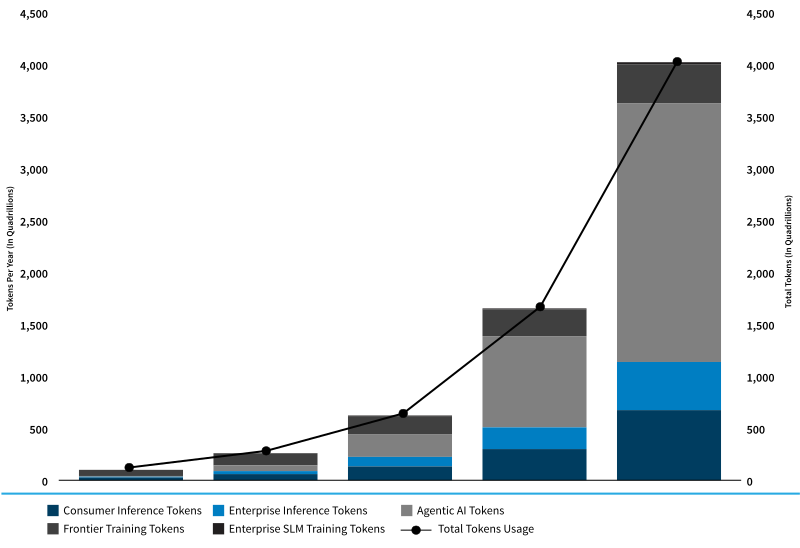
Together, these forces are expected to drive a dramatic expansion in token usage over the next several years, as shown below.
Estimated Annual Token Usage Between 2026 and 2030
Sources: Evercore ISI Research and William Blair, as of 5/19/2026. E refers to estimated.
Supply: Constrained, But Entering Price Discovery
The supply side of the token equation is notably less elastic than the demand side. AI compute power runs through a narrow set of chokepoints.
The first is Taiwan Semiconductor’s (TSMC’s) wafer output. Wafers are the thin, circular slices of silicon that serve as the starting material for chips, and TSMC's advanced node capacity takes years to bring online and cannot be rapidly expanded in response to demand spikes.
Next are the chip architectures of Nvidia, AMD, Broadcom, and others. Software improvements and optimizations have yielded better token throughput for each chip architecture generation, but step change improvements in performance typically only arrive with new generations of chips. So, the chip ecosystem is now attempting to deliver new generations of chips on a roughly annual cadence, but as the complexity of the chip and the system in which the chip sits rise, it’s becoming increasingly challenging to remain on roadmap timelines.
The last chokepoint is data center build cycles where demand from hyperscalers, sovereign AI programs, and enterprises continues to outpace component availability.
This supply inelasticity has an important consequence: for the first time, the market may be entering a phase of price discovery for tokens. For most of the past two years, the prevailing dynamic was price competition and token subsidization, with inference costs declining sharply as providers competed for market share.
That dynamic is beginning to shift. Anthropic's recent move toward consumption-based pricing (such as layering pay-per-token models on top of flat subscription tiers) is an early and meaningful signal.
As demand for tokens runs structurally ahead of the supply of tokens, providers will find it both necessary and commercially rational to price them toward market-clearing levels. The era of subsidized tokens may be ending, and the clearing price will likely be the mechanism through which returns on compute investment are ultimately measured.
The era of subsidized tokens is ending.
The Rideshare Analogy: From Land Grab to Unit Economics
The pattern within AI infrastructure has a recent and instructive precedent: the rideshare industry.
In the early years of rideshare, Uber and Lyft were able to heavily subsidize rides, as the companies were backed by venture capital and growth-at-all-costs mandates. Fares were set below cost, and drivers earned incentive payments that the underlying economics did not support.
The goal was scale, and it proved successful. But once rideshare reached critical mass, the subsidies unwound. Prices rose and driver incentives rationalized. The business model, long derided as permanently uneconomic, began generating real cash flow. Uber turned its first full-year GAAP profit in 2023.
Today, cloud providers are running a strikingly similar playbook. Inference, or the phase where an AI model is used to generate outputs from inputs, is being priced at, near, or below cost to accelerate adoption, demonstrate ROI to enterprise customers, and lock in developer ecosystems. In other words, the hyperscalers are currently subsidizing the AI land grab with their balance sheets. This is not irrational behavior; it is a rational investment in long-term platform positioning.
The questions we think investors need to be asking are how long effective subsidies persist and how turbulent the transition to positive unit economics will be. In this instance, the rideshare analogy offers some important nuance because the transition was not linear. There were false starts, competitive setbacks, and periods of margin pressure before the unit economics became clear.
Conclusion: The Return Question
We believe the return on cloud AI infrastructure spending ultimately depends on whether token prices can rise to levels that justify the capital that has been deployed. It appears to us that the structural conditions for this outcome are increasingly in place, and demand for tokens is growing faster than any reasonable supply expansion can accommodate. The market is also beginning the observable process of price discovery, with consumption-based pricing as early evidence of the shift.
The risks, of course, are real. Model efficiency could improve faster than expected, reducing token intensity per workload. New entrants in chip manufacturing could meaningfully loosen the supply constraint over time as well, while enterprise adoption could prove slower or more uneven than current enthusiasm suggests.
Navigating that nonlinearity is, in our view, a place where disciplined active management earns its place. As investors assessing the long-term economics of hyperscaler capex, instructive questions are whether the market is correctly pricing the duration and magnitude of the demand curve that lies ahead, and whether the price discovery mechanism, now beginning to operate, will be as powerful a value creation engine as the rideshare precedent suggests it can be.
Further, we challenge ourselves to think creatively about the potential duration of growth tied to this unique and powerful cycle.
We challenge ourselves to think creatively about the potential duration of growth tied to this unique and powerful cycle.
Those questions sit at the center of our investment process. We believe outperformance comes from investing in structurally advantaged growth companies whose stocks present attractive risk/reward opportunities, not simply from owning businesses with strong momentum due to their exposure to popular market themes.
In addition, our focus on strong management teams, sustainable business models, and attractive financials helps us to identify potential durable franchises, while the process of weighing our rigorous fundamental forecasts against a disciplined valuation framework helps us determine what we should ultimately pay for them.
In a cycle of this magnitude, that discipline is where we believe durable alpha can be found.
Christopher Sweeney, CFA, is a research analyst for William Blair's U.S. growth and core equity team.
Want the latest insights on the economy and other forces shaping the investment landscape?
Subscribe to our Investing Insights newsletter.
Any investment or strategy mentioned herein may not be appropriate for every investor. There can be no assurance that investment objectives will be met. Products and services listed are available only to residents of this jurisdiction and may only be available to certain categories of investors. The information on this website does not constitute an offer for products or services, or a solicitation of an offer to any persons outside of this jurisdiction who are prohibited from receiving such information under applicable laws and regulations. Nothing on this webpage should be construed as advice and is therefore not a recommendation to buy or sell shares.
Please carefully consider the William Blair Funds’ investment objectives, risks, charges, and expenses before investing. This and other information is contained in the Funds’ prospectus and summary prospectus, which you may obtain by calling 1-800-742-7272. Read the prospectus and summary prospectus carefully before investing. Investing includes the risk of loss.
The William Blair Funds are distributed by William Blair & Company, L.L.C., member FINRA/SIPC.
The William Blair SICAV is a Luxembourg investment company with variable capital registered with the Commission de Surveillance du Secteur Financier (“CSSF”) which qualifies as an undertaking for collective investment in transferable securities (“UCITS”). The Management Company of the SICAV has appointed William Blair Investment Management, LLC as the investment manager for the fund.
Please carefully consider the investment objectives, risks, charges, and expenses of the William Blair SICAV. This and other important information is contained in the prospectus and Key Investor Information Document (KIID). Read these documents carefully before investing. The information contained on this website is not a substitute for those documents or for professional external advice.
Information and opinions expressed are those of the authors and may not reflect the opinions of other investment teams within William Blair Investment Management, LLC, or affiliates. Factual information has been taken from sources we believe to be reliable, but its accuracy, completeness or interpretation cannot be guaranteed. Information is current as of the date appearing in this material only and subject to change without notice. Statements concerning financial market trends are based on current market conditions, which will fluctuate. This material may include estimates, outlooks, projections, and other forward-looking statements. Due to a variety of factors, actual events may differ significantly from those presented.
Investing involves risks, including the possible loss of principal. Equity securities may decline in value due to both real and perceived general market, economic, and industry conditions. The securities of smaller companies may be more volatile and less liquid than securities of larger companies. Investing in foreign denominated and/or domiciled securities may involve heightened risk due to currency fluctuations, and economic and political risks. These risks may be enhanced in emerging markets and frontier markets. Investing in the bond market is subject to certain risks including market, interest rate, issuer, credit, and inflation risk. High-yield, lower-rated, securities involve greater risk than higher-rated securities. Different investment styles may shift in and out of favor depending on market conditions. Diversification does not ensure against loss.
Past performance is not indicative of future returns. References to specific companies are for illustrative purposes only and should not be construed as investment advice or a recommendation to buy or sell any security.
William Blair Investment Management, LLC is an investment adviser registered with the U.S. Securities and Exchange Commission.
Issued in the United Kingdom by William Blair International, Ltd., authorized and regulated by the Financial Conduct Authority (FCA), and is only directed at and is only made available to persons falling within articles 19, 38, 47, and 49 of the Financial Services and Markets Act of 2000 (Financial Promotion) Order 2005 (all such persons being referred to as "relevant persons").
Issued in the European Economic Area (EEA) by William Blair B.V., authorized and supervised by the Dutch Authority for the Financial Markets (AFM) under license number 14006134 and also supervised by the Dutch Central Bank (DNB), registered at the Dutch Chamber of Commerce under number 82375682 and has its statutory seat in Amsterdam, the Netherlands. This material is only intended for eligible counterparties and professional clients.
Issued in Switzerland by William Blair Investment Services (Zurich) GmbH, Talstrasse 65, 8001 Zurich, Switzerland ("WBIS"). WBIS is engaged in the offering of collective investment schemes and renders further, non-regulated services in the financial sector. WBIS is affiliated with FINOS Finanzomubdsstelle Schweiz, a recognized ombudsman office where clients may initiate mediation proceedings pursuant to articles 74 et seq. of the Swiss Financial Services Act ("FinSA"). The client advisers of WBIS are registered with regservices.ch by BX Swiss AG, a client adviser registration body authorized by the Swiss Financial Market Supervisory Authority ("FINMA"). WBIS is not supervised by FINMA or any other supervisory authority or self-regulatory organization. This material is only intended for institutional and professional clients pursuant to article 4(3) to (5) FinSA.
Issued in Australia by William Blair Investment Management, LLC (“William Blair”), which is exempt from the requirement to hold an Australian financial services license under Australia's Corporations Act 2001 (Cth). William Blair is registered as an investment advisor with the U.S. Securities and Exchange Commission (“SEC”) and regulated by the SEC under the U.S. Investment Advisers Act of 1940, which differs from Australian laws. This material is intended only for wholesale clients.
Issued in Singapore by William Blair International (Singapore) Pte. Ltd. (Registration Number 201943312R), which is regulated by the Monetary Authority of Singapore under a Capital Markets Services License to conduct fund management activities. This material is intended only for institutional investors and may not be distributed to retail investors.
Issued in Canada by William Blair Investment Management, LLC, which relies on the international adviser exemption, pursuant to section 8.26 of National Instrument 31-103 in Canada.
The content contained in this site is intended as informational or educational in nature and does not constitute investment advice or a recommendation of any investment strategy or product for a particular investor. Investment advice and recommendations can be provided only after careful consideration of an investor’s objectives, guidelines, and restrictions. Investors should consult a financial professional/financial consultant or investment adviser before making any investment decisions. Investing includes the risk of loss.