We believe AI is more likely to enhance healthcare than disrupt it.
While much of the attention on AI in healthcare focuses on drug discovery, its most immediate impact has been improving efficiency across the healthcare system.
AI applications in healthcare have emerged across four key areas: prediction, diagnosis, treatment, and system efficiency.
ne of the most common questions among healthcare investors is how AI will impact current business models, from drug discovery and diagnostics to manufacturing. But there is another broader concern: AI has already disrupted many industries; will healthcare face the same threat?
The answer, as is often the case, is nuanced. Healthcare is not a single industry but a collection of disparate sub-industries, each with its own set of growth drivers and opportunities. AI has the potential to greatly improve workflows and efficiency across the healthcare ecosystem; however, I believe AI, rather than replacing entire subindustries, is more likely to serve as a powerful tool that can spur innovation, productivity, and long-term growth.
Why Healthcare May Adopt AI Differently
What makes the healthcare industry unique is the paramount need for safety and the overarching complexity of the regulatory environment.
Historically, technology companies have avoided heavily regulated industries such as healthcare. Instead, they produced highly effective tools—such as e-commerce, compute power, and in-silico simulations, which are computer-based experiments that virtually model medical processes—then partnered with healthcare companies well versed in the regulatory requirements necessary to succeed.
Therefore, I believe the most near-term logical path for AI in healthcare is the ability of healthcare companies to use AI through partnerships and acquisitions.
In addition, it is the more mundane aspects of healthcare (administrative tasks, revenue cycle management, billing, coding, and patient recruitment) where AI has made the most significant impact so far, despite more attention on using AI to discover new drug targets. Right now, AI is a more effective cost savings tool rather than a revenue generation tool, though I expect this to evolve over time.
Four Key Applications of AI in Healthcare
Today, the most successful and advanced use of AI in healthcare can be put into four buckets: predicting disease, detecting and identifying disease, treating disease, and improving system efficiency. And it is in these four buckets where we believe AI will have the most significant near-term impact.
Predicting Disease
The predicting disease bucket focuses on consumer technology. That includes current wearables (such as the Apple Watch and Fitbit) and emerging devices such as Meta and EssilorLuxottica’s smart glasses, which can detect potential biomarker changes before disease onset.
While this segment is less regulated and primarily consumer oriented, and some technologies are still in development, it represents the direction of AI in early disease prediction. These technologies can also directly benefit patients by increasing awareness of healthy habits and potentially changing patient behavior.
It is in these four buckets where we believe AI will have the most significant near-term impact.
Detecting and Identifying Disease
AI has been widely used to help enhance diagnosis, particularly in radiology and cardiology, by leveraging pattern recognition in millions of medical images to detect abnormalities such as lung nodules, strokes, and fractures. There are two main approaches: hardware integration (“AI inside the scanner”) and software integration (“AI inside the workflow”).
The hardware integration approach is used by imaging equipment manufacturers, for instance, which are embedding AI in devices to produce faster, clearer scans and simplified operations. This allows scanners to automatically optimize image quality, reduce noise, and, in some cases, significantly shorten scan times. AI can also automate routine tasks such as positioning, image reconstruction, and preliminary measurements, making machines easier to use and reducing reliance on highly specialized technicians.
Meanwhile, the software integration approach is used by imaging software providers to help facilitate the transition from on-premises to cloud-based imaging, enabling the instant streaming of large imaging files and seamless AI solution integration within radiologists’ workflows. Hospitals also prefer embedded AI in existing platforms to avoid managing multiple vendors.
Treating Disease
AI is also being applied in surgical procedures, cancer treatments, and real-time clinical decisions, which are characterized by some of the highest regulatory scrutiny and barriers to entry in the healthcare industry. In these environments, AI is not replacing physicians, but rather enhancing precision, improving planning, and enabling more consistent outcomes.
Several industry leaders are already embedding AI into their procedural ecosystems. For example, Intuitive Surgical’s da Vinci robotic system uses AI for post-operative analysis and is progressing toward real-time surgical guidance with 3D overlays and semi-automated tasks such as suturing.
In addition, RaySearch Laboratories uses AI to help automate complex radiation treatment planning; and some dental companies have been incorporating AI into digital workflows for orthodontics and dental implants.
Improving System Efficiency
AI offers some of the most immediate opportunities in healthcare by helping streamline workflows, reduce waste, and accelerate research. Clinicians currently spend a significant portion of their time—often 25% to 40%—on documentation[1], while U.S. healthcare administrative waste totals an estimated $250 billion to $300 billion annually[2]. Clinical trials also remain lengthy and costly despite $300 billion in annual pharma research and development (R&D) spending[3].
Clinicians currently spend a significant portion of their time—often 25% to 40%—on documentation.
And across these areas, AI is helping improve efficiency in tangible ways. In clinical trials, AI supports contract research organizations (CROs) and software firms in faster patient recruitment, site performance prediction, and automated data cleaning. In hospitals and health systems, AI can improve revenue cycle management by automating billing, coding, and claims processing. Meanwhile, in laboratories, life sciences tools companies are embedding AI into instruments to deliver faster, cleaner, and more reproducible results.
We believe improving efficiency and saving on administrative costs is the gateway for AI adoption in the healthcare industry. However, it will still require hospitals, health systems, and CROs to adopt it given the high regulatory burden of the healthcare industry. Therefore, we believe AI remains a productivity-enhancing, not industry-replacing, tool.
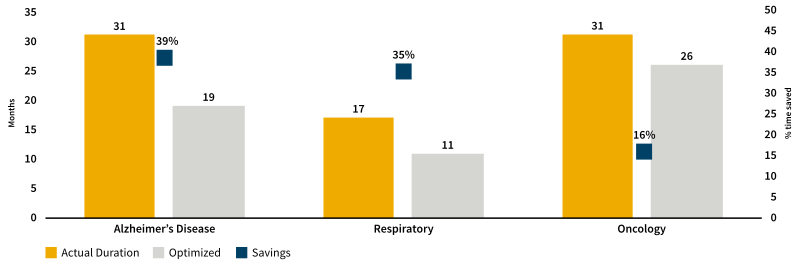
Trial Duration Reduction With AI-Driven Site Selections
Sources: McKinsey & Company, Bernstein analysis, and William Blair, as of March 2026. Data from McKinsey client case studies.
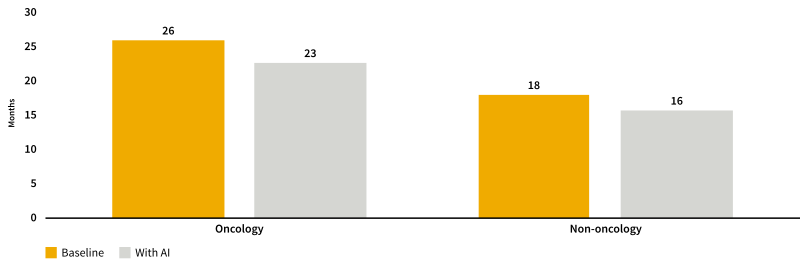
AI Can Help Reduce Phase 3 Recruitment Duration
Phase 3 recruitment time with AI
Sources: Clinicaltrials.gov, McKinsey & Company, Bernstein estimates and analysis, and William Blair, as of March 2026. Estimates assuming a 12.5% reduction in time. Trial duration data as of 2021.
Opportunity, Not Displacement
We believe the excitement around AI in drug discovery is warranted, but there remains a significant barrier: AI is only as good as the underlying models that support it.
And to that end, humans today only understand about 10% to 15% of human biology. The human body is incredibly complex, with molecular-level interactions appearing seemingly random given the genetic and environmental factors that are unique to each human’s experience and DNA. Thus, until humans better understand biology, AI’s role in drug discovery and development will likely be limited.
That said, biopharma companies have been investing in AI capabilities for years, and early signs of meaningful productivity gains are beginning to emerge. One example is the development of “lab-in-the-loop” systems, where in-silico models inform wet lab experiments, and those results continuously refine the models. This feedback loop has the potential to accelerate discovery, enabling researchers to generate more targets in less time.
While still evolving, these advances could ultimately shorten development timelines and reduce costs, allowing biopharma companies to expand margins and reinvest in R&D. Large pharmaceutical companies could be particularly well positioned, given their scale, proprietary datasets, and deep scientific expertise.
AI is only as good as the underlying models that support it.
At the same time, bringing a drug to market without completing human trials will be challenging for both regulators and companies because of safety risk. As a result, I believe there are still significant barriers to entry for AI to wholly replace pharmaceutical companies.
Until then, I believe AI will continue to have a profound impact on the efficiency of the healthcare system, on faster diagnoses, and on better prediction and treatment of disease.
Thus, on the global equity team, we have positioned our portfolio to leverage those healthcare companies that have the potential to rapidly adopt AI into their workflow and R&D process and create tangible benefits for their patients and their bottom line.
Matt Sykes is a research analyst on William Blair's global equity team.
Justin Lin, CFA, is a research analyst on William Blair's global equity team.
[1]Source: The National Institutes of Health. [2]Source: McKinsey. [3]Source: DeciBio.
Subscribe Now
Want the latest insights on the economy and other forces shaping the investment landscape?
Subscribe to our Investing Insights newsletter.
Any investment or strategy mentioned herein may not be appropriate for every investor. There can be no assurance that investment objectives will be met. Products and services listed are available only to residents of this jurisdiction and may only be available to certain categories of investors. The information on this website does not constitute an offer for products or services, or a solicitation of an offer to any persons outside of this jurisdiction who are prohibited from receiving such information under applicable laws and regulations. Nothing on this webpage should be construed as advice and is therefore not a recommendation to buy or sell shares.
Please carefully consider the William Blair Funds’ investment objectives, risks, charges, and expenses before investing. This and other information is contained in the Funds’ prospectus and summary prospectus, which you may obtain by calling 1-800-742-7272. Read the prospectus and summary prospectus carefully before investing. Investing includes the risk of loss.
The William Blair Funds are distributed by William Blair & Company, L.L.C., member FINRA/SIPC.
The William Blair SICAV is a Luxembourg investment company with variable capital registered with the Commission de Surveillance du Secteur Financier (“CSSF”) which qualifies as an undertaking for collective investment in transferable securities (“UCITS”). The Management Company of the SICAV has appointed William Blair Investment Management, LLC as the investment manager for the fund.
Please carefully consider the investment objectives, risks, charges, and expenses of the William Blair SICAV. This and other important information is contained in the prospectus and Key Investor Information Document (KIID). Read these documents carefully before investing. The information contained on this website is not a substitute for those documents or for professional external advice.
Information and opinions expressed are those of the authors and may not reflect the opinions of other investment teams within William Blair Investment Management, LLC, or affiliates. Factual information has been taken from sources we believe to be reliable, but its accuracy, completeness or interpretation cannot be guaranteed. Information is current as of the date appearing in this material only and subject to change without notice. Statements concerning financial market trends are based on current market conditions, which will fluctuate. This material may include estimates, outlooks, projections, and other forward-looking statements. Due to a variety of factors, actual events may differ significantly from those presented.
Investing involves risks, including the possible loss of principal. Equity securities may decline in value due to both real and perceived general market, economic, and industry conditions. The securities of smaller companies may be more volatile and less liquid than securities of larger companies. Investing in foreign denominated and/or domiciled securities may involve heightened risk due to currency fluctuations, and economic and political risks. These risks may be enhanced in emerging markets and frontier markets. Investing in the bond market is subject to certain risks including market, interest rate, issuer, credit, and inflation risk. High-yield, lower-rated, securities involve greater risk than higher-rated securities. Different investment styles may shift in and out of favor depending on market conditions. Diversification does not ensure against loss.
Past performance is not indicative of future returns. References to specific companies are for illustrative purposes only and should not be construed as investment advice or a recommendation to buy or sell any security.
William Blair Investment Management, LLC is an investment adviser registered with the U.S. Securities and Exchange Commission.
Issued in the United Kingdom by William Blair International, Ltd., authorized and regulated by the Financial Conduct Authority (FCA), and is only directed at and is only made available to persons falling within articles 19, 38, 47, and 49 of the Financial Services and Markets Act of 2000 (Financial Promotion) Order 2005 (all such persons being referred to as "relevant persons").
Issued in the European Economic Area (EEA) by William Blair B.V., authorized and supervised by the Dutch Authority for the Financial Markets (AFM) under license number 14006134 and also supervised by the Dutch Central Bank (DNB), registered at the Dutch Chamber of Commerce under number 82375682 and has its statutory seat in Amsterdam, the Netherlands. This material is only intended for eligible counterparties and professional clients.
Issued in Switzerland by William Blair Investment Services (Zurich) GmbH, Talstrasse 65, 8001 Zurich, Switzerland ("WBIS"). WBIS is engaged in the offering of collective investment schemes and renders further, non-regulated services in the financial sector. WBIS is affiliated with FINOS Finanzomubdsstelle Schweiz, a recognized ombudsman office where clients may initiate mediation proceedings pursuant to articles 74 et seq. of the Swiss Financial Services Act ("FinSA"). The client advisers of WBIS are registered with regservices.ch by BX Swiss AG, a client adviser registration body authorized by the Swiss Financial Market Supervisory Authority ("FINMA"). WBIS is not supervised by FINMA or any other supervisory authority or self-regulatory organization. This material is only intended for institutional and professional clients pursuant to article 4(3) to (5) FinSA.
Issued in Australia by William Blair Investment Management, LLC (“William Blair”), which is exempt from the requirement to hold an Australian financial services license under Australia's Corporations Act 2001 (Cth). William Blair is registered as an investment advisor with the U.S. Securities and Exchange Commission (“SEC”) and regulated by the SEC under the U.S. Investment Advisers Act of 1940, which differs from Australian laws. This material is intended only for wholesale clients.
Issued in Singapore by William Blair International (Singapore) Pte. Ltd. (Registration Number 201943312R), which is regulated by the Monetary Authority of Singapore under a Capital Markets Services License to conduct fund management activities. This material is intended only for institutional investors and may not be distributed to retail investors.
Issued in Canada by William Blair Investment Management, LLC, which relies on the international adviser exemption, pursuant to section 8.26 of National Instrument 31-103 in Canada.
The content contained in this site is intended as informational or educational in nature and does not constitute investment advice or a recommendation of any investment strategy or product for a particular investor. Investment advice and recommendations can be provided only after careful consideration of an investor’s objectives, guidelines, and restrictions. Investors should consult a financial professional/financial consultant or investment adviser before making any investment decisions. Investing includes the risk of loss.