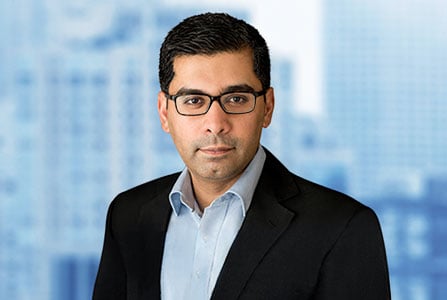
We believe global markets present a landscape of opportunity for equity investors despite macroeconomic headwinds. In this piece, we asked Chandan Khanna, a portfolio manager on William Blair’s Global Leaders and International Leaders strategies, to explain how he seeks to take advantage of such opportunities. In a multifaceted discussion, Chandan delves into his philosophy and process, discusses where he sees opportunities, and explains what drew him to William Blair.
How would you describe your investment philosophy?
Very simply, it’s a blend of quality and growth. Both need to be present. Growth on its own isn’t enough, because that’s where you can run into real downside risk. And quality without growth can lead you to overpay for stability that isn’t actually compounding. So, the philosophy is really about finding that balance—businesses that have the quality characteristics you want and the growth to justify the valuation. Focusing on quality allows you to be extremely patient, and that patience is central to how I invest.
My no and know philosophy is simple. No means declining a lot of things. Then, because you say no to so many things, what you do own, you can know very well.
You’ve said you have a no and know philosophy. What does that mean?
My no and know philosophy is simple. No means declining a lot of things. Then, because you say no to so many things, what you do own, you can know very well. I manage fairly concentrated portfolios, which gives me the ability to go deeper on the positions I hold. I believe that if you want to compound returns at an attractive rate, you have to concentrate. And if you concentrate, you need conviction.
What is your investment approach?
At its core, I believe equity is a unique asset class. I perceive it as the downside is limited to your invested capital, but the upside is theoretically unlimited. To capture that asymmetry, many investors focus so much on avoiding mistakes that they miss the big winners. But over time, the big winners can drive long-term returns as that growth offsets the inevitable losses elsewhere in your portfolio.
Our focus is on identifying those outsized winners, while we believe the quality discipline helps us avoid permanent capital impairment. To do that, I’ve historically leveraged a “5/10/15” approach, which means I look for companies that have the potential to deliver 5% organic sales growth, 10% earnings per share (EPS) growth and net margin, and 15% return on equity (ROE), margin of safety, and earnings before interest and taxes (EBIT) margin. It’s a way for me to put guardrails around words such as quality and growth, which can mean different things to different people. It provides that by capturing the specific attributes I look for in every investment—a blend of growth characteristics, quality characteristics, and valuation discipline.
There’s a strong level of overlap between my “5/10/15” approach and William Blair’s existing Leaders’ framework, which reinforces why joining William Blair was such a natural fit for me.
Did any great investors influence you?
Early on—before I was investing professionally but while I was investing personally—I read a great deal about Peter Lynch. I was lucky enough to meet him during a Fidelity interview when I was still in business school. He was no longer managing money day to day, but he was still involved with the investment committee, and his thinking definitely left an impression on me.
That said, at my prior firm I had a ringside seat to a number of exceptional investors, some with track records that rivaled or even exceeded his. So, the influence wasn’t just one person. It was a process of observing what worked for different investors, then refining and distilling which aspects of their success best resonated with me.
Ultimately, you can’t simply copy someone else. If the philosophy doesn’t fit your temperament, it breaks down at the wrong moments. The key is aligning your temperament with your investment philosophy and building from there.
Along those lines, did any investing books really influence you?
In addition to most of Peter Lynch’s books, there’s another piece that stuck with me—not a full book, but an essay often referred to as “Coffee Can Portfolio,” written by Bob Kirby, a former Capital Group portfolio manager. The central idea is that you can make more money being passively active than actively passive. He wrote that in the early 1980s, well before passive investing became dominant, but the point still holds: let your winners run and compound rather than constantly trading around them.
Tell me an investment story that has stayed with you over the years.
I had a real baptism by fire. I joined Capital Group in April 2008. I remember that first week of September, I had just started running my portfolio. Then, within my first month, Lehman Brothers happened, and the global financial crisis (GFC) decimated my portfolio. I was fortunate to be at a firm where we were encouraged to take risk at the right time, and I was able to add to positions I already owned and held them through the downturn and saw the positive impacts as things bounced back.
What did that teach you?
That volatility is the price you pay for performance. I believe very few people in this business—clients included—can truly stomach volatility. But as investor Shelby Davis said, “You make most of your money in a bear market, you just don’t realize it at the time. If you can stomach volatility, you can create an arbitrage, especially in a market like today that’s dominated by passive investing. Passive, by definition, is momentum-driven, which means it sells during periods of panic. As active managers, that’s something we can take advantage of.
Water your flowers and cut your weeds.
Any other investment lessons?
The other lesson that’s stayed with me comes from a study we did at Capital: water your flowers and cut your weeds. You only get a few investment ideas truly right over a lifetime—and you only need a few. When you find them, you have to be willing to stay with them. Those are the two that have really stuck with me.
Can you elaborate on the characteristics of stocks you like to invest in?
I tend to look for companies where I see a lot of upside optionality—strong right-tail potential—while trying to minimize left-tail risk. In other words, businesses that can scale over time in ways that may not be fully appreciated today. To be an anchor investor, you have to be an optimist and be willing to underwrite a future that’s inherently uncertain, often seeing possibilities the market doesn’t yet recognize.
You rarely have every answer upfront, but you can identify where meaningful option value exists and where it doesn’t. I’m drawn to companies that I believe have that embedded optionality—where the upside can compound in ways that outweigh the downside if you’re patient and disciplined.
How are you thinking about growth today?
Growth shifts over time. Identifying that shift and where it is moving to is part of the job—and part of the skill. Early in my career managing capital, consumer staples used to be a key area of global growth. I owned a high level of consumer staples up through 2015 and 2016, when those stocks became very expensive relative to their growth.
Around 2012 and 2013, growth increasingly converged in technology, and we were early to move our portfolio allocation there. Within technology, starting around 2018, growth leadership moved in fits and starts—from software to semiconductors. Today, the divergence between semis and software, even within tech, is as wide as it has ever been. In 2022, in regard to a graphics processing unit semiconductor position, I was asked, “Why do you own that? It’s not a quality growth business.” Today, the question is almost the opposite: “Why don’t you own more Nvidia?”
In healthcare, we’re moving toward more personalized approaches to treatment and prevention.
What do you see as the most exciting opportunities over the next several years, either from a country, sector, or theme perspective?
A growing growth theme is the personalization of everything—medicine, content, education, and beyond. As the cost of tailoring products and services to the individual continues to fall, the opportunity set expands.
In healthcare especially, it appears we are moving toward more personalized approaches to treatment and prevention. People respond differently to the same inputs, and advances in data, diagnostics, and technology should allow for much more targeted care.
That has meaningful implications for both outcomes and economics. Over time, the cost and time required to develop and deliver new therapies should come down, which is positive for society and creates a wide range of investment opportunities. More broadly, as personalization becomes more scalable across industries, it can open the door for companies with strong optionality and right-tail potential.
Are there any areas you tend to avoid?
In general, I’m less drawn to industries where the economics can change with the stroke of a pen; where regulation or a single external decision can materially alter outcomes. I also tend to avoid areas where one input largely determines the output.
How do U.S. and other developed market policies affect non-U.S. equities?
Policy decisions in the United States and other developed markets clearly affect non-U.S. equities, but the key point is that today’s environment isn’t necessarily a permanent one. Five years ago, few people would have anticipated the degree of tariffs or policy shifts we’ve seen more recently, and there will be developments over the next five years that are just as hard to predict now. So, it’s unlikely to be a smooth or linear path.
We are seeing some degree of decoupling driven by policy choices, particularly in trade and technology. That can create friction and volatility for non-U.S. markets. But policy direction can shift with administrations, and over the long term the global economy remains deeply interconnected. Even in areas such as artificial intelligence—where there’s clear competition—eventual monetization and scaling tend to require global linkages.
So, policy moves in developed markets can shape the operating environment and create periods of disruption, but they don’t fully sever the ties between markets. Over time, that underlying interconnectedness continues to matter for non-U.S. equities.
In volatile periods, the key is separating narrative from reality.
How do you tend to act when a stock is up or down meaningfully in a volatile period?
In volatile periods, I try to deconstruct what the market is saying versus what’s actually happening. A lot of the time the move is driven by the narrative—the price or P part of the P/E multiple—rather than by fundamentals, the E, or earnings. With good, high-quality companies, earnings don’t usually change that quickly. They may miss a quarter, but they’re often still compounding at attractive rates. What shifts faster is sentiment and the market’s view of the long-term story.
We’ve seen that repeatedly. In 2022-2023, Meta was viewed as a legacy media business—almost a “Yahoo 2.0” narrative—and then it became an AI leader. Alphabet was seen as an AI laggard not long ago and then quickly re-rated. The market’s perception can change much faster than underlying fundamentals.
In those moments, the key is separating narrative from reality. Sometimes that leads you to act, but often the right response is to do nothing: to hold your position if the core investment thesis and fundamentals remain intact.
How does valuation play a role in portfolio construction?
Valuation is very central to the “5/10/15” framework. We look for roughly a 15% margin of safety to intrinsic value when we invest. That said, it’s the last thing we assess. The starting point is always the business model—whether it’s a company we want to own. Then we do the work on the financial model and valuation. To determine if now is the time to buy that attractive business. There are plenty of businesses we admire but won’t own because the valuation isn’t right. In those cases, we’re willing to be patient, sometimes for years, and wait for the market to offer an opportunity. When it does, we look to move.
In other words, valuation is central to buy and sell decisions, but it isn’t central to determining whether a company is worth owning over the long term.
What are some key lessons you’ve learned over your career?
One of the biggest lessons has been the importance of management. In many international markets, management quality often matters more than the macro backdrop. As you move further down the market-cap spectrum or into higher-risk geographies, the difference between significant value creation and a poor outcome is frequently management teams’ ability to execute. Their capacity to navigate geopolitics, currency moves, and regulatory change becomes critical. Strong management teams can steer through those challenges and compound value over time, while weaker ones tend to struggle.
Want to hear more from Chandan? This article is excerpted from our interview. Read more here.
Chandan Khanna is a portfolio manager on William Blair's global equity team.
Subscribe Now
Want the latest insights on the economy and other forces shaping the investment landscape?
Subscribe to our Investing Insights newsletter.
Any investment or strategy mentioned herein may not be appropriate for every investor. There can be no assurance that investment objectives will be met. Products and services listed are available only to residents of this jurisdiction and may only be available to certain categories of investors. The information on this website does not constitute an offer for products or services, or a solicitation of an offer to any persons outside of this jurisdiction who are prohibited from receiving such information under applicable laws and regulations. Nothing on this webpage should be construed as advice and is therefore not a recommendation to buy or sell shares.
Please carefully consider the William Blair Funds’ investment objectives, risks, charges, and expenses before investing. This and other information is contained in the Funds’ prospectus and summary prospectus, which you may obtain by calling 1-800-742-7272. Read the prospectus and summary prospectus carefully before investing. Investing includes the risk of loss.
The William Blair Funds are distributed by William Blair & Company, L.L.C., member FINRA/SIPC.
The William Blair SICAV is a Luxembourg investment company with variable capital registered with the Commission de Surveillance du Secteur Financier (“CSSF”) which qualifies as an undertaking for collective investment in transferable securities (“UCITS”). The Management Company of the SICAV has appointed William Blair Investment Management, LLC as the investment manager for the fund.
Please carefully consider the investment objectives, risks, charges, and expenses of the William Blair SICAV. This and other important information is contained in the prospectus and Key Investor Information Document (KIID). Read these documents carefully before investing. The information contained on this website is not a substitute for those documents or for professional external advice.
Information and opinions expressed are those of the authors and may not reflect the opinions of other investment teams within William Blair Investment Management, LLC, or affiliates. Factual information has been taken from sources we believe to be reliable, but its accuracy, completeness or interpretation cannot be guaranteed. Information is current as of the date appearing in this material only and subject to change without notice. Statements concerning financial market trends are based on current market conditions, which will fluctuate. This material may include estimates, outlooks, projections, and other forward-looking statements. Due to a variety of factors, actual events may differ significantly from those presented.
Investing involves risks, including the possible loss of principal. Equity securities may decline in value due to both real and perceived general market, economic, and industry conditions. The securities of smaller companies may be more volatile and less liquid than securities of larger companies. Investing in foreign denominated and/or domiciled securities may involve heightened risk due to currency fluctuations, and economic and political risks. These risks may be enhanced in emerging markets and frontier markets. Investing in the bond market is subject to certain risks including market, interest rate, issuer, credit, and inflation risk. High-yield, lower-rated, securities involve greater risk than higher-rated securities. Different investment styles may shift in and out of favor depending on market conditions. Diversification does not ensure against loss.
Past performance is not indicative of future returns. References to specific companies are for illustrative purposes only and should not be construed as investment advice or a recommendation to buy or sell any security.
William Blair Investment Management, LLC is an investment adviser registered with the U.S. Securities and Exchange Commission.
Issued in the United Kingdom by William Blair International, Ltd., authorized and regulated by the Financial Conduct Authority (FCA), and is only directed at and is only made available to persons falling within articles 19, 38, 47, and 49 of the Financial Services and Markets Act of 2000 (Financial Promotion) Order 2005 (all such persons being referred to as "relevant persons").
Issued in the European Economic Area (EEA) by William Blair B.V., authorized and supervised by the Dutch Authority for the Financial Markets (AFM) under license number 14006134 and also supervised by the Dutch Central Bank (DNB), registered at the Dutch Chamber of Commerce under number 82375682 and has its statutory seat in Amsterdam, the Netherlands. This material is only intended for eligible counterparties and professional clients.
Issued in Switzerland by William Blair Investment Services (Zurich) GmbH, Talstrasse 65, 8001 Zurich, Switzerland ("WBIS"). WBIS is engaged in the offering of collective investment schemes and renders further, non-regulated services in the financial sector. WBIS is affiliated with FINOS Finanzomubdsstelle Schweiz, a recognized ombudsman office where clients may initiate mediation proceedings pursuant to articles 74 et seq. of the Swiss Financial Services Act ("FinSA"). The client advisers of WBIS are registered with regservices.ch by BX Swiss AG, a client adviser registration body authorized by the Swiss Financial Market Supervisory Authority ("FINMA"). WBIS is not supervised by FINMA or any other supervisory authority or self-regulatory organization. This material is only intended for institutional and professional clients pursuant to article 4(3) to (5) FinSA.
Issued in Australia by William Blair Investment Management, LLC (“William Blair”), which is exempt from the requirement to hold an Australian financial services license under Australia's Corporations Act 2001 (Cth). William Blair is registered as an investment advisor with the U.S. Securities and Exchange Commission (“SEC”) and regulated by the SEC under the U.S. Investment Advisers Act of 1940, which differs from Australian laws. This material is intended only for wholesale clients.
Issued in Singapore by William Blair International (Singapore) Pte. Ltd. (Registration Number 201943312R), which is regulated by the Monetary Authority of Singapore under a Capital Markets Services License to conduct fund management activities. This material is intended only for institutional investors and may not be distributed to retail investors.
Issued in Canada by William Blair Investment Management, LLC, which relies on the international adviser exemption, pursuant to section 8.26 of National Instrument 31-103 in Canada.
The content contained in this site is intended as informational or educational in nature and does not constitute investment advice or a recommendation of any investment strategy or product for a particular investor. Investment advice and recommendations can be provided only after careful consideration of an investor’s objectives, guidelines, and restrictions. Investors should consult a financial professional/financial consultant or investment adviser before making any investment decisions. Investing includes the risk of loss.