September 15, 2026 | Emerging Markets Debt
El Niño: Winners, Losers, and Investment Implications

Senior Corporate Credit and Sustainability Analyst
September 15, 2026 | Emerging Markets Debt
Senior Corporate Credit and Sustainability Analyst
View Fund:
https://im.williamblair.com/investments/sicav-funds/lu2093691256-emerging-markets-debt-hard-currency-fund
View Fund:
https://im.williamblair.com/investments/sicav-funds/lu2093699408-emerging-markets-debt-local-currency-fund
View Fund:
https://im.williamblair.com/investments/sicav-funds/lu2879845290-emerging-markets-frontier-debt-fund
View Strategy:
https://im.williamblair.com/investments/separate-accounts/emerging-markets-debt-hard-currency
View Strategy:
https://im.williamblair.com/investments/separate-accounts/emerging-markets-debt-local-currency

A strong El Niño, which is expected this year, could have far-reaching implications for emerging markets (EMs). Shifting weather patterns can affect food inflation, hydropower generation, economic growth, and agricultural commodity prices—creating both risks and opportunities across countries and asset classes. But for EM investors, the effects are rarely uniform, which is why we evaluate the short- and long-term dynamics alongside broader macroeconomic and market factors to identify potential opportunities and better understand portfolio risks.
El Niño is a climate phenomenon characterized by unusually warm sea surface temperatures in the central and eastern tropical Pacific Ocean. Part of the broader El Niño–Southern Oscillation (ENSO) cycle, it typically occurs every one to seven years and can disrupt weather patterns around the world, with potentially significant implications for some emerging markets.
The most recent El Niño occurred in 2023-2024, with temperature anomalies peaking between November and January. By comparison, the 2015-2016 event was classified as “very strong,” with sea surface temperature anomalies exceeding 2 degrees Celsius.
Scientists are forecasting another El Niño event this year, with temperature anomalies expected to surpass 2 degrees Celsius—potentially placing it in the “very strong” category. National Oceanic and Atmospheric Administration (NOAA) data showing record-high sea surface temperatures for this time of year add to those expectations. At the same time, the unusually wide range of forecasts points to considerable uncertainty around the event’s eventual strength and impacts.
A strong El Niño is likely to create winners and losers across EMs rather than produce a uniformly negative outcome. Historically, El Niño events have tended to disrupt global weather patterns, bringing drought to regions like Southeast Asia and southern Africa, while triggering increased rainfall in areas such as southern Latin America.
Current forecasts point to below-average rainfall across parts of northern South America—including Colombia, Ecuador, Venezuela, and northern Brazil—as well as Southeast Asia, while wetter conditions are expected in Turkey, North Africa, southern Brazil, Argentina, Uruguay, and the Middle East.
A weaker monsoon associated with El Niño could weigh on crop yields in India.
One potential transmission channel is power generation. Many Andean and sub-Saharan African countries rely heavily on hydropower, leaving them vulnerable to lower rainfall, declining reservoir levels, and reduced hydroelectric output. Past El Niño events have generally had only a modest impact on hydropower generation, but a stronger event could increase those risks.
A second channel is inflation, particularly in countries where food accounts for a large share of consumer spending and agricultural production is sensitive to weather conditions. Pakistan, Sri Lanka, and several sub-Saharan African economies could be especially exposed to higher food prices or weaker agricultural output.
El Niño can also have broader economic and political implications. India, for example, depends heavily on the monsoon season to support agricultural production. A weaker monsoon associated with El Niño could weigh on crop yields, contribute to food-price pressures, and create additional domestic and political challenges.
El Niño could create inflationary pressures in some EMs, particularly through energy and food prices. Weaker hydropower generation could raise electricity costs in parts of the Andes and Africa, while lower agricultural yields across portions of Asia and Africa could put upward pressure on food prices.
Historically, however, El Niño events have produced only modest increases in global inflation. And because these effects tend to be temporary and vary considerably by country, EM central banks may be inclined to look through them rather than respond aggressively.
Agricultural commodity exporters could emerge as some of the biggest beneficiaries.
Currency strength could provide an additional buffer. Several EM currencies have appreciated over the past year, helping offset some of the inflationary effects of higher import and commodity prices. Colombia, South Africa, Brazil, and Mexico are notable examples. This could be particularly important for Colombia and South Africa, where the inflationary effects of the 2026-2027 El Niño are expected to be more pronounced and largely materialize in 2027.
At the same time, agricultural commodity exporters could emerge as some of the biggest beneficiaries. Previous El Niño episodes have been associated with higher prices for commodities, including palm and coconut oil, rubber, cocoa, coffee, and rice. Historically, the largest price effects have tended to appear roughly a year after El Niño conditions begin.
Past El Niño periods have often coincided with higher prices for selected agricultural commodities, although the strongest effects may not emerge until roughly a year after the event begins.
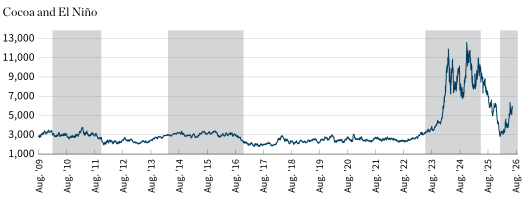
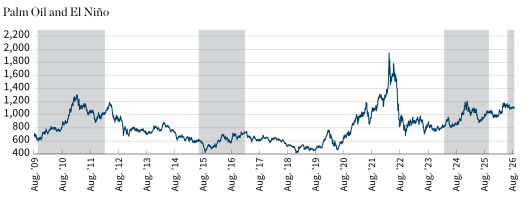
Sources: Bloomberg and William Blair, as of August 2026.
That creates potential opportunities across several EMs:
The table below illustrates the potential investment implications in more detail.
Differences in food inflation, hydropower exposure, growth sensitivity, and agricultural exports could shape the relative risks and opportunities across select countries.
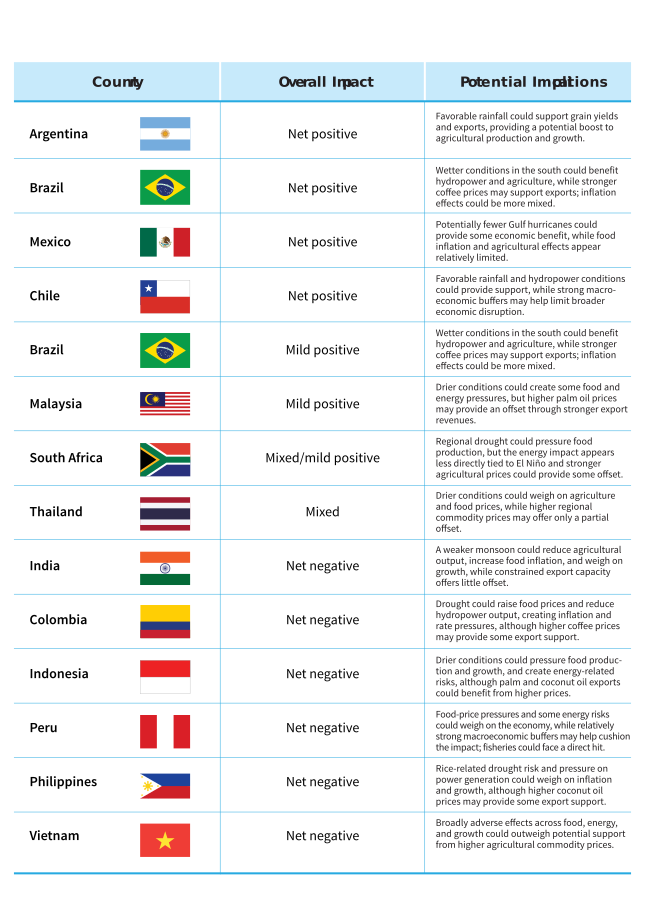
Source: William, Blair, as of August 2026.
The bottom line: El Niño is unlikely to produce a single, uniform outcome across EMs. Its effects will likely vary by country, depending on factors such as exposure to agriculture and hydropower, inflation sensitivity, currency strength, and commodity exports. As the event develops, we believe a country-by-country approach will be critical to assessing where shifting weather patterns could alter economic fundamentals, market pricing, and ultimately investment opportunities.
Alexandra Symeonidi, CFA, is a senior corporate credit and sustainability analyst on William Blair’s emerging markets debt team.
View Strategy:
https://im.williamblair.com/investments/separate-accounts/emerging-markets-frontier-debt
Want the latest insights on the economy and other forces shaping the investment landscape?
Subscribe to our Investing Insights newsletter.
Any investment or strategy mentioned herein may not be appropriate for every investor. There can be no assurance that investment objectives will be met. Products and services listed are available only to residents of this jurisdiction and may only be available to certain categories of investors. The information on this website does not constitute an offer for products or services, or a solicitation of an offer to any persons outside of this jurisdiction who are prohibited from receiving such information under applicable laws and regulations. Nothing on this webpage should be construed as advice and is therefore not a recommendation to buy or sell shares.
Please carefully consider the William Blair Funds’ investment objectives, risks, charges, and expenses before investing. This and other information is contained in the Funds’ prospectus and summary prospectus, which you may obtain by calling 1-800-742-7272. Read the prospectus and summary prospectus carefully before investing. Investing includes the risk of loss.
The William Blair Funds are distributed by William Blair & Company, L.L.C., member FINRA/SIPC.
The William Blair SICAV is a Luxembourg investment company with variable capital registered with the Commission de Surveillance du Secteur Financier (“CSSF”) which qualifies as an undertaking for collective investment in transferable securities (“UCITS”). The Management Company of the SICAV has appointed William Blair Investment Management, LLC as the investment manager for the fund.
Please carefully consider the investment objectives, risks, charges, and expenses of the William Blair SICAV. This and other important information is contained in the prospectus and Key Investor Information Document (KIID). Read these documents carefully before investing. The information contained on this website is not a substitute for those documents or for professional external advice.
Information and opinions expressed are those of the authors and may not reflect the opinions of other investment teams within William Blair Investment Management, LLC, or affiliates. Factual information has been taken from sources we believe to be reliable, but its accuracy, completeness or interpretation cannot be guaranteed. Information is current as of the date appearing in this material only and subject to change without notice. Statements concerning financial market trends are based on current market conditions, which will fluctuate. This material may include estimates, outlooks, projections, and other forward-looking statements. Due to a variety of factors, actual events may differ significantly from those presented.
Investing involves risks, including the possible loss of principal. Equity securities may decline in value due to both real and perceived general market, economic, and industry conditions. The securities of smaller companies may be more volatile and less liquid than securities of larger companies. Investing in foreign denominated and/or domiciled securities may involve heightened risk due to currency fluctuations, and economic and political risks. These risks may be enhanced in emerging markets and frontier markets. Investing in the bond market is subject to certain risks including market, interest rate, issuer, credit, and inflation risk. High-yield, lower-rated, securities involve greater risk than higher-rated securities. Different investment styles may shift in and out of favor depending on market conditions. Diversification does not ensure against loss.
Past performance is not indicative of future returns. References to specific companies are for illustrative purposes only and should not be construed as investment advice or a recommendation to buy or sell any security.
William Blair Investment Management, LLC is an investment adviser registered with the U.S. Securities and Exchange Commission.
Issued in the United Kingdom by William Blair International, Ltd., authorized and regulated by the Financial Conduct Authority (FCA), and is only directed at and is only made available to persons falling within articles 19, 38, 47, and 49 of the Financial Services and Markets Act of 2000 (Financial Promotion) Order 2005 (all such persons being referred to as "relevant persons").
Issued in the European Economic Area (EEA) by William Blair B.V., authorized and supervised by the Dutch Authority for the Financial Markets (AFM) under license number 14006134 and also supervised by the Dutch Central Bank (DNB), registered at the Dutch Chamber of Commerce under number 82375682 and has its statutory seat in Amsterdam, the Netherlands. This material is only intended for eligible counterparties and professional clients.
Issued in Switzerland by William Blair Investment Services (Zurich) GmbH, Talstrasse 65, 8001 Zurich, Switzerland ("WBIS"). WBIS is engaged in the offering of collective investment schemes and renders further, non-regulated services in the financial sector. WBIS is affiliated with FINOS Finanzomubdsstelle Schweiz, a recognized ombudsman office where clients may initiate mediation proceedings pursuant to articles 74 et seq. of the Swiss Financial Services Act ("FinSA"). The client advisers of WBIS are registered with regservices.ch by BX Swiss AG, a client adviser registration body authorized by the Swiss Financial Market Supervisory Authority ("FINMA"). WBIS is not supervised by FINMA or any other supervisory authority or self-regulatory organization. This material is only intended for institutional and professional clients pursuant to article 4(3) to (5) FinSA.
Issued in Australia by William Blair Investment Management, LLC (“William Blair”), which is exempt from the requirement to hold an Australian financial services license under Australia's Corporations Act 2001 (Cth). William Blair is registered as an investment advisor with the U.S. Securities and Exchange Commission (“SEC”) and regulated by the SEC under the U.S. Investment Advisers Act of 1940, which differs from Australian laws. This material is intended only for wholesale clients.
Issued in Singapore by William Blair International (Singapore) Pte. Ltd. (Registration Number 201943312R), which is regulated by the Monetary Authority of Singapore under a Capital Markets Services License to conduct fund management activities. This material is intended only for institutional investors and may not be distributed to retail investors.
Issued in Canada by William Blair Investment Management, LLC, which relies on the international adviser exemption, pursuant to section 8.26 of National Instrument 31-103 in Canada.


The content contained in this site is intended as informational or educational in nature and does not constitute investment advice or a recommendation of any investment strategy or product for a particular investor. Investment advice and recommendations can be provided only after careful consideration of an investor’s objectives, guidelines, and restrictions. Investors should consult a financial professional/financial consultant or investment adviser before making any investment decisions. Investing includes the risk of loss.
Copyright © 2026 William Blair. William Blair is a registered trademark of William Blair & Company, L.L.C. “William Blair” refers to William Blair Investment Management, LLC and affiliates.

