April 8, 2026 | Emerging Markets Debt
Middle Eastern Banks: Tested By Conflict

Portfolio Manager, Corporate Credit Analyst
April 8, 2026 | Emerging Markets Debt
Portfolio Manager, Corporate Credit Analyst
View Fund:
https://im.williamblair.com/investments/sicav-funds/lu2093691256-emerging-markets-debt-hard-currency-fund
View Fund:
https://im.williamblair.com/investments/sicav-funds/lu2093699408-emerging-markets-debt-local-currency-fund
View Fund:
https://im.williamblair.com/investments/sicav-funds/lu2879845290-emerging-markets-frontier-debt-fund
View Strategy:
https://im.williamblair.com/investments/separate-accounts/emerging-markets-debt-hard-currency

The ongoing conflict in Iran and its expansion across the region to target GCC countries unfolded following a period of debt-issuance growth in the region, especially from the financials sector. As the conflict continues, we believe a deeper dive into GCC financials is warranted. Below, we take a closer look at GCC banks, which represent about one-tenth of the J.P. Morgan CEMBI Broad Diversified’s[1] market capitalization.
Over the past few years, Gulf GCC countries have been actively pursuing economic diversification away from the hydrocarbon sector and pursuing social transformation by attracting foreign human and financial capital into the region. This is evidenced by the performance of non-hydrocarbon economic growth, which has outperformed real gross domestic product (GDP) growth in recent years, as the chart below shows.
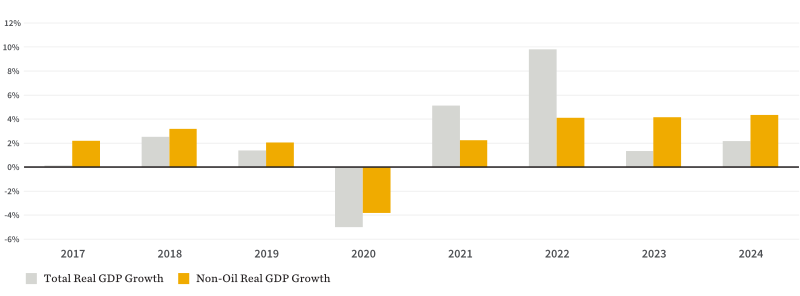
Source: IMF Database: Middle East and Central Asia Regional Economic Outlook.
Increased public debt issuance has accompanied economic diversification. The first chart below shows the Middle East’s share of emerging markets (EM) corporate primary debt issuance since 2017. The second chart shows that as of December 2025, the Middle East made up nearly one-fifth of the J.P. Morgan CEMBI Broad Diversified’s market capitalization, of which GCC countries represented more than 80%. The financials sector accounted for about half of the region’s exposure.
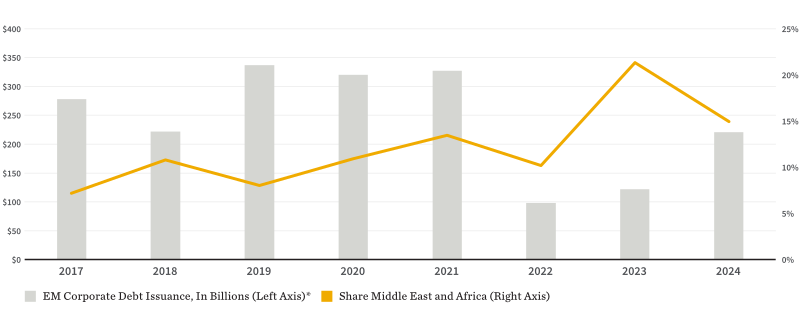
Source: J.P. Morgan, as of December 2025. Universe is the J.P. Morgan CEMBI Broad Diversified. *Excludes 100% government-owned entities.
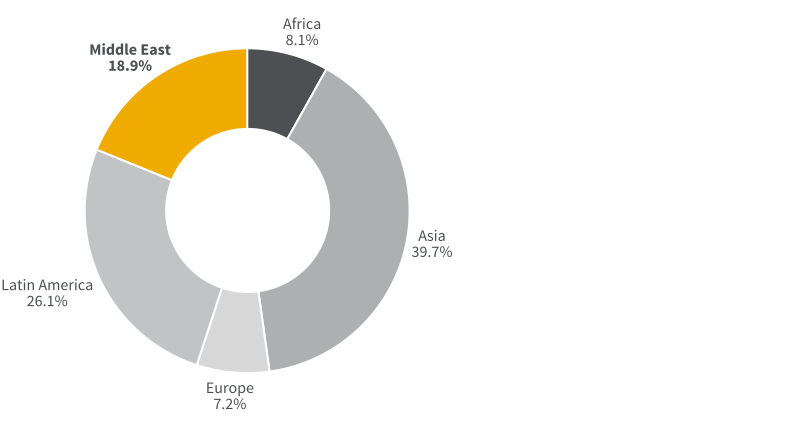
Source: J.P. Morgan, as of December 31, 2025. Universe is the J.P. Morgan CEMBI Broad Diversified.
Increased debt issuance from the financials sector has driven the region’s issuance growth. As a result, the share of GCC financials in the index has risen by more than 2.5 percentage points to nearly 9% since 2021, as shown in the chart below. This growth was mainly driven by issuers in Saudi Arabia, UAE, and Kuwait.
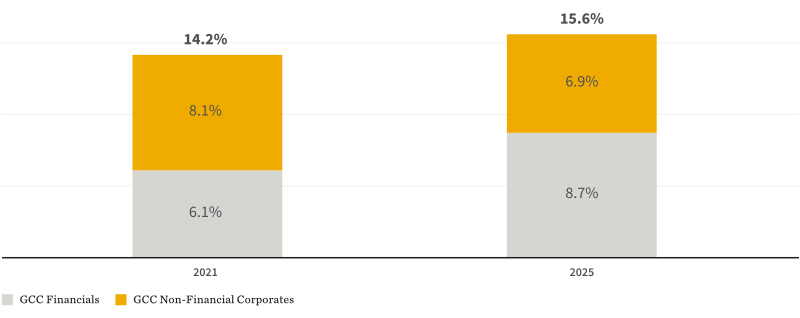
Source: J.P. Morgan, as of December 31, 2025. Universe is the J.P. Morgan CEMBI Broad Diversified.
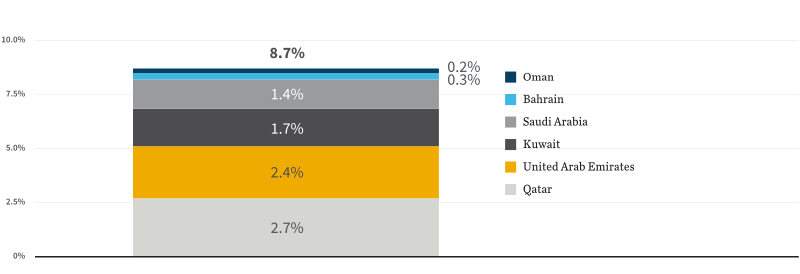
Source: J.P. Morgan, as of December 31, 2025. Universe is the J.P. Morgan CEMBI Broad Diversified.
After years of stability that fostered a supportive operating environment, the ongoing conflict in Iran and its expansion across the region into GCC countries may pose challenges to the pillars of the region’s growth strategy and to banks in the region.
In our view, there are three main channels through which the conflict may impact banks in the region. The degree of impact may vary depending on each bank’s business model, level of diversification, and overall strategy.
Loan Growth. We believe the most immediate and direct impact of the conflict on the banking sector is its negative impact on economic activity due to physical disruption, infrastructure destruction, and lower consumer and corporate confidence. This may impact banks’ lending growth and potentially revenue generation. From a credit investor’s perspective, however, a slowdown in lending growth might be positive from a capital perspective, although there are other factors that could offset that positive effect.
Funding. This is another potential channel of impact, both in terms of liquidity availability and cost of funding. As energy prices have risen, global rates have risen and financial conditions have tightened. Both institutional investors and depositors may become more risk averse and require a higher premium to provide funding to banks in the region. Additionally, the economic disruption caused by the conflict might reduce companies’ cash flows and hence the volume of deposits in the financial system.
Asset Quality. A slowdown in economic activity and damage to physical infrastructure may weaken the creditworthiness of borrowers and impact their ability to repay their debts, reduce the value of collateral, and even lead to defaults. This could entail additional provisioning requirements from banks and increase the balance of non-performing loans (NPLs).
We believe GCC banks could navigate this turbulent period relatively well.
While risks abound and the level of uncertainty is high, we believe GCC banks could benefit from strengths that allow them to navigate this turbulent period relatively well from a credit perspective. These include strong balance sheets, favorable ownership structures, and a supportive regulatory environment.
GCC banks came to the conflict in a position of fundamental strength. The median NPL coverage of banks in the region was 150%, according to our analysis, which indicates that there is room to absorb some asset-quality deterioration. At the same time, banks maintained a median capital buffer of more than 400 basis points above minimum requirements across the GCC,[2] and more than 300 basis points when excluding Saudi Arabia. That should alleviate concerns about solvency, even in the absence of extraordinary support.
One caveat pertains to dispersion. Individual banks may have weaker credit fundamentals than the aggregate data suggests and hence be more vulnerable to shocks. However, these banks represent a smaller part of our investment universe.
Most banks in the region have government ownership, often through controlling stakes. In turn, the creditworthiness of most GCC sovereigns is very strong, as evidenced by high credit ratings, relatively low debt levels, and high foreign exchange reserves. Combined, these factors translate into a strong ability and willingness to support local banks. This is often explicitly reflected in banks’ credit ratings, with many benefiting from rating uplifts directly as a result of their ownership structure.
In addition to the expectations of support embedded in the credit rating agencies’ assessments we described above, bank regulators and central banks in the region have a track record of providing support to the banking sector in events of stress. This happened during the COVID-19 period.
Following the start of the Iran conflict, regulators in the UAE, Qatar, and Kuwait came out with measures of support and/or relief for their respective banking sectors, with the UAE providing the most comprehensive plan. These measures include, among others: 1) temporary relaxation of liquidity and capital requirements; 2) provision for additional liquidity facilities; 3) temporary flexibility for bad-loan recognition; 4) temporary easing of reserve requirements; and 5) payment relief for borrowers.
We remain comfortable with the fundamentals of GCC banks.
While we are not downplaying the economic and human cost of the conflict, which are significant and should not be neglected, we remain comfortable with the fundamentals of GCC banks, which should support relative resilience through this turbulent period.
Mariana Villalba, CFA, is a portfolio manager and analyst on William Blair’s emerging markets debt team.
[1] The J.P. Morgan CEMBI Broad Diversified is a widely used benchmark that tracks the performance of U.S. dollar-denominated corporate bonds issued by companies in EMs. [2] Does not consider pillar 2 requirements applicable in Saudi Arabia, which are not publicly disclosed.
View Strategy:
https://im.williamblair.com/investments/separate-accounts/emerging-markets-debt-local-currency
View Strategy:
https://im.williamblair.com/investments/separate-accounts/emerging-markets-frontier-debt
Want the latest insights on the economy and other forces shaping the investment landscape?
Subscribe to our Investing Insights newsletter.
Any investment or strategy mentioned herein may not be appropriate for every investor. There can be no assurance that investment objectives will be met. Products and services listed are available only to residents of this jurisdiction and may only be available to certain categories of investors. The information on this website does not constitute an offer for products or services, or a solicitation of an offer to any persons outside of this jurisdiction who are prohibited from receiving such information under applicable laws and regulations. Nothing on this webpage should be construed as advice and is therefore not a recommendation to buy or sell shares.
Please carefully consider the William Blair Funds’ investment objectives, risks, charges, and expenses before investing. This and other information is contained in the Funds’ prospectus and summary prospectus, which you may obtain by calling 1-800-742-7272. Read the prospectus and summary prospectus carefully before investing. Investing includes the risk of loss.
The William Blair Funds are distributed by William Blair & Company, L.L.C., member FINRA/SIPC.
The William Blair SICAV is a Luxembourg investment company with variable capital registered with the Commission de Surveillance du Secteur Financier (“CSSF”) which qualifies as an undertaking for collective investment in transferable securities (“UCITS”). The Management Company of the SICAV has appointed William Blair Investment Management, LLC as the investment manager for the fund.
Please carefully consider the investment objectives, risks, charges, and expenses of the William Blair SICAV. This and other important information is contained in the prospectus and Key Investor Information Document (KIID). Read these documents carefully before investing. The information contained on this website is not a substitute for those documents or for professional external advice.
Information and opinions expressed are those of the authors and may not reflect the opinions of other investment teams within William Blair Investment Management, LLC, or affiliates. Factual information has been taken from sources we believe to be reliable, but its accuracy, completeness or interpretation cannot be guaranteed. Information is current as of the date appearing in this material only and subject to change without notice. Statements concerning financial market trends are based on current market conditions, which will fluctuate. This material may include estimates, outlooks, projections, and other forward-looking statements. Due to a variety of factors, actual events may differ significantly from those presented.
Investing involves risks, including the possible loss of principal. Equity securities may decline in value due to both real and perceived general market, economic, and industry conditions. The securities of smaller companies may be more volatile and less liquid than securities of larger companies. Investing in foreign denominated and/or domiciled securities may involve heightened risk due to currency fluctuations, and economic and political risks. These risks may be enhanced in emerging markets and frontier markets. Investing in the bond market is subject to certain risks including market, interest rate, issuer, credit, and inflation risk. High-yield, lower-rated, securities involve greater risk than higher-rated securities. Different investment styles may shift in and out of favor depending on market conditions. Diversification does not ensure against loss.
Past performance is not indicative of future returns. References to specific companies are for illustrative purposes only and should not be construed as investment advice or a recommendation to buy or sell any security.
William Blair Investment Management, LLC is an investment adviser registered with the U.S. Securities and Exchange Commission.
Issued in the United Kingdom by William Blair International, Ltd., authorized and regulated by the Financial Conduct Authority (FCA), and is only directed at and is only made available to persons falling within articles 19, 38, 47, and 49 of the Financial Services and Markets Act of 2000 (Financial Promotion) Order 2005 (all such persons being referred to as "relevant persons").
Issued in the European Economic Area (EEA) by William Blair B.V., authorized and supervised by the Dutch Authority for the Financial Markets (AFM) under license number 14006134 and also supervised by the Dutch Central Bank (DNB), registered at the Dutch Chamber of Commerce under number 82375682 and has its statutory seat in Amsterdam, the Netherlands. This material is only intended for eligible counterparties and professional clients.
Issued in Switzerland by William Blair Investment Services (Zurich) GmbH, Talstrasse 65, 8001 Zurich, Switzerland ("WBIS"). WBIS is engaged in the offering of collective investment schemes and renders further, non-regulated services in the financial sector. WBIS is affiliated with FINOS Finanzomubdsstelle Schweiz, a recognized ombudsman office where clients may initiate mediation proceedings pursuant to articles 74 et seq. of the Swiss Financial Services Act ("FinSA"). The client advisers of WBIS are registered with regservices.ch by BX Swiss AG, a client adviser registration body authorized by the Swiss Financial Market Supervisory Authority ("FINMA"). WBIS is not supervised by FINMA or any other supervisory authority or self-regulatory organization. This material is only intended for institutional and professional clients pursuant to article 4(3) to (5) FinSA.
Issued in Australia by William Blair Investment Management, LLC (“William Blair”), which is exempt from the requirement to hold an Australian financial services license under Australia's Corporations Act 2001 (Cth). William Blair is registered as an investment advisor with the U.S. Securities and Exchange Commission (“SEC”) and regulated by the SEC under the U.S. Investment Advisers Act of 1940, which differs from Australian laws. This material is intended only for wholesale clients.
Issued in Singapore by William Blair International (Singapore) Pte. Ltd. (Registration Number 201943312R), which is regulated by the Monetary Authority of Singapore under a Capital Markets Services License to conduct fund management activities. This material is intended only for institutional investors and may not be distributed to retail investors.
Issued in Canada by William Blair Investment Management, LLC, which relies on the international adviser exemption, pursuant to section 8.26 of National Instrument 31-103 in Canada.


The content contained in this site is intended as informational or educational in nature and does not constitute investment advice or a recommendation of any investment strategy or product for a particular investor. Investment advice and recommendations can be provided only after careful consideration of an investor’s objectives, guidelines, and restrictions. Investors should consult a financial professional/financial consultant or investment adviser before making any investment decisions. Investing includes the risk of loss.
Copyright © 2026 William Blair. William Blair is a registered trademark of William Blair & Company, L.L.C. “William Blair” refers to William Blair Investment Management, LLC and affiliates.

