Private credit risk is elevated and rising at the margin, but remains largely contained within the asset class.
Key pressure points for direct lending—leveraged buyout (LBO) exposure, software valuations, and refinancing risk—are building as the cycle matures.
Spillover to banks and insurers appears limited, with the primary impact concentrated on private credit investors and managers.
Private credit in general and direct lending in particular have moved to the center of market attention—both in headlines and in portfolios. For investors with meaningful exposure to the financial sector, including banks, insurers, and alternative asset managers, understanding the contours of this risk is increasingly important. But the implications extend beyond the financial sector, with potential knock-on effects for industries such as software that are closely tied to financing conditions.
What Are Private Credit and Direct Lending?
Definitions of private credit vary, and different definitions bring different levels of disclosure, making comparisons (and risk assessment) less straightforward. At its core, however, private credit refers to privately originated, illiquid lending provided by nonbank investors, structured outside public debt markets. Direct lending can be defined as a subsegment of private credit in which the loan is given to a company.
Adjacent instruments, such as collateralized loan obligations (CLOs) and certain forms of asset-backed lending, are typically not classified as direct lending but can share similar characteristics. As a result, positive correlations across these segments can be elevated, an important consideration when evaluating how risks could transmit through the broader system.
Growth of an Industry
Direct lending has grown roughly tenfold over the past 15 years—a rapid expansion that can be traced largely to structural changes following the Global Financial Crisis (GFC).
In particular, tighter regulation, including Basel III and the Dodd-Frank Act, reshaped the economics of bank lending. Under these frameworks, loans became more capital-intensive, requiring greater levels of stable funding and balance sheet commitment. Banks responded by repricing risk, tightening lending standards, shortening loan tenors, and demanding more collateral.
These shifts had two important effects. First, they reduced banks’ willingness to hold loans on balance sheet, pushing them toward an originate-to-distribute model, where loans are underwritten and then sold to third parties. Second, they created a gap in the market—one that private credit providers were well positioned to fill. At the same time, the expansion of private equity, which is closely linked to private credit, further fueled demand for alternative lending solutions.
The evolution of private credit also reflects a familiar lending cycle. Early in the cycle, limited capital gives lenders strong bargaining power, supporting disciplined underwriting and attractive pricing, which in turn drives strong performance. As capital flows into the space, competition increases, terms loosen, and pricing weakens—ultimately setting the stage for more challenging outcomes.
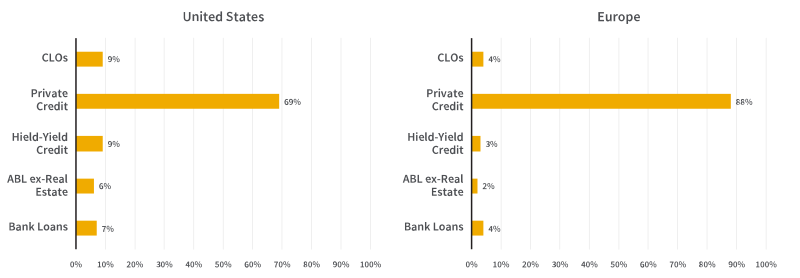
Today, we estimate that the direct lending asset class is valued at approximately $2 trillion, representing around 5% of total global lending excluding investment grade bonds and real-estate-backed lending.
Exposure, however, is not uniform. The asset class is more developed—and more heavily used—in the United States than in Europe, suggesting that any potential stress is more likely to be concentrated among U.S. participants.
Total Lending Excluding Real Estate Securitization and Investment-Grade Bonds
Sources: Federal Reserve, ECB, Pitchbook, and William Blair, as of 2025. ABL refers to asset-based lending.
Pockets of Stress—But No Systemic Crisis
Concerns about a potential systemic crisis in direct lending stem from the speed and scale of its growth, combined with limited transparency and signs of late-cycle behavior.
As capital has poured into the asset class, underwriting standards in some areas have weakened—evidenced by higher leverage, looser covenants, and more aggressive deal structures.
At the same time, valuations can appear smoothed due to infrequent pricing, raising questions about how assets would reprice in a downturn.
The interconnectedness with private equity, reliance on institutional funding, and overlap with adjacent markets such as broadly syndicated loans and CLOs add to the concern that stress could propagate more broadly.
For some observers, these dynamics resemble elements of past credit cycles, fueling fears—whether justified or not—that dislocations in direct lending could extend beyond the asset class itself.
We believe the risks are likely to remain contained within the ecosystem, with limited spillover to banks, insurance companies, or the broader economy.
Our assessment is more measured. While pockets of stress may emerge within direct lending funds, we believe the risks are likely to remain contained within the ecosystem, with limited spillover to banks, insurance companies, or the broader economy. In other words, this is not shaping up to be a systemic event—but it is a development worth monitoring closely.
Several factors support this view. First, direct lending remains a relatively small percentage of the overall lending system, accounting for roughly 5% of total lending. That makes it relevant, but not large enough on its own to drive systemic instability.
Second, while there are linkages between direct lending and traditional financial institutions, the degree of risk transfer appears limited. Some banks or insurers may face write-downs in a stress scenario, but the exposures are unlikely to be broad or interconnected enough to trigger systemwide disruption.
Third, leverage at the direct lending fund level is generally moderate, particularly when compared with pre-GFC structures. Structures tend to be more straightforward, with significantly less reliance on re-securitization or synthetic exposures.
Finally, asset-liability mismatches appear contained. Much of the capital in direct lending is provided by long-term investors through closed-end or similarly structured vehicles, where funding is relatively stable and less susceptible to sudden withdrawals.
Understanding the Risk Stack
To better assess the outlook, it is useful to frame the discussion around two questions: what level of risk does direct lending entail, and how is that risk evolving?
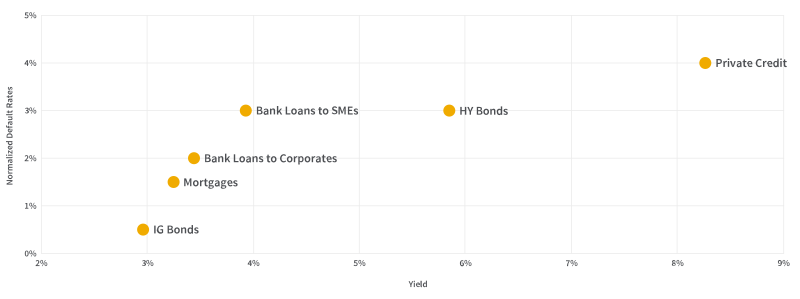
In terms of the former, by design, direct lending sits toward the higher end of the risk spectrum. Investors are compensated for this through elevated yields—currently in the high single digits—with historical default rates around 4%, exceeding those of many other lending segments. On a ratings-equivalent basis, much of the market aligns with single-B credit, placing it firmly in non-investment-grade territory. As a result, higher default rates relative to public high-yield markets are not unexpected; they are a structural feature of the asset class rather than a signal of distress in isolation.
European Yields vs. Normalized Default Rates
Sources: Bloomberg and William Blair, as of December 2025.
The more important question is directionality, and here, risks appear to be building at the margin. Several factors are contributing. Exposure to structurally challenged sectors, including segments of software that may lag in an AI-driven environment, is one area of concern. In addition, direct lending has significant exposure to leveraged buyout (LBO) financing, where deal structures have become more aggressive over time. Higher interest rates are compounding these pressures, increasing debt service burdens. At the same time, leverage levels remain elevated, and a growing maturity wall (particularly beginning in 2028) raises refinancing risk.
These dynamics are interconnected. Higher leverage and weaker underwriting amplify sensitivity to interest rates, while sector-specific pressures can erode earnings just as refinancing needs increase. Taken together, they point to a more challenging forward environment, even if the risks remain contained within the direct lending ecosystem.
LBO Concentration and Software Exposure: A Linked Risk
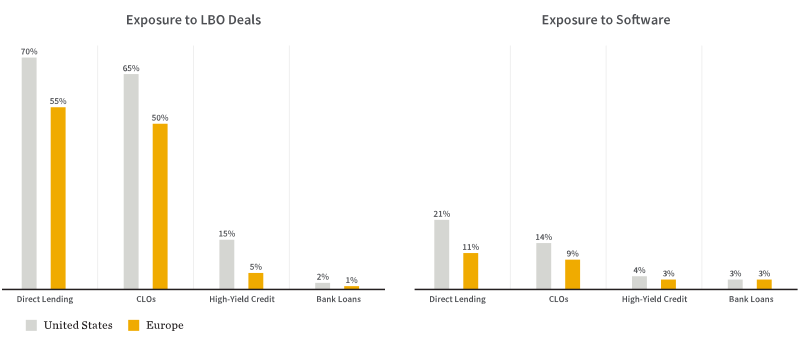
Direct lending has meaningful exposure to LBO transactions, which account for roughly half of total loan origination. This concentration matters because LBO structures typically carry higher leverage and depend heavily on stable or growing enterprise values to support repayment.
In parallel, the asset class has significant exposure to software—generally around 20% at the market level, with some funds materially higher—largely reflecting private equity’s own sector allocation. The linkage is important: direct lending is, in many ways, a mirror of private equity risk.
Within software, several factors point to rising vulnerability. Leverage levels are elevated, with net debt to earnings before interest, taxes, depreciation, and amortization (EBITDA) often around eight times—higher than in most other sectors. At the same time, valuations have declined materially from their 2021-2022 peak, eroding loan-to-value cushions and reducing the margin for error. Unlike asset-heavy industries, collateral in software lending is typically tied to enterprise value rather than hard assets, making recoveries more sensitive to market conditions.
Structure further amplifies these risks. Many LBO loans are “bullet” maturities, where principal is repaid or refinanced at the end of the term. This creates dependence on private equity exits or refinancing markets. As a result, the growing maturity wall beginning in 2028 is a key pressure point—particularly for deals originated in the 2020–2021 period, when valuations and leverage were at their peak. If exit activity remains constrained or financing conditions tighten, repayment risk could rise meaningfully within this cohort.
Direct Lending Exposure to LBOs and Software Deals
Sources: Federal Reserve, ECB, Pitchbook, and William Blair, as of December 2025.
Default Trends: Stable With Early Signs of Strain
Default rates in direct lending have not yet shown a meaningful deterioration, but there are early indicators of underlying stress.
One notable development is the rise in payment-in-kind (PIK) structures, which now account for roughly 15% of loans in some private credit portfolios. Under PIK arrangements, borrowers capitalize interest rather than paying it in cash, effectively deferring obligations and masking near-term stress. While this can provide temporary flexibility, it often signals weaker credit quality and can amplify losses if conditions worsen.
Outcomes will likely depend in part on the pace and severity of AI disruption on borrower’s businesses. In a more adverse scenario for software companies—such as a rapid AI disruption—default rates could rise toward 10%, representing a meaningful deterioration. In a more moderate scenario, where pressures build gradually and are more manageable, defaults may settle in the 5% to 6% range. In both cases, the direction of travel suggests increasing strain, even if current conditions remain relatively stable.
Assessing the Impact on Financials
For equity investors, the key question is how stress in direct lending could transmit to financials—particularly banks, insurers, and alternative asset managers.
Banks
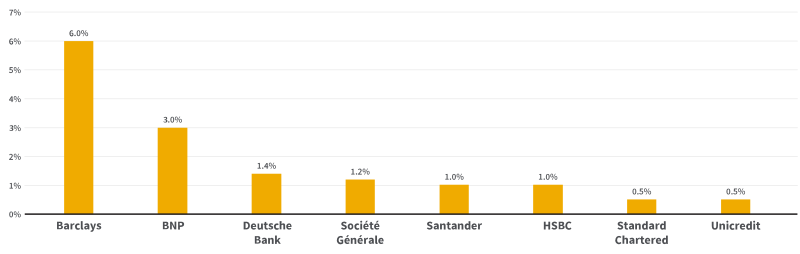
For banks, risks appear manageable and primarily flow through three channels. First, direct overlap with private credit borrowers is limited. Banks typically operate with lower risk tolerances, resulting in minimal exposure to the same borrower base; for example, software exposure within bank loan books is generally below 5%.
Second, banks have indirect exposure through lending to direct lending funds, alternative asset managers, and, in some cases, investors in those funds. This represents the largest point of connection, but exposures remain relatively modest—typically under 5% for U.S., European, and Japanese banks. Importantly, these loans tend to have a different risk profile than the underlying assets held by direct lending funds. Banks benefit from additional structural protections, including lower loan-to-value ratios, shorter tenors, and stronger collateral packages. Even under conservative stress assumptions—combining high leverage with low recovery rates—losses would need to be extreme, with an estimated 60% to 70% of underlying fund assets defaulting, before materially impacting bank lenders.
Third, there could be a negative impact on fee income coming from weaker investment banking, loan syndication and loan origination activity. This is more of a profitability headwind than a balance sheet risk, but it is likely to be more pronounced for institutions with larger investment banking franchises.
Overall, while larger, more investment banking–oriented institutions may have somewhat higher exposure across these channels, risks remain contained and manageable.
Disclosed Exposure to Private Credit (Percentage of Loans)
Sources: Bank disclosures, as of December 2025.
Insurance Companies
For insurance companies, exposure is more meaningful but still appears contained.
Private credit allocations are concentrated in life insurers, representing roughly 10% of assets in Europe and closer to 15% in the United States.
However, the composition of these portfolios differs from that of direct lending funds. Insurers tend to hold higher-quality, investment-grade private credit, driven by regulatory requirements and asset-liability matching considerations. Portfolios are typically tilted toward asset-backed sectors such as infrastructure and real estate, where collateral is more tangible and cash flows more stable, resulting in a more defensive risk profile.
Alternative Asset Managers
The most direct impact is likely to fall on alternative asset managers. Unlike banks and insurers, these firms are not balance-sheet-intensive, so the effects are less about solvency and more about earnings. Pressure would likely emerge through lower management fee income, slower growth in AUM, and weaker fund performance. In addition, the ongoing push to expand private credit and direct lending into retail and wealth channels introduces potential asset-liability mismatches, particularly if liquidity expectations are misaligned with underlying assets. This can lead to fund outflows and reputational damage. It is worth mentioning that outcomes across managers will vary based on business mix, degree of retail exposure, and geographic footprint.
We’re Watching: Key Risk Indicators
Several areas warrant close monitoring as the private credit cycle evolves.
Disclosure and transparency. Reporting remains inconsistent across managers, making comparisons difficult—even within the same segment. Differences in valuation practices, portfolio composition, and risk metrics can obscure underlying exposures and complicate risk assessment.
Hidden leverage. There is potential for indirect leverage within the system—for example, when a bank lends both to a direct lending fund and to a limited partner (LP) invested in that same fund or a general partner (GP managing the fund). While current regulation appears to limit the scale of this risk, it could still amplify losses under stress.
Weaker underwriting standards. Looser covenants and lower-quality collateral can result in higher effective loan-to-value ratios. This risk is primarily borne by LPs and alternative asset managers.
AI-driven disruption. A faster-than-expected shift—particularly affecting software—could materially pressure valuations. A further 50% decline in equity values would push effective loan-to-value ratios above 100% in some cases. Combined with upcoming maturity walls, this could drive default rates higher over a relatively short period.
Fraud and structural risks. Risks such as double pledging of collateral—historically more common in asset-backed lending—could emerge in less transparent direct lending structures. There are also concerns about potential credit rating inflation, particularly in insurance portfolios holding private credit assets.
Key indicators. Against this backdrop, we are focused on a set of leading indicators: default rates across private credit funds, PIK levels, retail redemption trends, software valuations, and disclosure from banks and insurers regarding their exposure to private credit and private equity. Fundraising trends for private credit and direct lending strategies will also be an important signal of investor sentiment and liquidity conditions.
Esteban Gonzalez Rosell is a research analyst on William Blair's global equity team.
Want the latest insights on the economy and other forces shaping the investment landscape?
Subscribe to our Investing Insights newsletter.
Any investment or strategy mentioned herein may not be appropriate for every investor. There can be no assurance that investment objectives will be met. Products and services listed are available only to residents of this jurisdiction and may only be available to certain categories of investors. The information on this website does not constitute an offer for products or services, or a solicitation of an offer to any persons outside of this jurisdiction who are prohibited from receiving such information under applicable laws and regulations. Nothing on this webpage should be construed as advice and is therefore not a recommendation to buy or sell shares.
Please carefully consider the Funds’ investment objectives, risks, charges, and expenses before investing. This and other information is contained in the Funds’ prospectus and summary prospectus, which you may obtain by calling 1-800-742-7272. Read the prospectus and summary prospectus carefully before investing. Investing includes the risk of loss.
The William Blair Funds and William Blair ETFs are distributed by William Blair & Company, L.L.C., member FINRA/SIPC.
The William Blair SICAV is a Luxembourg investment company with variable capital registered with the Commission de Surveillance du Secteur Financier (“CSSF”) which qualifies as an undertaking for collective investment in transferable securities (“UCITS”). The Management Company of the SICAV has appointed William Blair Investment Management, LLC as the investment manager for the fund.
Please carefully consider the investment objectives, risks, charges, and expenses of the William Blair SICAV. This and other important information is contained in the prospectus and Key Investor Information Document (KIID). Read these documents carefully before investing. The information contained on this website is not a substitute for those documents or for professional external advice.
Information and opinions expressed are those of the authors and may not reflect the opinions of other investment teams within William Blair Investment Management, LLC, or affiliates. Factual information has been taken from sources we believe to be reliable, but its accuracy, completeness or interpretation cannot be guaranteed. Information is current as of the date appearing in this material only and subject to change without notice. Statements concerning financial market trends are based on current market conditions, which will fluctuate. This material may include estimates, outlooks, projections, and other forward-looking statements. Due to a variety of factors, actual events may differ significantly from those presented.
Investing involves risks, including the possible loss of principal. Equity securities may decline in value due to both real and perceived general market, economic, and industry conditions. The securities of smaller companies may be more volatile and less liquid than securities of larger companies. Investing in foreign denominated and/or domiciled securities may involve heightened risk due to currency fluctuations, and economic and political risks. These risks may be enhanced in emerging markets and frontier markets. Investing in the bond market is subject to certain risks including market, interest rate, issuer, credit, and inflation risk. High-yield, lower-rated, securities involve greater risk than higher-rated securities. Different investment styles may shift in and out of favor depending on market conditions. Diversification does not ensure against loss.
Past performance is not indicative of future returns. References to specific companies are for illustrative purposes only and should not be construed as investment advice or a recommendation to buy or sell any security.
William Blair Investment Management, LLC is an investment adviser registered with the U.S. Securities and Exchange Commission.
Issued in the United Kingdom by William Blair International, Ltd., authorized and regulated by the Financial Conduct Authority (FCA), and is only directed at and is only made available to persons falling within articles 19, 38, 47, and 49 of the Financial Services and Markets Act of 2000 (Financial Promotion) Order 2005 (all such persons being referred to as "relevant persons").
Issued in the European Economic Area (EEA) by William Blair B.V., authorized and supervised by the Dutch Authority for the Financial Markets (AFM) under license number 14006134 and also supervised by the Dutch Central Bank (DNB), registered at the Dutch Chamber of Commerce under number 82375682 and has its statutory seat in Amsterdam, the Netherlands. This material is only intended for eligible counterparties and professional clients.
Issued in Switzerland by William Blair Investment Services (Zurich) GmbH, Talstrasse 65, 8001 Zurich, Switzerland ("WBIS"). WBIS is engaged in the offering of collective investment schemes and renders further, non-regulated services in the financial sector. WBIS is affiliated with FINOS Finanzomubdsstelle Schweiz, a recognized ombudsman office where clients may initiate mediation proceedings pursuant to articles 74 et seq. of the Swiss Financial Services Act ("FinSA"). The client advisers of WBIS are registered with regservices.ch by BX Swiss AG, a client adviser registration body authorized by the Swiss Financial Market Supervisory Authority ("FINMA"). WBIS is not supervised by FINMA or any other supervisory authority or self-regulatory organization. This material is only intended for institutional and professional clients pursuant to article 4(3) to (5) FinSA.
Issued in Australia by William Blair Investment Management, LLC (“William Blair”), which is exempt from the requirement to hold an Australian financial services license under Australia's Corporations Act 2001 (Cth). William Blair is registered as an investment advisor with the U.S. Securities and Exchange Commission (“SEC”) and regulated by the SEC under the U.S. Investment Advisers Act of 1940, which differs from Australian laws. This material is intended only for wholesale clients.
Issued in Singapore by William Blair International (Singapore) Pte. Ltd. (Registration Number 201943312R), which is regulated by the Monetary Authority of Singapore under a Capital Markets Services License to conduct fund management activities. This material is intended only for institutional investors and may not be distributed to retail investors.
Issued in Canada by William Blair Investment Management, LLC, which relies on the international adviser exemption, pursuant to section 8.26 of National Instrument 31-103 in Canada.
The content contained in this site is intended as informational or educational in nature and does not constitute investment advice or a recommendation of any investment strategy or product for a particular investor. Investment advice and recommendations can be provided only after careful consideration of an investor’s objectives, guidelines, and restrictions. Investors should consult a financial professional/financial consultant or investment adviser before making any investment decisions. Investing includes the risk of loss.