February 11, 2026 | Emerging Markets Debt
Reform and Resilience in Frontier Markets

Portfolio Manager

Portfolio Manager
February 11, 2026 | Emerging Markets Debt
Portfolio Manager
Portfolio Manager
View Fund:
https://im.williamblair.com/investments/sicav-funds/lu2879845290-emerging-markets-frontier-debt-fund
View Fund:
https://im.williamblair.com/investments/sicav-funds/lu2093691256-emerging-markets-debt-hard-currency-fund
View Fund:
https://im.williamblair.com/investments/sicav-funds/lu2093699408-emerging-markets-debt-local-currency-fund
View Strategy:
https://im.williamblair.com/investments/separate-accounts/emerging-markets-frontier-debt

We believe frontier markets remain attractive in 2026, supported by resilient fundamentals, high real yields, and ongoing foreign-exchange (FX) adjustments.
While the scope for further rate cuts is generally limited following aggressive easing in 2025, select countries—including Egypt, Ghana, Zambia, and Kenya—retain room for additional monetary easing as inflation moderates and external balances improve.
Elsewhere, although the potential for additional easing is more constrained, strong carry, improving fiscal dynamics, and robust external accounts—particularly among commodity exporters—should continue to support investor interest.
Despite tighter spreads and more concentrated positioning in a handful of markets, we believe the risk/reward profile remains favorable, with most frontier debt offering meaningful spread pickup over sovereign and developed market peers and systemic risks contained by resilient fundamentals.
Below, we show our top exposures, followed by some highlights of our thinking.
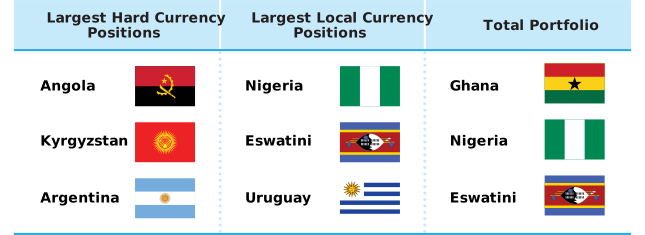
Source: William Blair, as of December 2025. Beta buckets are based on the team’s qualitative and quantitative analysis. Risk buckets are provided for illustrative purposes only and are not intended as investment advice or as projections of future returns. Overweights/underweights may vary between vehicles.
We remain focused on selective hard currency sovereign exposures where improving policy credibility and fiscal discipline support resilient carry and potential spread compression.
In Angola, our overweight to hard currency debt is supported by the government’s commitment to fiscal discipline and conservative oil-price assumptions in the 2026 budget. This “belt-tightening” approach signals a prudent approach to managing external vulnerabilities, particularly amid moderating oil revenues. Angola’s consistent budget surpluses and Fitch’s affirmation of its B- rating with a “stable” outlook also give us confidence in the credit’s resilience. We also remain positioned in a short-dated amortizing bond—a more defensive expression of this view given its amortizing structure and lower beta to risk appetite.
Political stability following Kyrgyzstan President Japarov’s electoral consolidation provides a favorable macro backdrop for Kyrgyzstan.
Meanwhile, Kyrgyzstan’s debut Eurobond has continued to attract investor interest, supported by moderate public debt, strong remittance inflows, and adequate FX reserves. Political stability following President Sadyr Japarov’s electoral consolidation and robust gross domestic product (GDP) growth projections provide a favorable macro backdrop, in our opinion. We believe we could see continued spread compression and stable income generation from this position.
Lastly, our overweight to Argentinian hard currency bonds reflects our conviction in the country’s improving macro trajectory. The U.S. Treasury’s backstop agreement, including a substantial swap line and direct debt purchases, has materially reduced near-term default risk and bolstered investor sentiment. President Javier Milei’s strengthened reform mandate, alongside fiscal outperformance and easing inflation, supports our view that Argentina’s Eurobonds offer compelling value. As the International Monetary Fund (IMF) program progresses and market access normalizes, we believe we could see further spread tightening and capital appreciation.
In local currency markets, we emphasize high-carry positions where improving inflation dynamics, policy inflection points, and currency stability support attractive risk-adjusted returns.
Our positioning in Nigerian local currency debt remains favorable. Moderating inflation and the central bank’s shift away from tightening have created a supportive backdrop for bond prices. FX reforms have helped stabilize the naira, while improving macro fundamentals led Standard & Poor’s (S&P) to revise Nigeria’s sovereign outlook to “positive.” We expect continued yield compression and currency stability, reinforcing our view that Nigeria is a high-carry, high-conviction opportunity.
We maintained a position in Eswatini local bonds. The lilangeni is pegged 1:1 to the South African rand, and the rates market largely tracks South African government bonds. Ongoing implementation of the National Development Plan and prudent fiscal management have helped keep macro risks contained. With essentially rand-linked exposure, Eswatini serves as a high-carry proxy for South Africa, where we broadly remain constructive on the outlook for further disinflation and gradual easing of monetary policy to support the performance of the rates market.
Uruguay remains a strategic local currency holding. Inflation has moved within the central bank’s target range, enabling a measured easing cycle that should support bond valuations. The peso remains stable, and the government’s multiyear budget continues to emphasize fiscal consolidation. Uruguay’s investment-grade status and prudent macro management underpin our confidence in this position.
Ghana remains our largest and most strategic position across both hard and local currency buckets.
Progress under the IMF program has been substantial, with a return to primary surplus, rebuilding of FX reserves, and continued reform implementation. Fourth quarter 2025 rating and outlook upgrades from S&P and Moody’s reflect improved fiscal and external metrics.
Meanwhile, the cedi has appreciated and stabilized, while sharply lower inflation has enabled meaningful rate cuts. All in all, Ghana appears well positioned, with favorable export dynamics, credible policy execution, and improving investor confidence supporting the outlook.
Yvette Babb is a portfolio manager on William Blair’s emerging markets debt team.
Daniel Wood is a portfolio manager on William Blair’s emerging markets debt team.
View Strategy:
https://im.williamblair.com/investments/separate-accounts/emerging-markets-debt-hard-currency
View Strategy:
https://im.williamblair.com/investments/separate-accounts/emerging-markets-debt-local-currency
Want the latest insights on the economy and other forces shaping the investment landscape?
Subscribe to our Investing Insights newsletter.
Any investment or strategy mentioned herein may not be appropriate for every investor. There can be no assurance that investment objectives will be met. Products and services listed are available only to residents of this jurisdiction and may only be available to certain categories of investors. The information on this website does not constitute an offer for products or services, or a solicitation of an offer to any persons outside of this jurisdiction who are prohibited from receiving such information under applicable laws and regulations. Nothing on this webpage should be construed as advice and is therefore not a recommendation to buy or sell shares.
Please carefully consider the William Blair Funds’ investment objectives, risks, charges, and expenses before investing. This and other information is contained in the Funds’ prospectus and summary prospectus, which you may obtain by calling 1-800-742-7272. Read the prospectus and summary prospectus carefully before investing. Investing includes the risk of loss.
The William Blair Funds are distributed by William Blair & Company, L.L.C., member FINRA/SIPC.
The William Blair SICAV is a Luxembourg investment company with variable capital registered with the Commission de Surveillance du Secteur Financier (“CSSF”) which qualifies as an undertaking for collective investment in transferable securities (“UCITS”). The Management Company of the SICAV has appointed William Blair Investment Management, LLC as the investment manager for the fund.
Please carefully consider the investment objectives, risks, charges, and expenses of the William Blair SICAV. This and other important information is contained in the prospectus and Key Investor Information Document (KIID). Read these documents carefully before investing. The information contained on this website is not a substitute for those documents or for professional external advice.
Information and opinions expressed are those of the authors and may not reflect the opinions of other investment teams within William Blair Investment Management, LLC, or affiliates. Factual information has been taken from sources we believe to be reliable, but its accuracy, completeness or interpretation cannot be guaranteed. Information is current as of the date appearing in this material only and subject to change without notice. Statements concerning financial market trends are based on current market conditions, which will fluctuate. This material may include estimates, outlooks, projections, and other forward-looking statements. Due to a variety of factors, actual events may differ significantly from those presented.
Investing involves risks, including the possible loss of principal. Equity securities may decline in value due to both real and perceived general market, economic, and industry conditions. The securities of smaller companies may be more volatile and less liquid than securities of larger companies. Investing in foreign denominated and/or domiciled securities may involve heightened risk due to currency fluctuations, and economic and political risks. These risks may be enhanced in emerging markets and frontier markets. Investing in the bond market is subject to certain risks including market, interest rate, issuer, credit, and inflation risk. High-yield, lower-rated, securities involve greater risk than higher-rated securities. Different investment styles may shift in and out of favor depending on market conditions. Diversification does not ensure against loss.
Past performance is not indicative of future returns. References to specific companies are for illustrative purposes only and should not be construed as investment advice or a recommendation to buy or sell any security.
William Blair Investment Management, LLC is an investment adviser registered with the U.S. Securities and Exchange Commission.
Issued in the United Kingdom by William Blair International, Ltd., authorized and regulated by the Financial Conduct Authority (FCA), and is only directed at and is only made available to persons falling within articles 19, 38, 47, and 49 of the Financial Services and Markets Act of 2000 (Financial Promotion) Order 2005 (all such persons being referred to as "relevant persons").
Issued in the European Economic Area (EEA) by William Blair B.V., authorized and supervised by the Dutch Authority for the Financial Markets (AFM) under license number 14006134 and also supervised by the Dutch Central Bank (DNB), registered at the Dutch Chamber of Commerce under number 82375682 and has its statutory seat in Amsterdam, the Netherlands. This material is only intended for eligible counterparties and professional clients.
Issued in Switzerland by William Blair Investment Services (Zurich) GmbH, Talstrasse 65, 8001 Zurich, Switzerland ("WBIS"). WBIS is engaged in the offering of collective investment schemes and renders further, non-regulated services in the financial sector. WBIS is affiliated with FINOS Finanzomubdsstelle Schweiz, a recognized ombudsman office where clients may initiate mediation proceedings pursuant to articles 74 et seq. of the Swiss Financial Services Act ("FinSA"). The client advisers of WBIS are registered with regservices.ch by BX Swiss AG, a client adviser registration body authorized by the Swiss Financial Market Supervisory Authority ("FINMA"). WBIS is not supervised by FINMA or any other supervisory authority or self-regulatory organization. This material is only intended for institutional and professional clients pursuant to article 4(3) to (5) FinSA.
Issued in Australia by William Blair Investment Management, LLC (“William Blair”), which is exempt from the requirement to hold an Australian financial services license under Australia's Corporations Act 2001 (Cth). William Blair is registered as an investment advisor with the U.S. Securities and Exchange Commission (“SEC”) and regulated by the SEC under the U.S. Investment Advisers Act of 1940, which differs from Australian laws. This material is intended only for wholesale clients.
Issued in Singapore by William Blair International (Singapore) Pte. Ltd. (Registration Number 201943312R), which is regulated by the Monetary Authority of Singapore under a Capital Markets Services License to conduct fund management activities. This material is intended only for institutional investors and may not be distributed to retail investors.
Issued in Canada by William Blair Investment Management, LLC, which relies on the international adviser exemption, pursuant to section 8.26 of National Instrument 31-103 in Canada.


The content contained in this site is intended as informational or educational in nature and does not constitute investment advice or a recommendation of any investment strategy or product for a particular investor. Investment advice and recommendations can be provided only after careful consideration of an investor’s objectives, guidelines, and restrictions. Investors should consult a financial professional/financial consultant or investment adviser before making any investment decisions. Investing includes the risk of loss.
Copyright © 2026 William Blair. William Blair is a registered trademark of William Blair & Company, L.L.C. “William Blair” refers to William Blair Investment Management, LLC and affiliates.

