Emerging markets (EM) equity returns have been driven by extreme mega-cap concentration, with index breadth collapsing to historic lows and masking weakness across much of the opportunity set.
This concentration has distorted relative results for active managers, particularly those constrained by diversification rules or broad benchmarks, as small-cap underperformance and index construction limit flexibility.
We view these dynamics as cyclical rather than structural, with history suggesting breadth should mean revert and opportunities broaden for managers able to invest across the market-cap spectrum.
Emerging markets (EMs) are delivering a familiar paradox: strong headline returns but shrinking opportunity beneath the surface. Index breadth has collapsed to historic lows, with only about a third of EM stocks beating the benchmark, thanks to surging tech-heavy mega caps that increasingly dominate performance.
For active managers, especially those constrained by funds’ diversification rules or running broad all-cap strategies, this creates an unusually narrow playing field and challenges relative results. As a result, a smaller share of active managers have beaten the index: over the past year, the MSCI Emerging Markets Index ranks in the 36th percentile among U.S.-domiciled emerging markets funds, compared with the 51st and 55th percentiles over the three- and five-year periods, respectively.
But this isn’t necessarily a structural reality. Market breadth tends to be cyclical, and today’s concentration, however extreme, has a long history of mean reverting. However, in the current environment, having the flexibility to invest in the most attractive opportunity set across the market-cap spectrum is key.
Breadth Collapses as Mega Caps Take Over
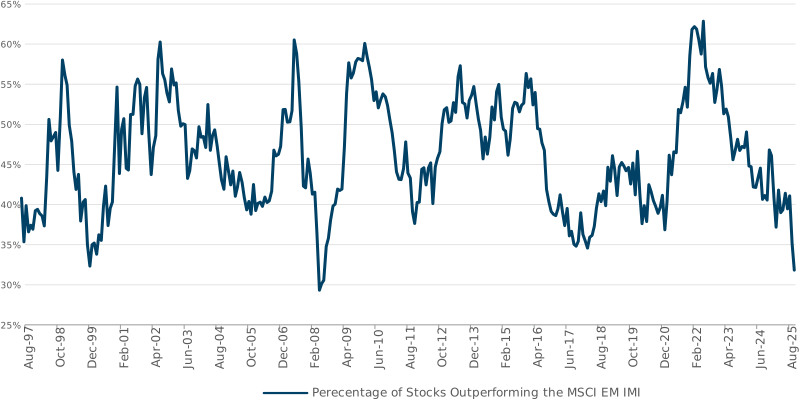
The percentage of stocks outperforming the MSCI EM Investible Market Index (IMI) has fallen to a historic low of 32%. This weakness reflects the sharp rise in index concentration, with large mega caps driving returns—a dynamic similar to the “Mag 7” effect in the United States.
This is creating a more challenging backdrop for active managers, especially for funds subject to diversification rules, limiting the ability to overweight the biggest names just as they exert the most influence on index performance.
However, as the chart below shows, index breadth is cyclical. These periods of extreme concentration have historically mean reverted.
Percentage of Stocks Outperforming the MSCI EM IMI Over the Past Year
Source: William Blair, as of October 14, 2025. Past performance is historical and does not guarantee future results. A direct investment in an unmanaged index is not possible.
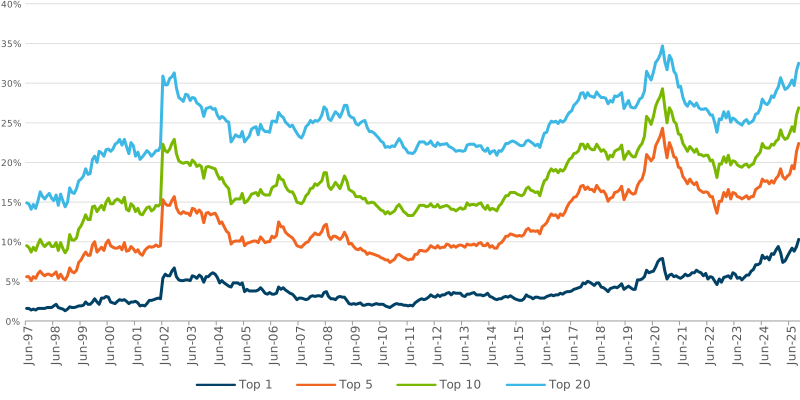
The largest index holdings have steadily grown over time, and TSMC now represents nearly 10% of the MSCI EM IMI (and an even higher weight in the standard MSCI EM Index). This makes it impossible to overweight the stock in a UCITS fund, which is capped at a 10% position in any individual security, and creates challenges for more diversified portfolios in general.
This issue is even more pronounced when using an EM growth index as benchmark. While it may seem reasonable and appropriate to measure a growth manager’s results against the relevant style index, the current concentration level of EM growth indices makes headline performance of the index less representative of the overall style performance as it is highly biased by a few stocks. As a matter of fact, TSMC represents 13% of the MSCI EM Growth IMI and 15% of the MSCI EM Growth Index. Moreover, the top five largest holdings in the EM growth indices account for roughly a third of the overall index performance.
Weighting of Top 1, 5, 10 and 20 Positions in the MSCI EM IMI
Source: William Blair, as of October 31, 2025. Past performance is historical and does not guarantee future results. A direct investment in an unmanaged index is not possible.
Small-Cap Weakness Distorting Relative Results
Another unusual dynamic is the quite significant underperformance of small caps relative to large caps. Because of this, the MSCI EM IMI (which includes small caps) is underperforming the more concentrated, large-cap-heavy MSCI EM Index.
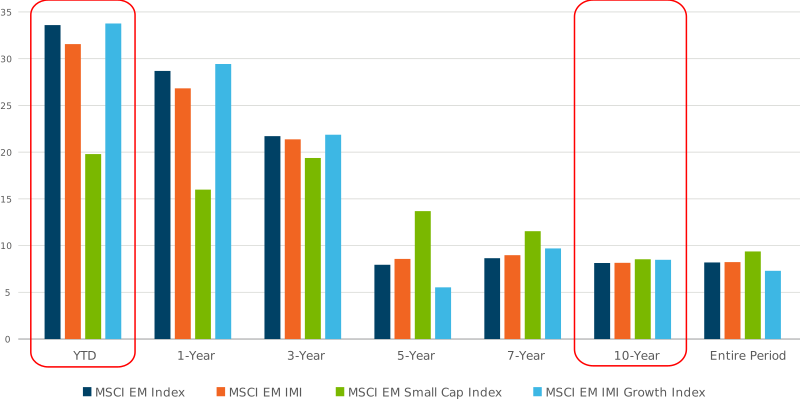
As the chart below shows, the MSCI EM Index and MSCI EM IMI have delivered broadly similar returns over longer periods (such as 10 years), but in 2025 the standard index has meaningfully outperformed the IMI version. The key driver is the sharp underperformance of small caps relative to large mega caps.
EM Benchmark Performance Comparison
Source: FactSet, MSCI, and William Blair, from September 29, 2000, to October 31, 2025. Shows gross returns. Past performance is historical and does not guarantee future results. A direct investment in an unmanaged index is not possible.
Transitory Effects?
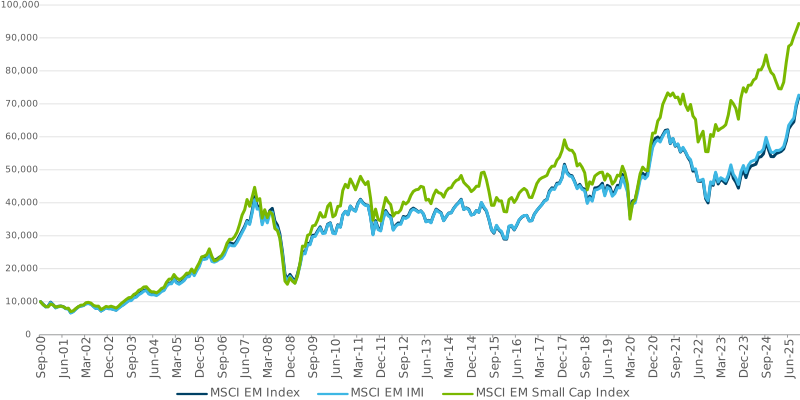
We view these effects as transitory and reflective of short-term distortions. Small caps have significantly underperformed over the past year but have outperformed over five years, and in our opinion remain attractive over the long term. As the chart below shows, the MSCI EM Small Cap Index has delivered stronger long-term returns than both the MSCI EM Index and the MSCI EM IMI, which, notably, have performed in line over longer periods despite the more than 200-basis-point gap between them year-to-date.
Small-Cap Index Has Outperformed Over the Long Term
Source: FactSet, MSCI, and William Blair, as of October 31, 2025. Shows cumulative performance. Returns are gross. Past performance is historical and does not guarantee future results. A direct investment in an unmanaged index is not possible.
While EM performance in 2025 has been dominated by mega caps and marked by historic small-cap underperformance, we believe these extremes are unlikely to persist indefinitely. Market breadth has always been cyclical, and history suggests that opportunities will broaden again. For active managers, we believe maintaining flexibility remains essential to navigate these shifting dynamics and capture alpha in the areas offering the most attractive opportunities.
Romina Graiver, partner, is a portfolio specialist for William Blair’s global equity team.
The MSCI EM Index is a free float–adjusted, market-capitalization index representing large- and mid-cap companies across EMs. The MSCI EM IMI is a comprehensive EM index that includes large-, mid-, and small-cap companies to reflect the full investable universe. The MSCI EM Small Cap Index is an index that captures the performance of small-cap companies across EMs. The MSCI EM Growth Index is the growth-focused style index derived from the MSCI EM universe, emphasizing companies with higher expected earnings growth and growth-oriented characteristics. The MSCI EM Growth IMI is the growth-focused style index derived from the MSCI EM IMI universe, emphasizing companies with higher expected earnings growth and growth-oriented characteristics.
Want the latest insights on the economy and other forces shaping the investment landscape?
Subscribe to our Investing Insights newsletter.
Any investment or strategy mentioned herein may not be appropriate for every investor. There can be no assurance that investment objectives will be met. Products and services listed are available only to residents of this jurisdiction and may only be available to certain categories of investors. The information on this website does not constitute an offer for products or services, or a solicitation of an offer to any persons outside of this jurisdiction who are prohibited from receiving such information under applicable laws and regulations. Nothing on this webpage should be construed as advice and is therefore not a recommendation to buy or sell shares.
Please carefully consider the William Blair Funds’ investment objectives, risks, charges, and expenses before investing. This and other information is contained in the Funds’ prospectus and summary prospectus, which you may obtain by calling 1-800-742-7272. Read the prospectus and summary prospectus carefully before investing. Investing includes the risk of loss.
The William Blair Funds are distributed by William Blair & Company, L.L.C., member FINRA/SIPC.
The William Blair SICAV is a Luxembourg investment company with variable capital registered with the Commission de Surveillance du Secteur Financier (“CSSF”) which qualifies as an undertaking for collective investment in transferable securities (“UCITS”). The Management Company of the SICAV has appointed William Blair Investment Management, LLC as the investment manager for the fund.
Please carefully consider the investment objectives, risks, charges, and expenses of the William Blair SICAV. This and other important information is contained in the prospectus and Key Investor Information Document (KIID). Read these documents carefully before investing. The information contained on this website is not a substitute for those documents or for professional external advice.
Information and opinions expressed are those of the authors and may not reflect the opinions of other investment teams within William Blair Investment Management, LLC, or affiliates. Factual information has been taken from sources we believe to be reliable, but its accuracy, completeness or interpretation cannot be guaranteed. Information is current as of the date appearing in this material only and subject to change without notice. Statements concerning financial market trends are based on current market conditions, which will fluctuate. This material may include estimates, outlooks, projections, and other forward-looking statements. Due to a variety of factors, actual events may differ significantly from those presented.
Investing involves risks, including the possible loss of principal. Equity securities may decline in value due to both real and perceived general market, economic, and industry conditions. The securities of smaller companies may be more volatile and less liquid than securities of larger companies. Investing in foreign denominated and/or domiciled securities may involve heightened risk due to currency fluctuations, and economic and political risks. These risks may be enhanced in emerging markets and frontier markets. Investing in the bond market is subject to certain risks including market, interest rate, issuer, credit, and inflation risk. High-yield, lower-rated, securities involve greater risk than higher-rated securities. Different investment styles may shift in and out of favor depending on market conditions. Diversification does not ensure against loss.
Past performance is not indicative of future returns. References to specific companies are for illustrative purposes only and should not be construed as investment advice or a recommendation to buy or sell any security.
William Blair Investment Management, LLC is an investment adviser registered with the U.S. Securities and Exchange Commission.
Issued in the United Kingdom by William Blair International, Ltd., authorized and regulated by the Financial Conduct Authority (FCA), and is only directed at and is only made available to persons falling within articles 19, 38, 47, and 49 of the Financial Services and Markets Act of 2000 (Financial Promotion) Order 2005 (all such persons being referred to as "relevant persons").
Issued in the European Economic Area (EEA) by William Blair B.V., authorized and supervised by the Dutch Authority for the Financial Markets (AFM) under license number 14006134 and also supervised by the Dutch Central Bank (DNB), registered at the Dutch Chamber of Commerce under number 82375682 and has its statutory seat in Amsterdam, the Netherlands. This material is only intended for eligible counterparties and professional clients.
Issued in Switzerland by William Blair Investment Services (Zurich) GmbH, Talstrasse 65, 8001 Zurich, Switzerland ("WBIS"). WBIS is engaged in the offering of collective investment schemes and renders further, non-regulated services in the financial sector. WBIS is affiliated with FINOS Finanzomubdsstelle Schweiz, a recognized ombudsman office where clients may initiate mediation proceedings pursuant to articles 74 et seq. of the Swiss Financial Services Act ("FinSA"). The client advisers of WBIS are registered with regservices.ch by BX Swiss AG, a client adviser registration body authorized by the Swiss Financial Market Supervisory Authority ("FINMA"). WBIS is not supervised by FINMA or any other supervisory authority or self-regulatory organization. This material is only intended for institutional and professional clients pursuant to article 4(3) to (5) FinSA.
Issued in Australia by William Blair Investment Management, LLC (“William Blair”), which is exempt from the requirement to hold an Australian financial services license under Australia's Corporations Act 2001 (Cth). William Blair is registered as an investment advisor with the U.S. Securities and Exchange Commission (“SEC”) and regulated by the SEC under the U.S. Investment Advisers Act of 1940, which differs from Australian laws. This material is intended only for wholesale clients.
Issued in Singapore by William Blair International (Singapore) Pte. Ltd. (Registration Number 201943312R), which is regulated by the Monetary Authority of Singapore under a Capital Markets Services License to conduct fund management activities. This material is intended only for institutional investors and may not be distributed to retail investors.
Issued in Canada by William Blair Investment Management, LLC, which relies on the international adviser exemption, pursuant to section 8.26 of National Instrument 31-103 in Canada.
The content contained in this site is intended as informational or educational in nature and does not constitute investment advice or a recommendation of any investment strategy or product for a particular investor. Investment advice and recommendations can be provided only after careful consideration of an investor’s objectives, guidelines, and restrictions. Investors should consult a financial professional/financial consultant or investment adviser before making any investment decisions. Investing includes the risk of loss.