September 22, 2026 | Emerging Markets Debt
The Critical Minerals Tug of War

Senior Corporate Credit and Sustainability Analyst
September 22, 2026 | Emerging Markets Debt
Senior Corporate Credit and Sustainability Analyst
View Fund:
https://im.williamblair.com/investments/sicav-funds/lu2879845290-emerging-markets-frontier-debt-fund
View Fund:
https://im.williamblair.com/investments/sicav-funds/lu2093691256-emerging-markets-debt-hard-currency-fund
View Fund:
https://im.williamblair.com/investments/sicav-funds/lu2093699408-emerging-markets-debt-local-currency-fund
View Strategy:
https://im.williamblair.com/investments/separate-accounts/emerging-markets-debt-hard-currency

The race for critical minerals is reshaping global trade, industrial policy, and geopolitics. As demand surges, EMs are moving beyond extraction—seeking to capture more value by building out domestic processing and refining. And that can lead to opportunities for EM debt investors.
Critical minerals are the building blocks of modern life, powering everything from consumer electronics to defense systems, AI infrastructure, and the energy transition. While definitions vary by country, most critical mineral lists converge on commodities such as lithium, copper, nickel, and rare earth elements.
In recent years, governments worldwide have rolled out critical mineral strategies in response to an increasingly fragmented geopolitical landscape and the strong long-term demand outlook. The scramble for control over these supply chains has drawn frequent comparisons to a modern-day gold rush—although this one is broader in scope, more strategic in nature, and increasingly driven by national policy objectives.
The global race for critical minerals has created a geopolitical tug of war between the United States and China, Europe and China, and, more broadly, developed markets and EMs.
As the United States and Europe seek to secure alternative sources of critical minerals, expand domestic processing and refining capacity, and reduce reliance on China, competition is increasingly influencing trade, investment, and industrial policy worldwide.
The United States has published a critical minerals list and launched Section 232 investigations aimed at strengthening its position in these supply chains while protecting domestic industries from foreign competition. Similarly, the European Union’s Critical Raw Materials Act seeks to boost domestic production of key minerals, diversify supply sources, and reduce vulnerability to market disruptions and price shocks.
EMs are using mineral wealth as both a geopolitical tool and a catalyst for investment, industrial development, and economic growth.
EMs sit at the epicenter of this tug of war because many of the world’s critical mineral reserves are concentrated in many of these countries. Their objective is not only to protect domestic resources, but also to develop vertically integrated industries and capture more value across the full supply chain. While developed-market policies have largely responded to concerns over supply-chain concentration and China’s growing dominance, EM frameworks are more proactive—using mineral wealth as both a geopolitical tool and a catalyst for investment, industrial development, and economic growth.
Brazil, for example, is a major player in the critical minerals race, holding the world’s second-largest rare earth reserves, accounting for more than 20% of the global total. The country has introduced the Critical and Strategic Minerals Bill, which provides tax incentives and guarantees a credit fund for the development of resources.
India is another rare-earth leader, with the world’s third-largest reserves after Brazil, and it, too, has sought to protect its role in the supply chain with the launching of the National Critical Mineral Mission, which will focus on local mining and processing of 24 vital minerals, acquisition of mining blocks overseas, and recycling of critical metals.
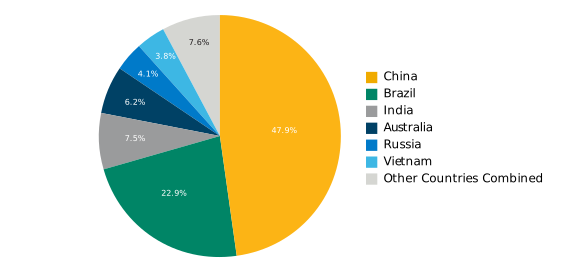
Sources: USGS and William Blair, as of August 2026. Other countries combined include United States, 2.1%; Greenland, 1.6%; Tanzania, 1.0%; South Africa, 0.9%; Canada, 0.9%; Thailand, 0.0005%; and rest of world, 1.1%.
China, however, remains the dominant force in rare earths, controlling nearly half of global reserves. This excludes additional resources secured through joint ventures, particularly in Africa, which holds around 30% of global mineral reserves. Researchers estimate that close to 40% roughly of Africa’s future rare-earth supply is committed to Chinese buyers via offtake agreements. China’s influence is even greater in production, accounting for nearly 70% of global output. China takes a more integrated approach, focusing on the entire value chain from the outset—from ownership of enabling infrastructure such as ports and railways to project financing and equipment supply.
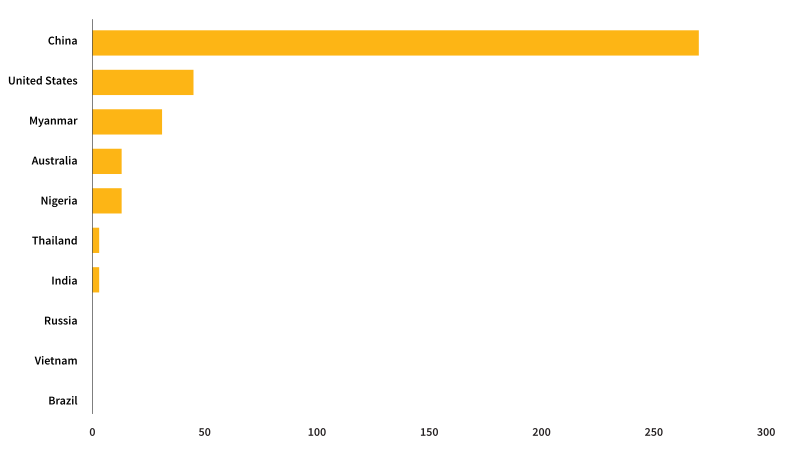
Sources: USGS and William Blair, as of August 2026.
The concentration of reserves in certain countries—particularly in EMs—creates incentives to develop domestic ore extraction capacity and attracts international investors. However, refining minerals into finished products remains a significant challenge. Smelting and refining are capital- and energy-intensive, often generate relatively low returns, and may be constrained by limited access to reliable power.
China controls more than 90% of global rare-earth refining capacity and roughly 70% of processing capacity for many critical minerals. This dominance has been built over decades through a broader strategic effort that included sustained state support, subsidies, and, at times, below-market pricing that weakened overseas competition.
To us, this is the central challenge that resource-rich EMs must address.
Capturing the full value of these resources will likely require substantial investment.
Brazil is blessed with a high-grade rare-earth resource that is relatively easy to extract, so mining should attract an abundance of domestic and foreign investment. However, capturing the full value of these resources will likely require substantial investment in downstream refining capacity, which may not always be commercially viable and could therefore require government support.
Several Brazilian initiatives suggest the country may avoid the experience of resource-rich markets such as Australia, where much of the value is lost because raw ore is exported for refining and processing elsewhere. Brazil is considering the creation of a national critical-metals company, with support from its development bank and national oil company, as well as tax incentives for downstream processors.
India’s case is more complex, given its greater reliance on Chinese imports and limited domestic expertise in downstream metals processing. But India, much like its young population, can quickly jump on the learning curve as it has done in other industries, such as solar cells and modules manufacturing. India’s focus on recycling can also alleviate some of its import reliance, and its recent royalty reform is promising for the industry.
Lastly, Indonesia provides a good example of how emerging countries can tackle the mining-versus-processing dilemma. The country banned exports of nickel ore, helping domestic producers vertically integrate. It also provided tax holidays and other incentives to domestic downstream processing players, allowing for an influx of investments. Indonesia is now a powerhouse across the value chain of nickel products and basically a market maker when it comes to nickel pricing.
The race for critical minerals is no longer about who owns the resources, but who can build the industries around them. EMs hold many of the world’s largest mineral reserves, giving them a unique opportunity to move up the value chain and capture a greater share of the economic benefits. Success, however, likely depends on policies that attract investment, develop technical expertise, and support downstream processing. Countries such as Indonesia have already demonstrated what is possible, while Brazil and India are taking important steps in the right direction, suggesting that the next chapter of the critical minerals story may be written in EMs.
Alexandra Symeonidi, CFA, is a senior corporate credit and sustainability analyst on William Blair’s emerging markets debt team.
View Strategy:
https://im.williamblair.com/investments/separate-accounts/emerging-markets-debt-local-currency
View Strategy:
https://im.williamblair.com/investments/separate-accounts/emerging-markets-frontier-debt
Want the latest insights on the economy and other forces shaping the investment landscape?
Subscribe to our Investing Insights newsletter.
Any investment or strategy mentioned herein may not be appropriate for every investor. There can be no assurance that investment objectives will be met. Products and services listed are available only to residents of this jurisdiction and may only be available to certain categories of investors. The information on this website does not constitute an offer for products or services, or a solicitation of an offer to any persons outside of this jurisdiction who are prohibited from receiving such information under applicable laws and regulations. Nothing on this webpage should be construed as advice and is therefore not a recommendation to buy or sell shares.
Please carefully consider the William Blair Funds’ investment objectives, risks, charges, and expenses before investing. This and other information is contained in the Funds’ prospectus and summary prospectus, which you may obtain by calling 1-800-742-7272. Read the prospectus and summary prospectus carefully before investing. Investing includes the risk of loss.
The William Blair Funds are distributed by William Blair & Company, L.L.C., member FINRA/SIPC.
The William Blair SICAV is a Luxembourg investment company with variable capital registered with the Commission de Surveillance du Secteur Financier (“CSSF”) which qualifies as an undertaking for collective investment in transferable securities (“UCITS”). The Management Company of the SICAV has appointed William Blair Investment Management, LLC as the investment manager for the fund.
Please carefully consider the investment objectives, risks, charges, and expenses of the William Blair SICAV. This and other important information is contained in the prospectus and Key Investor Information Document (KIID). Read these documents carefully before investing. The information contained on this website is not a substitute for those documents or for professional external advice.
Information and opinions expressed are those of the authors and may not reflect the opinions of other investment teams within William Blair Investment Management, LLC, or affiliates. Factual information has been taken from sources we believe to be reliable, but its accuracy, completeness or interpretation cannot be guaranteed. Information is current as of the date appearing in this material only and subject to change without notice. Statements concerning financial market trends are based on current market conditions, which will fluctuate. This material may include estimates, outlooks, projections, and other forward-looking statements. Due to a variety of factors, actual events may differ significantly from those presented.
Investing involves risks, including the possible loss of principal. Equity securities may decline in value due to both real and perceived general market, economic, and industry conditions. The securities of smaller companies may be more volatile and less liquid than securities of larger companies. Investing in foreign denominated and/or domiciled securities may involve heightened risk due to currency fluctuations, and economic and political risks. These risks may be enhanced in emerging markets and frontier markets. Investing in the bond market is subject to certain risks including market, interest rate, issuer, credit, and inflation risk. High-yield, lower-rated, securities involve greater risk than higher-rated securities. Different investment styles may shift in and out of favor depending on market conditions. Diversification does not ensure against loss.
Past performance is not indicative of future returns. References to specific companies are for illustrative purposes only and should not be construed as investment advice or a recommendation to buy or sell any security.
William Blair Investment Management, LLC is an investment adviser registered with the U.S. Securities and Exchange Commission.
Issued in the United Kingdom by William Blair International, Ltd., authorized and regulated by the Financial Conduct Authority (FCA), and is only directed at and is only made available to persons falling within articles 19, 38, 47, and 49 of the Financial Services and Markets Act of 2000 (Financial Promotion) Order 2005 (all such persons being referred to as "relevant persons").
Issued in the European Economic Area (EEA) by William Blair B.V., authorized and supervised by the Dutch Authority for the Financial Markets (AFM) under license number 14006134 and also supervised by the Dutch Central Bank (DNB), registered at the Dutch Chamber of Commerce under number 82375682 and has its statutory seat in Amsterdam, the Netherlands. This material is only intended for eligible counterparties and professional clients.
Issued in Switzerland by William Blair Investment Services (Zurich) GmbH, Talstrasse 65, 8001 Zurich, Switzerland ("WBIS"). WBIS is engaged in the offering of collective investment schemes and renders further, non-regulated services in the financial sector. WBIS is affiliated with FINOS Finanzomubdsstelle Schweiz, a recognized ombudsman office where clients may initiate mediation proceedings pursuant to articles 74 et seq. of the Swiss Financial Services Act ("FinSA"). The client advisers of WBIS are registered with regservices.ch by BX Swiss AG, a client adviser registration body authorized by the Swiss Financial Market Supervisory Authority ("FINMA"). WBIS is not supervised by FINMA or any other supervisory authority or self-regulatory organization. This material is only intended for institutional and professional clients pursuant to article 4(3) to (5) FinSA.
Issued in Australia by William Blair Investment Management, LLC (“William Blair”), which is exempt from the requirement to hold an Australian financial services license under Australia's Corporations Act 2001 (Cth). William Blair is registered as an investment advisor with the U.S. Securities and Exchange Commission (“SEC”) and regulated by the SEC under the U.S. Investment Advisers Act of 1940, which differs from Australian laws. This material is intended only for wholesale clients.
Issued in Singapore by William Blair International (Singapore) Pte. Ltd. (Registration Number 201943312R), which is regulated by the Monetary Authority of Singapore under a Capital Markets Services License to conduct fund management activities. This material is intended only for institutional investors and may not be distributed to retail investors.
Issued in Canada by William Blair Investment Management, LLC, which relies on the international adviser exemption, pursuant to section 8.26 of National Instrument 31-103 in Canada.


The content contained in this site is intended as informational or educational in nature and does not constitute investment advice or a recommendation of any investment strategy or product for a particular investor. Investment advice and recommendations can be provided only after careful consideration of an investor’s objectives, guidelines, and restrictions. Investors should consult a financial professional/financial consultant or investment adviser before making any investment decisions. Investing includes the risk of loss.
Copyright © 2026 William Blair. William Blair is a registered trademark of William Blair & Company, L.L.C. “William Blair” refers to William Blair Investment Management, LLC and affiliates.

