October 6, 2026 | Emerging Markets Debt
The Geopolitical Reshaping of Energy

Senior Corporate Credit and Sustainability Analyst
October 6, 2026 | Emerging Markets Debt
Senior Corporate Credit and Sustainability Analyst
View Fund:
https://im.williamblair.com/investments/sicav-funds/lu2093691256-emerging-markets-debt-hard-currency-fund
View Fund:
https://im.williamblair.com/investments/sicav-funds/lu2093699408-emerging-markets-debt-local-currency-fund
View Fund:
https://im.williamblair.com/investments/sicav-funds/lu2879845290-emerging-markets-frontier-debt-fund
View Strategy:
https://im.williamblair.com/investments/separate-accounts/emerging-markets-debt-hard-currency

The energy disruptions stemming from the recent Iran war and other geopolitical conflicts have reinforced the urgency of diversifying energy systems and accelerating the energy transition. In turn, we believe this is supporting demand for critical metals; strengthening the outlook for renewable energy deployment; and creating a growing set of investment opportunities in EMs, since many of these resources are concentrated there.
The world has experienced two major energy crises within just five years, both with significant consequences for government finances and household disposable income, and the fiscal burden of repeated energy shocks has become increasingly difficult to ignore. Many developing economies continue to grapple with high debt levels, while fiscal positions across much of the developed world have also deteriorated.
Fossil fuel subsidies are expected to shoot up vastly this year to $1.1 trillion, marking an increase of around $400 billion compared to last year.[1] The 2022 energy crisis was even more costly, as explicit fossil fuel subsidies were expected to reach $1.3 trillion, while implicit costs, including unpriced health and environmental costs, were more than $5 trillion.[2]
At the same time, the economics of clean energy continue to improve. The rapid decline in the cost of solar, wind, and battery technologies has made renewable energy increasingly competitive with conventional energy sources. Solar photovoltaic (PV) costs have fallen by 90% in the last decade, onshore wind by 70%, and batteries by more than 90%.[3]
With heightened volatility in oil and gas markets driven by geopolitical tensions and supply disruptions, we believe these trends have further strengthened the economic rationale for accelerating the deployment of renewable energy and reducing dependence on imported fuels. In 2025, renewables became the world's largest source of electricity generation, surpassing coal for the first time ever.[4]
But it’s not just costs and economics—while the motivation behind the energy transition was centered around climate ambition a few years ago, energy security is now the primary policy driver, as renewable energy eliminates the need for imported fuel once installed. In other words, solar, wind, and batteries do not have a constant dependency for fuel supply once in place, which, in turn, can help reduce dependency on other countries.
We have seen a wave of policy responses aimed at accelerating renewable energy adoption, particularly across Europe and Asia, regions most exposed to geopolitical crisis.
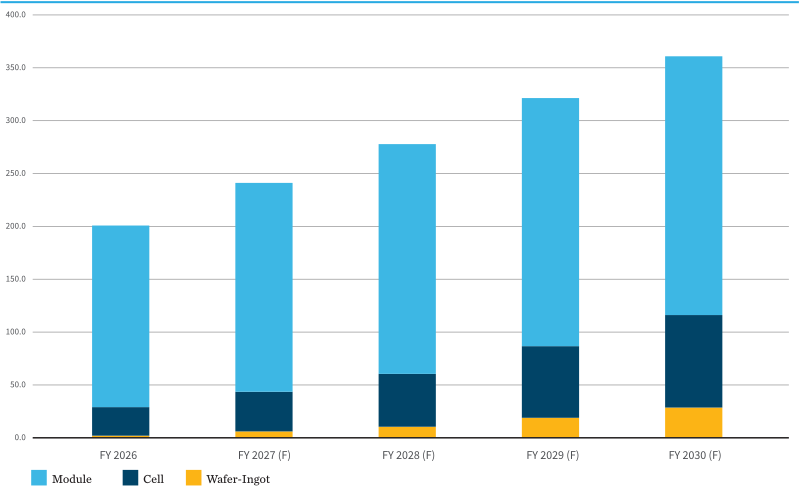
Sources: Care Edge Research and William Blair, as of August 2026. FY refers to fiscal year. Data after fiscal year 2027 is forecast.
Following the Iran war and the accompanied energy supply shock, a temporary oil demand destruction is expected this year. The International Energy Agency and OPEC have both cut oil demand forecasts, driven by the price surge and tighter supply. While the outlook is less clear over the next few years, we believe that oversupply might resurface again in 2027 (due to supply surpassing demand), which could bring oil prices lower.
But as energy consumption is linked to global growth, we believe cheap renewable energy could unlock large gross domestic product (GDP) growth potential for many EMs. This higher GDP potential could translate to broader growth in consumption and commodity demand.
Furthermore, the biggest beneficiary in the commodities space may likely be metals, particularly battery metals and rare earths. Bloomberg expects battery metals demand to considerably grow in 2026, due, in part, to the rise in global passenger EV sales.[12]
Another large driver for this growth is battery energy storage systems (BESS), which go hand in hand with renewable energy installations, as they are used to stabilize the grid and address intermittency issues of energy generation from solar and wind.
Globally, BESS capacity is expected to expand rapidly, rising from around 250 GW in 2025[13] to more than 1,500 GW by 2030.[14] Led by China, EMs are driving much of this growth, with China accounting for approximately 60% of installations.[15] China already has the world's largest installed BESS base as well, exceeding 135 GW in 2025, and is projected to add between 64 GW and 85 GW of new energy storage capacity (primarily BESS) in 2026.[16]
In comparison, the European Union's installed capacity stood at around 40 GW in 2025[17] and is expected to reach near 180 GW by 2030,[18] while India is forecast to grow its BESS capacity to 47 GW by the end of the decade.[19]
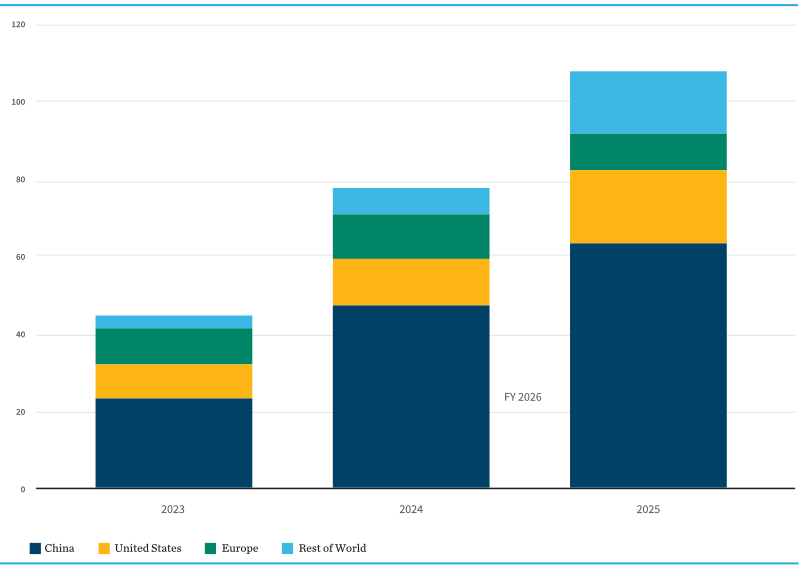
Sources: International Energy Agency and William Blair, as of August 2026.
Meanwhile, lithium, copper, aluminum, and certain rare earths are benefiting the most from the energy transition theme.
Lithium has seen impressive demand growth—more than 20% in 2025 alone.[20] This continuous demand improvement, together with tighter supply in 2026, has lifted prices. BESS installations have also been a significant driver, making up around 20% of total lithium demand.[21] With Chile boasting the largest lithium mine in the world, and China, Zimbabwe, and Argentina being in the top 5 producing countries, EMs have been playing a key role in delivering clean, reliable, and low-cost energy.
For copper, thematic demand for electrification and data centers has kept prices high despite the weak cyclical outlook. Elevated copper prices have benefited many EM countries, especially Chile, the Democratic Republic of Congo, Peru, and Zambia. Copper prices are also providing support to the Chilean peso as the two share a long relationship.
Aluminum has also benefited from electrification and AI infrastructure demand, but the price response has been different, as aluminum supply is typically more elastic than copper if there is enough reliable and cost-competitive power available.
In addition, China is a key aluminum producer, making up around 60% of total global aluminum production.[22] India is also a large aluminum producer, but it’s not a very large exporter, as most supply is consumed domestically due to the country’s infrastructure boom.
Furthermore, certain rare-earth magnets have become key components of batteries, EVs, and more recently, AI and robotics, and the strong demand outlook supports prices. There’s a relatively large price bifurcation, however, in Chinese and offshore prices as China controls about 90% of rare-earth refining.
Other EMs have rushed to secure supply of these resources, with Brazil launching its critical mineral fund in 2026, and Argentina, Peru, Indonesia, and the Philippines participating in relevant bilateral frameworks with the United States.
The energy transition is no longer driven solely by climate objectives—it has increasingly become a response to energy security concerns, economic competitiveness, and the need for greater resilience in an uncertain geopolitical landscape. For EMs, we believe this shift presents a significant opportunity to position themselves at the center of the next phase of global growth.
Alexandra Symeonidi, CFA, is a senior corporate credit and sustainability analyst on William Blair’s emerging markets debt team.
[1]Source: UNDP press release. [2]Source: IMF. [3]Source: IRENA. [4]Source: Ember. [5]Source: Carbon Brief. [6]Source: PV Tech. [7]Source: PV Tech. [8]Source: Enerdata. [9]Source: Eco-Business. [10]Source: India's Press Information Bureau. [11]Source: Philippine New Agency. [12]Source: BloombergNEF Electric Vehicle Outlook. [13]Source: ESS News. [14]Source: IEA. [15]Source: Energy Storage News. [16]Source: China Energy Storage Alliance (CNESA). [17]Source: Energy Institute. [18]Source: Green Tech Lead. [19]Source: India's Press Information Bureau. [20]Source: IEA. [21]Source: Benchmark Mineral Intelligence. [22]Source: Statista.
View Strategy:
https://im.williamblair.com/investments/separate-accounts/emerging-markets-debt-local-currency
View Strategy:
https://im.williamblair.com/investments/separate-accounts/emerging-markets-frontier-debt
Want the latest insights on the economy and other forces shaping the investment landscape?
Subscribe to our Investing Insights newsletter.
Any investment or strategy mentioned herein may not be appropriate for every investor. There can be no assurance that investment objectives will be met. Products and services listed are available only to residents of this jurisdiction and may only be available to certain categories of investors. The information on this website does not constitute an offer for products or services, or a solicitation of an offer to any persons outside of this jurisdiction who are prohibited from receiving such information under applicable laws and regulations. Nothing on this webpage should be construed as advice and is therefore not a recommendation to buy or sell shares.
Please carefully consider the William Blair Funds’ investment objectives, risks, charges, and expenses before investing. This and other information is contained in the Funds’ prospectus and summary prospectus, which you may obtain by calling 1-800-742-7272. Read the prospectus and summary prospectus carefully before investing. Investing includes the risk of loss.
The William Blair Funds are distributed by William Blair & Company, L.L.C., member FINRA/SIPC.
The William Blair SICAV is a Luxembourg investment company with variable capital registered with the Commission de Surveillance du Secteur Financier (“CSSF”) which qualifies as an undertaking for collective investment in transferable securities (“UCITS”). The Management Company of the SICAV has appointed William Blair Investment Management, LLC as the investment manager for the fund.
Please carefully consider the investment objectives, risks, charges, and expenses of the William Blair SICAV. This and other important information is contained in the prospectus and Key Investor Information Document (KIID). Read these documents carefully before investing. The information contained on this website is not a substitute for those documents or for professional external advice.
Information and opinions expressed are those of the authors and may not reflect the opinions of other investment teams within William Blair Investment Management, LLC, or affiliates. Factual information has been taken from sources we believe to be reliable, but its accuracy, completeness or interpretation cannot be guaranteed. Information is current as of the date appearing in this material only and subject to change without notice. Statements concerning financial market trends are based on current market conditions, which will fluctuate. This material may include estimates, outlooks, projections, and other forward-looking statements. Due to a variety of factors, actual events may differ significantly from those presented.
Investing involves risks, including the possible loss of principal. Equity securities may decline in value due to both real and perceived general market, economic, and industry conditions. The securities of smaller companies may be more volatile and less liquid than securities of larger companies. Investing in foreign denominated and/or domiciled securities may involve heightened risk due to currency fluctuations, and economic and political risks. These risks may be enhanced in emerging markets and frontier markets. Investing in the bond market is subject to certain risks including market, interest rate, issuer, credit, and inflation risk. High-yield, lower-rated, securities involve greater risk than higher-rated securities. Different investment styles may shift in and out of favor depending on market conditions. Diversification does not ensure against loss.
Past performance is not indicative of future returns. References to specific companies are for illustrative purposes only and should not be construed as investment advice or a recommendation to buy or sell any security.
William Blair Investment Management, LLC is an investment adviser registered with the U.S. Securities and Exchange Commission.
Issued in the United Kingdom by William Blair International, Ltd., authorized and regulated by the Financial Conduct Authority (FCA), and is only directed at and is only made available to persons falling within articles 19, 38, 47, and 49 of the Financial Services and Markets Act of 2000 (Financial Promotion) Order 2005 (all such persons being referred to as "relevant persons").
Issued in the European Economic Area (EEA) by William Blair B.V., authorized and supervised by the Dutch Authority for the Financial Markets (AFM) under license number 14006134 and also supervised by the Dutch Central Bank (DNB), registered at the Dutch Chamber of Commerce under number 82375682 and has its statutory seat in Amsterdam, the Netherlands. This material is only intended for eligible counterparties and professional clients.
Issued in Switzerland by William Blair Investment Services (Zurich) GmbH, Talstrasse 65, 8001 Zurich, Switzerland ("WBIS"). WBIS is engaged in the offering of collective investment schemes and renders further, non-regulated services in the financial sector. WBIS is affiliated with FINOS Finanzomubdsstelle Schweiz, a recognized ombudsman office where clients may initiate mediation proceedings pursuant to articles 74 et seq. of the Swiss Financial Services Act ("FinSA"). The client advisers of WBIS are registered with regservices.ch by BX Swiss AG, a client adviser registration body authorized by the Swiss Financial Market Supervisory Authority ("FINMA"). WBIS is not supervised by FINMA or any other supervisory authority or self-regulatory organization. This material is only intended for institutional and professional clients pursuant to article 4(3) to (5) FinSA.
Issued in Australia by William Blair Investment Management, LLC (“William Blair”), which is exempt from the requirement to hold an Australian financial services license under Australia's Corporations Act 2001 (Cth). William Blair is registered as an investment advisor with the U.S. Securities and Exchange Commission (“SEC”) and regulated by the SEC under the U.S. Investment Advisers Act of 1940, which differs from Australian laws. This material is intended only for wholesale clients.
Issued in Singapore by William Blair International (Singapore) Pte. Ltd. (Registration Number 201943312R), which is regulated by the Monetary Authority of Singapore under a Capital Markets Services License to conduct fund management activities. This material is intended only for institutional investors and may not be distributed to retail investors.
Issued in Canada by William Blair Investment Management, LLC, which relies on the international adviser exemption, pursuant to section 8.26 of National Instrument 31-103 in Canada.


The content contained in this site is intended as informational or educational in nature and does not constitute investment advice or a recommendation of any investment strategy or product for a particular investor. Investment advice and recommendations can be provided only after careful consideration of an investor’s objectives, guidelines, and restrictions. Investors should consult a financial professional/financial consultant or investment adviser before making any investment decisions. Investing includes the risk of loss.
Copyright © 2026 William Blair. William Blair is a registered trademark of William Blair & Company, L.L.C. “William Blair” refers to William Blair Investment Management, LLC and affiliates.

