February 5, 2026 | Global Equity
The Problem With Quality

Portfolio Manager
February 5, 2026 | Global Equity
Portfolio Manager
View Fund:
https://im.williamblair.com/investments/mutual-funds/wbeix-emerging-markets-growth-fund
View Fund:
https://im.williamblair.com/investments/mutual-funds/wbelx-emerging-markets-leaders-fund
View Fund:
https://im.williamblair.com/investments/mutual-funds/besix-emerging-markets-small-cap-growth-fund
View Fund:
https://im.williamblair.com/investments/sicav-funds/lu0995405320-emerging-markets-growth-fund

One of the more striking features of equity markets in recent years—especially EMs—is how badly so called “quality” companies have trailed the field.
In 2025, the MSCI EM Quality sub-index underperformed the broad MSCI EM Index by 20%. The cumulative gap recently peaked at an eye watering 38%. For a sub-index built around high return on equity, low leverage, and steady earnings—winning attributes of the post-global financial crisis (GFC) market—we view this as a remarkable fall from grace.
Just as curious: the long standing marriage between “quality” and “growth” has broken down. From 2013 to 2020, in EMs, the two factors moved together almost in lockstep, rising or falling relative to the market in seven of eight years. Since then, they’ve agreed only once, in 2022. The gap between the quality and growth sub indices in 2025 alone was more than 20%. The relationship has gone from a duet to a divorce.
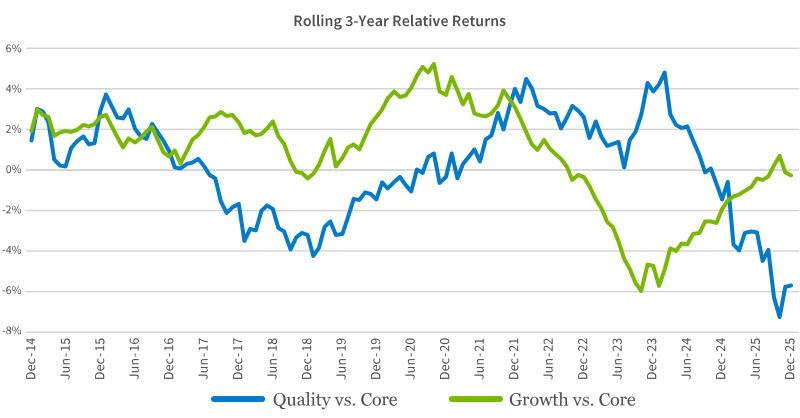
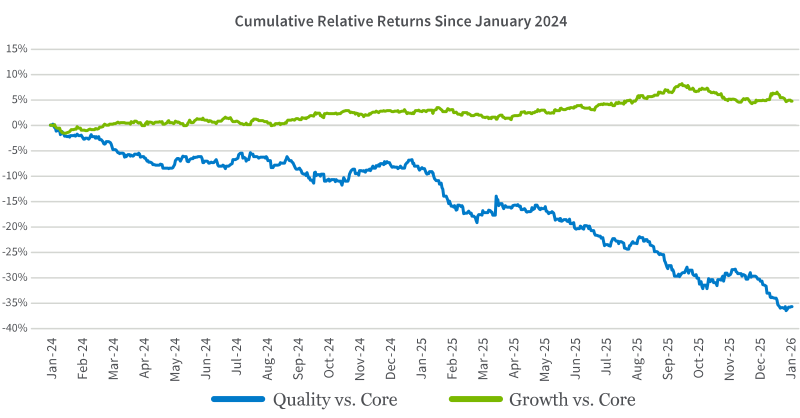
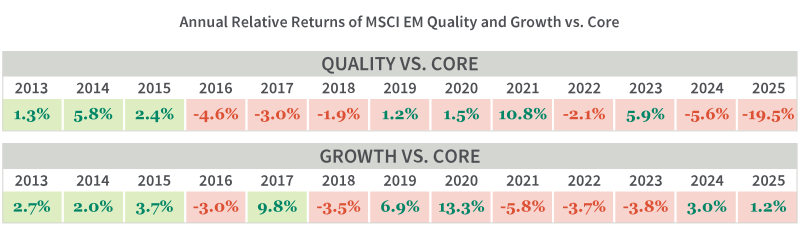
Source: Bloomberg, MSCI, and William Blair, as of January 27, 2026. Past performance is not indicative of future returns. Cumulative returns are from January 19, 2024, through January 27, 2026. Annualized three-year returns and table returns are from December 31, 2014, through December 31, 2025. The MSCI EM Index includes large- and mid-cap stocks across 24 EM countries. The MSCI EM Growth Index captures large- and mid-cap securities exhibiting overall growth style characteristics across 24 EM countries The MSCI EM Quality Index aims to capture the performance of quality growth stocks by identifying stocks with high quality scores based on three main fundamental variables: high return on equity (ROE), stable year-over-year earnings growth, and low financial leverage. A direct investment in an unmanaged index is not possible.
What explains this anti quality regime, and why has quality decoupled from growth? Two forces stand out: big cycles and weaker visibility into the future.
Over the last few years, two sorts of cyclical sectors have taken the lead in EMs: long ignored value sectors emerging from deep winters, and technology hardware and AI infrastructure players riding a once in a generation capital expenditure (capex) boom.
On the value side, sectors such as shipbuilding, mining, defense equipment, electrical gear, and old fashioned banking—especially in South Korea and China—have enjoyed the kind of revival usually reserved for once faded rock bands. These industries spent very long periods of time starved of incremental capacity investment. When demand finally reappeared—supercharged by AI driven infrastructure needs, higher defense spending, and supply chain rewiring—the inflection in profitability was powerful.
Traditionally, these companies were dismissed as price takers with negligible moats. Yet it turns out prices rise quite readily when demand surges, supply can’t (or won’t) catch up, and capacity takes years to build. Suddenly, undifferentiated companies look unique. We think many would no longer be classified as value stocks.
A similar dynamic has lifted companies in the AI infrastructure supply chain. As has been well documented, the scale and complexity of the AI capex wave has created a long queue of customers for any firm that can manufacture the required picks and shovels of the new digital gold rush.
If markets are indeed long term weighing machines, investors today increasingly feel that they’re weighing in the dark. Several forces have dimmed outyear visibility for us.
The geopolitical order is in flux, with rising great power rivalry, shakier trade relations, populist (even polarizing) politics, and a monetary system struggling to find its next equilibrium. It is unclear what sort of new world order will emerge from the ongoing shifts, even to the inner sanctum of the Trump or Xi administrations, and this uncertainty tends to blur investors’ ability to forecast.
In the current mood, some investors behave as if left tail risk is universal and therefore ignorable.
At the same time, many industries face profound and accelerating disruption. Even before the “AI moment” of 2023, the combination of global reach and near zero marginal cost of digital distribution meant new champions could emerge in the blink of an eye. Now the mass deployment of generative AI threatens moats built on human intelligence, judgment, or content creation—software, IT services, online travel agencies, and more.
Warren Buffett’s “moats” still matter, but we now have a trebuchet (in the form of AI) that is powerful enough to lob boulders over many of them.
With both left and right tail risks widening, the traditional selling point of quality—visibility and resilience—appears less prized. In the current mood, some investors behave as if left tail risk is universal and therefore ignorable. This is a puzzling but powerful sentiment.
It has not been an easy time for quality focused investors. But it has been a deeply instructive one. Four lessons stand out.
1. The world has changed—for good.
Nostalgia, as Canadian Prime Minister Mark Carney recently explained, is not a strategy. Irrespective of which way the future U.S. electorate shifts, the post Cold War world order is being retired. Great power rivalry, fiscal imbalances, supply chain fragility, AI transformation, and infrastructure constraints are not cyclical quirks; they’re structural realities.
We think needs and wants are changing—for nations, businesses, and consumers. Thus, we should expect to find growth in different places. Harking back to old growth engines will often disappoint. We think it is necessary to follow the needs and wants for the new world, because the companies innovatively catering for this will be best positioned to grow.
We believe relying solely on stability and historical returns presents the risk of overlooking companies whose advantages stem from the physical world.
2. Quality is broader than backward looking ROIC.
Cash flow return on invested capital (CFROIC) remains a valuable compass, but not the only one, and certainly not the destination. What we believe matters most for returns is incremental CFROIC, not the historical variety. Many companies that generated high returns via intangible advantages—human intelligence, judgement, content—could see structural pressure from AI.
We view a broader aperture as essential. We as William Blair Emerging Markets Leaders portfolio managers think of quality in two buckets. The first includes qualitative attributes: a superior customer proposition, durable moats, a resilient growth runway, and differentiated management and culture. The second includes observable outcomes: strong or consolidating market positions and peer leading financials, including (but not limited to) CFROIC.
We believe relying solely on stability and historical returns presents the risk of overlooking companies whose advantages stem from the physical world—advantages that AI cannot erode so easily.
3. Quality alone is not enough; underappreciation is key.
Owning a quality business at an inappropriate price, or one that is facing meaningful headwinds, is a likely route to disappointment. We focus on situations where quality and/or growth are underappreciated, where one or more tenets are overlooked: corporate improvement, growth trajectory, resilience, or right tail optionality. Valuation work helps us to identify underappreciation, but so does trying to understand what the market is failing to see.
Imbalances resolve themselves—sometimes abruptly.
4. Cyclical winners have a shelf life; some long lasting—and others less so.
Many of today’s winners have benefited from acute demand supply imbalances in long life equipment and infrastructure. But imbalances resolve themselves—sometimes abruptly. Demand can slow, and investors can fail to foresee this given a conflation between the growth of the stock of long-life assets versus the growth in flow of incremental long-life assets. Supply usually responds (“the cure for high prices is high prices”). And new technologies—especially in AI hardware—regularly leapfrog old ones.
Many of these cycles are correlated, meaning a surprising number of EM winners are leveraged to one master trend: the AI capex boom. We believe in the transformational potential of AI adoption; however, we also appreciate the risks that come with large capex cycles. How do we apply guardrails to our enthusiasm?
Our approach for the William Blair Emerging Markets Leaders strategy involves a measured exposure to the booming cycles; a focus on the more durable investment trends (some trends will be surprisingly durable); a preference for companies less exposed to technological obsolescence or competition; and constant monitoring of lead indicators.
This discipline may constrain returns during the roaring phase of a cycle, but it aims to protect client capital when the music inevitably slows and to enhance returns across the full arc.
We believe there is a good chance that quality indices regain their footing. A 38% relative drawdown in EMs has improved the risk/reward balance. If some of today’s cyclical winners stumble—value or growth cyclicals alike—the rebound in quality could be sharp. And quality companies still offer better defense against a raft of left tail risks that many market participants seem happy to ignore—until they aren’t.
But we believe it unwise to predict a day of reckoning, which may never happen for some industries. And we mustn’t expect all quality stocks to recover in this new world—some are facing a structural deterioration in their quality. Instead, we’d prefer to adhere to a disciplined playbook for quality investing in a post Covid, AI accelerated world:
These rules are aligned with a quality-oriented investment approach that is for all seasons—components of which some of us might have overlooked in the long calm between the GFC and the COVID era.
Ian Smith, partner, is a portfolio manager on William Blair’s global equity team.
View Fund:
https://im.williamblair.com/investments/sicav-funds/lu0995405593-emerging-markets-leaders-fund
View Fund:
https://im.williamblair.com/investments/sicav-funds/lu1397782274-emerging-markets-small-cap-growth-fund
View Strategy:
https://im.williamblair.com/investments/separate-accounts/emerging-markets-growth
View Strategy:
https://im.williamblair.com/investments/separate-accounts/emerging-markets-leaders
View Strategy:
https://im.williamblair.com/investments/separate-accounts/emerging-markets-small-cap-growth
Want the latest insights on the economy and other forces shaping the investment landscape?
Subscribe to our Investing Insights newsletter.
Any investment or strategy mentioned herein may not be appropriate for every investor. There can be no assurance that investment objectives will be met. Products and services listed are available only to residents of this jurisdiction and may only be available to certain categories of investors. The information on this website does not constitute an offer for products or services, or a solicitation of an offer to any persons outside of this jurisdiction who are prohibited from receiving such information under applicable laws and regulations. Nothing on this webpage should be construed as advice and is therefore not a recommendation to buy or sell shares.
Please carefully consider the William Blair Funds’ investment objectives, risks, charges, and expenses before investing. This and other information is contained in the Funds’ prospectus and summary prospectus, which you may obtain by calling 1-800-742-7272. Read the prospectus and summary prospectus carefully before investing. Investing includes the risk of loss.
The William Blair Funds are distributed by William Blair & Company, L.L.C., member FINRA/SIPC.
The William Blair SICAV is a Luxembourg investment company with variable capital registered with the Commission de Surveillance du Secteur Financier (“CSSF”) which qualifies as an undertaking for collective investment in transferable securities (“UCITS”). The Management Company of the SICAV has appointed William Blair Investment Management, LLC as the investment manager for the fund.
Please carefully consider the investment objectives, risks, charges, and expenses of the William Blair SICAV. This and other important information is contained in the prospectus and Key Investor Information Document (KIID). Read these documents carefully before investing. The information contained on this website is not a substitute for those documents or for professional external advice.
Information and opinions expressed are those of the authors and may not reflect the opinions of other investment teams within William Blair Investment Management, LLC, or affiliates. Factual information has been taken from sources we believe to be reliable, but its accuracy, completeness or interpretation cannot be guaranteed. Information is current as of the date appearing in this material only and subject to change without notice. Statements concerning financial market trends are based on current market conditions, which will fluctuate. This material may include estimates, outlooks, projections, and other forward-looking statements. Due to a variety of factors, actual events may differ significantly from those presented.
Investing involves risks, including the possible loss of principal. Equity securities may decline in value due to both real and perceived general market, economic, and industry conditions. The securities of smaller companies may be more volatile and less liquid than securities of larger companies. Investing in foreign denominated and/or domiciled securities may involve heightened risk due to currency fluctuations, and economic and political risks. These risks may be enhanced in emerging markets and frontier markets. Investing in the bond market is subject to certain risks including market, interest rate, issuer, credit, and inflation risk. High-yield, lower-rated, securities involve greater risk than higher-rated securities. Different investment styles may shift in and out of favor depending on market conditions. Diversification does not ensure against loss.
Past performance is not indicative of future returns. References to specific companies are for illustrative purposes only and should not be construed as investment advice or a recommendation to buy or sell any security.
William Blair Investment Management, LLC is an investment adviser registered with the U.S. Securities and Exchange Commission.
Issued in the United Kingdom by William Blair International, Ltd., authorized and regulated by the Financial Conduct Authority (FCA), and is only directed at and is only made available to persons falling within articles 19, 38, 47, and 49 of the Financial Services and Markets Act of 2000 (Financial Promotion) Order 2005 (all such persons being referred to as "relevant persons").
Issued in the European Economic Area (EEA) by William Blair B.V., authorized and supervised by the Dutch Authority for the Financial Markets (AFM) under license number 14006134 and also supervised by the Dutch Central Bank (DNB), registered at the Dutch Chamber of Commerce under number 82375682 and has its statutory seat in Amsterdam, the Netherlands. This material is only intended for eligible counterparties and professional clients.
Issued in Switzerland by William Blair Investment Services (Zurich) GmbH, Talstrasse 65, 8001 Zurich, Switzerland ("WBIS"). WBIS is engaged in the offering of collective investment schemes and renders further, non-regulated services in the financial sector. WBIS is affiliated with FINOS Finanzomubdsstelle Schweiz, a recognized ombudsman office where clients may initiate mediation proceedings pursuant to articles 74 et seq. of the Swiss Financial Services Act ("FinSA"). The client advisers of WBIS are registered with regservices.ch by BX Swiss AG, a client adviser registration body authorized by the Swiss Financial Market Supervisory Authority ("FINMA"). WBIS is not supervised by FINMA or any other supervisory authority or self-regulatory organization. This material is only intended for institutional and professional clients pursuant to article 4(3) to (5) FinSA.
Issued in Australia by William Blair Investment Management, LLC (“William Blair”), which is exempt from the requirement to hold an Australian financial services license under Australia's Corporations Act 2001 (Cth). William Blair is registered as an investment advisor with the U.S. Securities and Exchange Commission (“SEC”) and regulated by the SEC under the U.S. Investment Advisers Act of 1940, which differs from Australian laws. This material is intended only for wholesale clients.
Issued in Singapore by William Blair International (Singapore) Pte. Ltd. (Registration Number 201943312R), which is regulated by the Monetary Authority of Singapore under a Capital Markets Services License to conduct fund management activities. This material is intended only for institutional investors and may not be distributed to retail investors.
Issued in Canada by William Blair Investment Management, LLC, which relies on the international adviser exemption, pursuant to section 8.26 of National Instrument 31-103 in Canada.


The content contained in this site is intended as informational or educational in nature and does not constitute investment advice or a recommendation of any investment strategy or product for a particular investor. Investment advice and recommendations can be provided only after careful consideration of an investor’s objectives, guidelines, and restrictions. Investors should consult a financial professional/financial consultant or investment adviser before making any investment decisions. Investing includes the risk of loss.
Copyright © 2026 William Blair. William Blair is a registered trademark of William Blair & Company, L.L.C. “William Blair” refers to William Blair Investment Management, LLC and affiliates.

