January 12, 2026 | Global Equity
EM Equity Outlook 2026: From Rebound to Rotation

Portfolio Manager

Portfolio Manager
January 12, 2026 | Global Equity
Portfolio Manager
Portfolio Manager
View Fund:
https://im.williamblair.com/investments/mutual-funds/wbeix-emerging-markets-growth-fund
View Fund:
https://im.williamblair.com/investments/mutual-funds/besix-emerging-markets-small-cap-growth-fund
View Fund:
https://im.williamblair.com/investments/mutual-funds/wbelx-emerging-markets-leaders-fund

EMs are entering 2026 from a position of renewed strength. A weakening U.S. dollar, improving fundamentals, and broadening country and sector leadership have created a favorable backdrop for investors—and we believe EM equities continue to offer an efficient gateway to global secular themes such as AI, power infrastructure investment, healthcare innovation, changing consumer patterns, and manufacturing upgrades.
After more than a decade of underperformance, EM equities outpaced developed market (DM) equities in 2025. The MSCI Emerging Markets Index rose 30% year to date as of November 30, compared with 17% for the MSCI USA Investable Market Index (IMI), marking EM’s strongest relative year since 2009.
Gains were widespread across regions: North Asia led, with Korea and Taiwan benefiting from AI-related semiconductor demand, and China’s robust exports and renewed focus on innovation driving its performance. Elsewhere, Latin America and South Africa rebounded amid policy easing, a weaker dollar, and stronger commodity prices.
Sector performance also broadened beyond information technology to include materials, industrials, and healthcare, underscoring that the opportunity set in EMs now extends beyond technology.
An inverted U.S. Dollar Index shows that periods of dollar weakness typically coincide with EM equities outperforming those of developed markets.
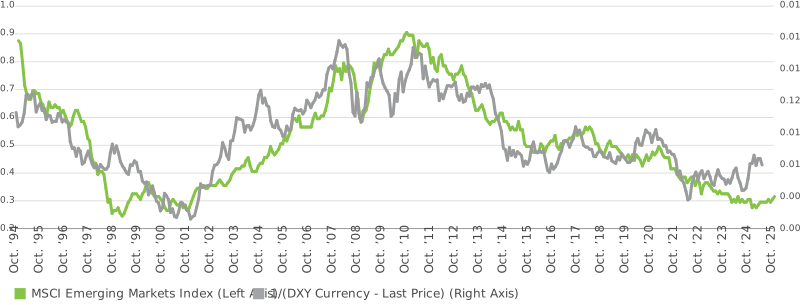
Sources: Bloomberg and William Blair, as of October 2025. left axis shows relative performance of the MSCI Emerging Markets Index to the MSCI World Index. The right axis shows the inverse of the U.S. Dollar Index. Past performance is historical and not indicative of future returns. A direct investment in an unmanaged index is not possible.
A key driver of renewed EM performance has been a sustained shift in global macro conditions. EM markets historically exhibit a strong inverse relationship with the U.S. dollar, and 2025’s weakening U.S. dollar trend provided a significant tailwind. The strong negative correlation between EM relative returns and dollar strength highlights the importance of currency cycles to EM valuations.
The rerating of EM equities stands on a firm foundation. After U.S. President Trump’s April “Liberation Day” announcement of sweeping tariffs triggered a brief bout of volatility, investor flows into EM equities turned positive and have remained steady since. Institutional positioning, however, is still relatively light despite the performance recovery, suggesting continued room for capital reallocation. At the same time, heightened concentration risk in U.S. markets has likely strengthened investors’ motivation to diversify globally. The United States now represents roughly two-thirds of the MSCI All Country World Index by market capitalization, or nearly three times its share of global gross domestic product (GDP).
The AI investment cycle is redefining the global landscape, and EMs are deeply embedded in the AI growth story. Markets such as Taiwan and Korea remain integral to the global semiconductor and server-component supply chains, providing much of the hardware required for AI applications. More than 20% of total EM revenue is expected to be AI-related in 2029, according to Goldman Sachs, and we believe the ongoing AI capex cycle should remain a durable source of growth across North Asia.
While U.S. firms have captured a disproportionate share of the AI-related market-cap expansion, EMs play a central role in the infrastructure buildout. This is most pronounced in semiconductors, memory, and data-center power systems. China’s domestic AI initiatives, including the emergence of locally developed models, have also accelerated technology investment, placing the country roughly two years behind the United States in the AI investment cycle, in our view.
The AI investment cycle is redefining the global landscape, and EMs are deeply embedded in the AI growth story. — Todd McClone, CFA, Partner
Rising AI-driven energy demand has created parallel opportunities in EM power infrastructure. Korean firms such as Hyundai Electric and Hyosung Heavy are key suppliers of transformers and grid components, while Indian manufacturers are expanding renewable-energy and transmission capacity to meet industrial demand.
Defense spending has also emerged as a durable global theme. Korea’s Hanwha Aerospace and Hyundai Rotem, along with Turkey’s Aselsan Elektronik, have become major exporters of defense systems to Western Europe and the Middle East, while Indian defense companies such as Bharat Electronics and Hindustan Aeronautics are benefiting from increased domestic defense budgets and import substitution. The Korean shipbuilding sector, through HD Hyundai Heavy Industries and related firms, is participating in both liquefied natural gas (LNG) infrastructure and potentially the U.S. naval upgrade program, reinforcing its industrial relevance.
Healthcare is another source of structural growth. After several years of weakness, Chinese and Indian contract research and contract development and manufacturing (CRO/CDMO) firms are seeing renewed demand linked to biotechnology investment and GLP-1 production. As domestic research-and-development (R&D) ecosystems mature, healthcare innovation is becoming a more enduring contributor to EM earnings quality.
After several years of relative underperformance, the valuation gap between quality and value within EM has begun to narrow as investors refocus on sustainable earnings and resilient business models. Historically, periods in which quality-oriented EM equities have lagged the index have been short-lived.
As inflation moderates and monetary policy across several EM economies shifts toward easing, market leadership is likely to broaden beyond early-cycle beneficiaries. A U.S. Federal Reserve pivot to rate cuts and a softer dollar would create room for many EM central banks to lower rates without undermining currency stability, reinforcing domestic growth prospects and supporting asset valuations. Investor sentiment has improved meaningfully, with renewed inflows into EM equities and bonds reflecting rising confidence in the durability of this cycle.
In India, consumption and the deepening of the financial system continue to serve as key growth engines. — Ian Smith, Partner
The macro backdrop remains constructive. EM economic growth is expected to continue outpacing that of developed markets, supported by improving fiscal balances, moderating inflation, and an increasingly stable global policy environment. As fundamentals regain influence, we believe corporate earnings momentum should strengthen, particularly in markets in which high real yields previously constrained growth.
From a portfolio perspective, we believe investors could benefit from maintaining core exposure to high-quality manufacturing companies in North Asia and India, two markets positioned to capture the next wave of AI and industrial spending. In Latin America, opportunities are emerging in quality growth names with attractive valuations in Brazil and Mexico as monetary and fiscal conditions improve. Meanwhile, exposure to defensive quality companies, particularly in healthcare and select areas of the consumption-related sector, can serve as portfolio ballasts and provide resilience against market volatility.
China’s economy continues its transition from property-driven growth to advanced manufacturing. The government’s massive fiscal support program has prioritized industrial upgrading and technological self-reliance. Bank lending has shifted accordingly, with financing to the property sector declining sharply, while credit to manufacturing, semiconductors, robotics, and biotech has surged.
Year-over-year loan growth shows a clear pivot away from property lending and toward industrial sectors, underscoring Beijing’s push to support advanced manufacturing and productive investment.
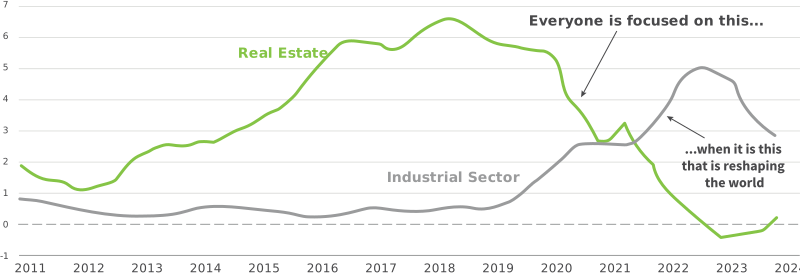
Sources: Gavekal and William Blair, as of 12/31/24.
Although domestic consumption remains subdued, rising exports to EMs are helping offset trade frictions with the West. China’s dominance in electric vehicles (EVs), batteries, and solar power continues to anchor its manufacturing edge, while infrastructure investment and targeted fiscal programs provide a steady policy backstop. Despite lingering structural headwinds and geopolitical risks, we believe current valuations are attractive, and point to potential reengagement from Western investors, which could have an outsized impact on performance.
India’s market lagged in 2025 as high valuations, modest earnings growth, trade tensions with the United States, and limited AI exposure weighed on performance. Yet India’s structural story remains compelling. The country’s ongoing infrastructure buildout continues to drive growth, supported by sustained public investment and pro-manufacturing initiatives, such as the Make in India and Production Linked Incentive programs.
Since the early 2000s, India’s small- and mid-cap segment has delivered substantially higher cumulative returns than China A-shares, China H-shares, and the NIFTY.

Sources: Bloomberg and William Blair, as of September 2025. Chart shows total returns rebased to 0 on 1/31/2002. China A-shares are represented by the CSI 300 Index; China H-shares by the MSCI China Index; India large-cap equities by the NIFTY; India small- and mid-cap equities by the NIFTY Midcap 100. Past performance is historical and is not indicative of future returns. A direct investment in an unmanaged index is not possible.
Consumption and the deepening of the financial system continue to serve as key growth engines. Low household leverage and a young, expanding workforce underpin steady demand for credit and durable goods, while rising incomes support the shift from staples to discretionary spending. India’s economy is forecast by Morgan Stanley and World Bank to grow at roughly twice the pace of global GDP over the medium term.
Despite near-term consolidation, we believe India’s encouraging long-term equity story remains intact. Over the past decade, Indian small- and midcap equities have far outperformed both the NIFTY and Chinese benchmarks, illustrating the country’s depth of entrepreneurial opportunity. Corporate earnings are expected to strengthen in 2026, supported by policy continuity, fiscal stimulus, and an improving macro backdrop.
Although valuations are still somewhat elevated, we believe the combination of reform momentum, expanding manufacturing capacity, and resilient consumer demand continues to reinforce India’s position as one of the most durable growth stories in EMs.
Brazil and Mexico headline a Latin American recovery story centered on improving monetary conditions and fiscal pragmatism. Brazil’s benchmark interest rate was 15% as of November 2025, its highest level in nearly two decades. However, its disinflation trend has strengthened, and analysts expect a gradual easing cycle to commence in early 2026. Despite the drag from high borrowing costs, Brazil’s macroeconomic backdrop remains stable, and lower rates should help revive credit growth and corporate investment.
Mexico continues to benefit from nearshoring: roughly 85% of its exports enter the U.S. tariff-free under existing trade agreements. Foreign direct investment reached a record high in the first half of 2025 as manufacturers continued to relocate supply chains closer to the U.S. market. Elsewhere, Argentina’s market remains small and illiquid, though scope for renewed policy reforms under President Javier Milei’s administration have drawn cautious optimism.
In Europe, the Middle East, and Africa (EMEA), we believe United Arab Emirates (UAE) equities offer a compelling case supported by strong macro fundamentals, geopolitical stability, and positive investor sentiment. The economy is projected to grow at 4% to 5% annually, driven by diversification into non-oil sectors, such as technology, renewable energy, and tourism. Real estate continues to benefit from robust demand and rising prices, while financial institutions enjoy healthy credit growth and digital transformation. Infrastructure spending on transport, logistics, and energy projects underpins long-term growth, reinforcing the UAE’s position as a resilient and diversified market in the region.
Meanwhile, South Africa’s market rebounded in 2025, supported by improved political sentiment, a steadier macro backdrop, and stronger commodity prices. With valuations still below historical averages and sectors like mining, financials, and consumer staples positioned to benefit from cyclical recovery, we believe South Africa offers selective opportunities for long-term investors seeking exposure to EMs with commodity leverage.
EMs now account for 60% of global population and 40% of global GDP (driving 70% of real growth), but represent only 11% of the MSCI ACWI weight. They also remain underweighted in global portfolios, underscoring the long-term potential for reallocation.
With the U.S. dollar in retreat, fundamentals improving, and new growth engines emerging across regions, we believe the case for sustained EM leadership is gaining traction. EMs are home to many of the world’s most competitive companies, many of which are global leaders in semiconductors, energy infrastructure, and healthcare innovation.
As capital redistributes, we expect investors reward proven profitability and quality, and we believe EM equities are poised to continue their shift from potential to performance.
Todd McClone, CFA, partner, is a portfolio manager on William Blair’s global equity team.
Ian Smith, partner, is a portfolio manager on William Blair’s global equity team.

Part 1 | Protectionism, Policy Shifts, and the New Economic Reality
Part 2 | EM Equity Outlook 2026: From Rebound to Rotation
Part 3 | EM Debt Outlook 2026: Momentum Continues
Part 4 | China: Repositioning for the Next Phase of Global Industrialization
The CSI 300 Index is a market-capitalization-weighted index that consists of 300 A-share stocks traded on the Shanghai and Shenzhen exchanges. The MSCI All Country World Index (ACWI) captures large- and mid-cap representation across developed and emerging markets. The MSCI Emerging Markets (EM) Index captures large- and mid-cap representation across 27 EMs. The MSCI China Index captures large- and mid-cap representation across China A shares, H shares, B shares, Red chips, P chips, and foreign listings (such as ADRs). The MSCI USA Investable Market Index (IMI) captures large-, mid-, and small-cap companies across the U.S. equity market. The NIFTY (formally NIFTY 50) is India’s main stock market benchmark. It tracks the 50 largest and most liquid companies listed on the National Stock Exchange of India (NSE). The NIFTY Midcap 100 Index tracks the performance of the 100 mid-sized companies listed on the National Stock Exchange of India.
References to specific companies are for illustrative purposes only and are not intended and should not be interpreted as recommendations to purchase or sell such securities. The securities discussed do not represent all securities purchased, sold, or recommended for clients. It should not be assumed that any investment in the securities referenced was or will be profitable. As of the date of publication, William Blair Investment Management held positions in the following companies referenced in one or more of its investment strategies: Aselsan Elektronik, Bharat Electronics, Hanwha Aerospace, HD Hyundai Heavy Industries, Hindustan Aeronautics, Hyundai Electric, Hyosung Heavy, Hyundai Rotem. Companies discussed but not listed were not held by William Blair Investment Management. Holdings are subject to change without notice.
View Fund:
https://im.williamblair.com/investments/sicav-funds/lu0995405320-emerging-markets-growth-fund
View Fund:
https://im.williamblair.com/investments/sicav-funds/lu0995405593-emerging-markets-leaders-fund
View Fund:
https://im.williamblair.com/investments/sicav-funds/lu1397782274-emerging-markets-small-cap-growth-fund
View Strategy:
https://im.williamblair.com/investments/separate-accounts/emerging-markets-growth
View Strategy:
https://im.williamblair.com/investments/separate-accounts/emerging-markets-leaders
View Strategy:
https://im.williamblair.com/investments/separate-accounts/emerging-markets-small-cap-growth
Want the latest insights on the economy and other forces shaping the investment landscape?
Subscribe to our Investing Insights newsletter.
Any investment or strategy mentioned herein may not be appropriate for every investor. There can be no assurance that investment objectives will be met. Products and services listed are available only to residents of this jurisdiction and may only be available to certain categories of investors. The information on this website does not constitute an offer for products or services, or a solicitation of an offer to any persons outside of this jurisdiction who are prohibited from receiving such information under applicable laws and regulations. Nothing on this webpage should be construed as advice and is therefore not a recommendation to buy or sell shares.
Please carefully consider the William Blair Funds’ investment objectives, risks, charges, and expenses before investing. This and other information is contained in the Funds’ prospectus and summary prospectus, which you may obtain by calling 1-800-742-7272. Read the prospectus and summary prospectus carefully before investing. Investing includes the risk of loss.
The William Blair Funds are distributed by William Blair & Company, L.L.C., member FINRA/SIPC.
The William Blair SICAV is a Luxembourg investment company with variable capital registered with the Commission de Surveillance du Secteur Financier (“CSSF”) which qualifies as an undertaking for collective investment in transferable securities (“UCITS”). The Management Company of the SICAV has appointed William Blair Investment Management, LLC as the investment manager for the fund.
Please carefully consider the investment objectives, risks, charges, and expenses of the William Blair SICAV. This and other important information is contained in the prospectus and Key Investor Information Document (KIID). Read these documents carefully before investing. The information contained on this website is not a substitute for those documents or for professional external advice.
Information and opinions expressed are those of the authors and may not reflect the opinions of other investment teams within William Blair Investment Management, LLC, or affiliates. Factual information has been taken from sources we believe to be reliable, but its accuracy, completeness or interpretation cannot be guaranteed. Information is current as of the date appearing in this material only and subject to change without notice. Statements concerning financial market trends are based on current market conditions, which will fluctuate. This material may include estimates, outlooks, projections, and other forward-looking statements. Due to a variety of factors, actual events may differ significantly from those presented.
Investing involves risks, including the possible loss of principal. Equity securities may decline in value due to both real and perceived general market, economic, and industry conditions. The securities of smaller companies may be more volatile and less liquid than securities of larger companies. Investing in foreign denominated and/or domiciled securities may involve heightened risk due to currency fluctuations, and economic and political risks. These risks may be enhanced in emerging markets and frontier markets. Investing in the bond market is subject to certain risks including market, interest rate, issuer, credit, and inflation risk. High-yield, lower-rated, securities involve greater risk than higher-rated securities. Different investment styles may shift in and out of favor depending on market conditions. Diversification does not ensure against loss.
Past performance is not indicative of future returns. References to specific companies are for illustrative purposes only and should not be construed as investment advice or a recommendation to buy or sell any security.
William Blair Investment Management, LLC is an investment adviser registered with the U.S. Securities and Exchange Commission.
Issued in the United Kingdom by William Blair International, Ltd., authorized and regulated by the Financial Conduct Authority (FCA), and is only directed at and is only made available to persons falling within articles 19, 38, 47, and 49 of the Financial Services and Markets Act of 2000 (Financial Promotion) Order 2005 (all such persons being referred to as "relevant persons").
Issued in the European Economic Area (EEA) by William Blair B.V., authorized and supervised by the Dutch Authority for the Financial Markets (AFM) under license number 14006134 and also supervised by the Dutch Central Bank (DNB), registered at the Dutch Chamber of Commerce under number 82375682 and has its statutory seat in Amsterdam, the Netherlands. This material is only intended for eligible counterparties and professional clients.
Issued in Switzerland by William Blair Investment Services (Zurich) GmbH, Talstrasse 65, 8001 Zurich, Switzerland ("WBIS"). WBIS is engaged in the offering of collective investment schemes and renders further, non-regulated services in the financial sector. WBIS is affiliated with FINOS Finanzomubdsstelle Schweiz, a recognized ombudsman office where clients may initiate mediation proceedings pursuant to articles 74 et seq. of the Swiss Financial Services Act ("FinSA"). The client advisers of WBIS are registered with regservices.ch by BX Swiss AG, a client adviser registration body authorized by the Swiss Financial Market Supervisory Authority ("FINMA"). WBIS is not supervised by FINMA or any other supervisory authority or self-regulatory organization. This material is only intended for institutional and professional clients pursuant to article 4(3) to (5) FinSA.
Issued in Australia by William Blair Investment Management, LLC (“William Blair”), which is exempt from the requirement to hold an Australian financial services license under Australia's Corporations Act 2001 (Cth). William Blair is registered as an investment advisor with the U.S. Securities and Exchange Commission (“SEC”) and regulated by the SEC under the U.S. Investment Advisers Act of 1940, which differs from Australian laws. This material is intended only for wholesale clients.
Issued in Singapore by William Blair International (Singapore) Pte. Ltd. (Registration Number 201943312R), which is regulated by the Monetary Authority of Singapore under a Capital Markets Services License to conduct fund management activities. This material is intended only for institutional investors and may not be distributed to retail investors.
Issued in Canada by William Blair Investment Management, LLC, which relies on the international adviser exemption, pursuant to section 8.26 of National Instrument 31-103 in Canada.


The content contained in this site is intended as informational or educational in nature and does not constitute investment advice or a recommendation of any investment strategy or product for a particular investor. Investment advice and recommendations can be provided only after careful consideration of an investor’s objectives, guidelines, and restrictions. Investors should consult a financial professional/financial consultant or investment adviser before making any investment decisions. Investing includes the risk of loss.
Copyright © 2026 William Blair. William Blair is a registered trademark of William Blair & Company, L.L.C. “William Blair” refers to William Blair Investment Management, LLC and affiliates.

