As consumer spending and corporate profits come under pressure, U.S. growth is currently being driven by AI-driven investment and policy shifts.
Tariff pressure and global competition has forced Europe to pivot toward investment-led, domestically focused growth.
Structural inefficiencies and an ongoing property correction continue to weigh on China’s domestic demand outlook.
Renewed focus on domestic economies spells better growth support in the United States and the European Union (EU). China’s domestic consumption will likely continue to struggle under the weight of the ongoing housing market correction. All in all, we believe a stable U.S. dollar, ample global liquidity, and strong demand for industrial commodities are likely to prove fertile ground for emerging market (EM) assets in 2026.
United States: Tariff Challenges Spur Policy Shifts
The U.S. economy is entering 2026 with narrow gross domestic product (GDP) growth, challenged consumer spending, and weaker corporate profits. And because of the recent government shutdown, economic data for the second half of the year is scant.
However, AI-related infrastructure investment—think data centers, software, chips, and related equipment—explained as much as three-fourths of the overall GDP growth in the first six months of 2025, based on official data.[1]
Considering the announced acceleration of capital expenditure (capex) spending by all major hyperscalers, there is little reason to expect AI-related infrastructure to feature less prominently in U.S. GDP growth in the second half of 2025.
Meanwhile, the U.S. consumer faces ongoing challenges as tariff-induced inflation eats into consumers’ purchasing power. Seven months after the current U.S. administration raised tariffs on “Liberation Day,” the overall consumer price inflation is up modestly: annual inflation accelerated from a low of 2.3% in April to just over 3% in September, thanks largely to continued (and belated) housing disinflation.
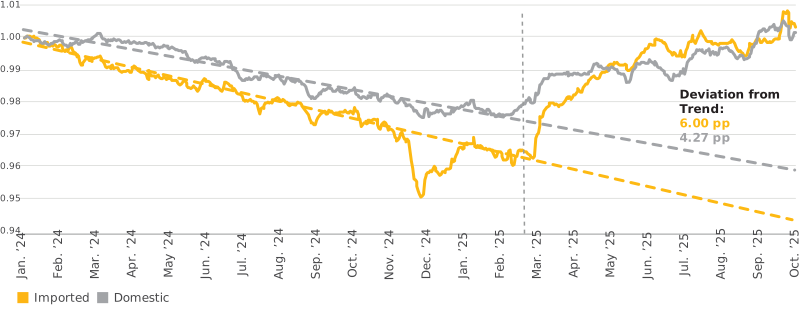
Just below the headline level, things look less rosy. Goods prices are moving up sequentially at an accelerating rate. This is in sharp contrast to two decades of persistent declines. According to the Harvard Business School Pricing Lab, imported goods prices are up approximately 6% from pre-tariff trends, while domestic goods prices are up some 4.3%.
Goods Prices Break From Trend Following New Tariffs
After years of gradual price declines, both domestic and imported goods have seen abrupt increases once new tariff measures took effect. Imported goods prices have climbed the most, rising around 6 percentage points relative to trend, while domestic goods are up more than 4 points.
Sources: Harvard Business School Pricing Lab and William Blair, as of October 11, 2025.
U.S. consumer spending has not remained unscathed: retail sales adjusted for inflation are barely growing and consumer discretionary stocks within the S&P 500 Index have lagged the overall index by about 12% through the end of November 2025.
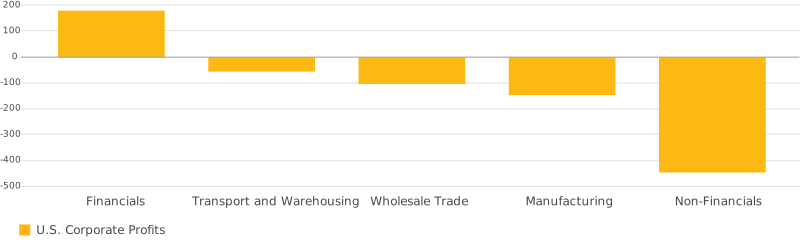
Tariff-related disruption is also eating into corporate profits more broadly. According to aggregate corporate profits data tracked by the U.S. Bureau of Economic Analysis, manufacturing, wholesale trade, and transport profits are down sequentially by 10% to 20% in the first half of 2025 from 2024. Outside of AI-related investment and financials, U.S. companies are feeling squeezed.
Year-Over-Year Change in U.S. Corporate Profits (In Billions)
Tariff-related disruptions have weighed on corporate profitability, and most industries outside AI investment and financials have experienced noticeable strain.
Sources: U.S. Bureau of Economic Analysis (BEA) and William Blair, as of June 30, 2025.
Facing midterm elections in November 2026, the current U.S. administration is likely to focus on supporting the domestic economy. The One Big Beautiful Bill Act aims to catalyze greater investment into domestic production by reducing or eliminating tax on structures, research and development, and other activities. The Tax Foundation estimates that the new rules will reduce 2026 tax liabilities for manufacturers by over 2% and other industries by half that amount.
In mid-November, the U.S. administration reversed its stance on tariffing agricultural products after domestic consumers recoiled from rapid increases of food prices. And allowing banks to hold smaller capital buffers, together with a 30% reduction in supervisory and regulatory units of the U.S. Federal Reserve (Fed), is estimated to free several trillion dollars’ worth in lending capacity.[2]
Lower corporate taxes and more lending, not to mention a possible “housing emergency” to lower mortgage rates in a bid to revive the moribund housing market, all suggest stronger, broader GDP growth in 2026.
But inflation is likely to prove sticky, especially since much of the tariff impact is still working its way through the economy, and new tariffs—on kitchen cabinets and bathroom vanities, for example—have yet to take effect.
Inflation is likely to prove sticky, especially since much of the tariff impact is still working its way through the economy.
Europe and China: Shifting Toward Domestic Revival
All these tariffs and “America First” policies appear to have produced a broad focus on reviving domestic market dynamism in Europe and China.
Europe’s New Growth Era
European exporters are facing major headwinds from U.S. tariffs and Chinese competition. German exports to the United States fell by 7.4% in the first nine months of 2025. And although the European Union (EU) negotiated a trade deal that taxes steel and aluminum as final products, U.S. authorities have been applying the negotiated tariff rate of 50% on 407 steel and aluminum “derivative” products (which are capital and consumer goods produced in Europe) as well, further crimping European exporters. And in the latest negotiations twist, U.S. Secretary of Commerce Howard Lutnick and U.S. Trade Representative Jamieson Greer used their late-November trip to Brussels to make tariff relief contingent on the EU scrapping its digital regulations.
In response, Germany, the single largest economy within the euro area, abandoned its decades-old self-imposed fiscal austerity in favor of investing in national infrastructure and defense. Although the size of the investment is enormous—€500 billion relative to Germany’s €4.5 trillion-sized economy—the infrastructure upgrade is urgently needed.
Hence, the fiscal multiplier from this spending is likely to be significantly more than one, meaning that for every €1 spent, the returns to the economy will be several times higher. Once the funds disbursement gains steam, it is likely to help Germany register economic growth in 2026 after four years of stagnation.
In addition, much of the government funds in Germany and elsewhere in Europe are increasingly likely to be spent purchasing from domestic producers; “Made in Europe” is now an explicit policy aim across the continent.
The rest of the EU is not standing still. According to the Centre for European Policy Studies, the EU has been generating more start-ups than the United States in each of the last five years, and many acknowledge the continent’s highly skilled and increasingly entrepreneurial labor force.
What is needed is domestically generated financial capital, which the European Commission already identified earlier in 2025. Change in Europe tends to be slow, but the continent is undeniably moving toward incentivizing more growth after years of focus on fiscal austerity.
“Made in Europe” is now an explicit policy aim across the continent.
China’s Path to Market Efficiency
In China, rather than supporting start-ups, winding down companies is identified as a key impediment to building a truly single, domestic market. Local governments tend to support local firms via tax breaks, preferential access to bank lending, and other schemes; they prop up local champions and resist industry consolidation, often leading to overcapacity and meager profits for all.
This is a complex challenge involving revenue sharing among central and regional fiscal authorities. For the past 18 months, local authorities have been issuing bonds as a means of debt swap, and local government financing vehicles are supposed to be wound down by June 2027. For now, aggregate government deficit is running in double digits of the country’s GDP, but domestic consumption is likely to remain depressed in 2026, as housing prices continue to adjust.
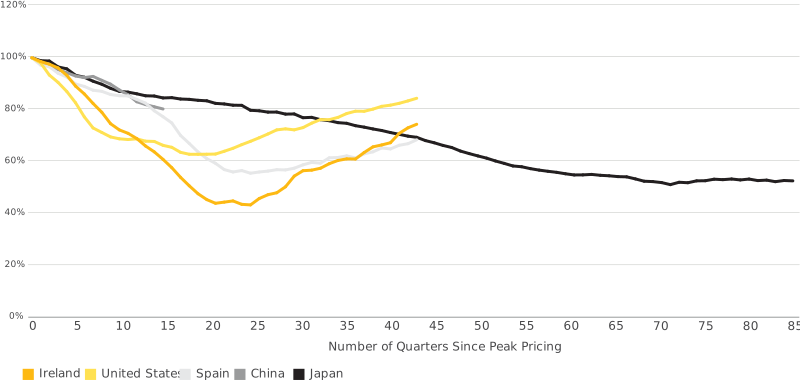
Chinese authorities have also made periodic efforts to support residential real estate activity and household incomes, and we are likely to see renewed efforts in 2026. However, China’s residential real-estate sector must continue to downsize, and housing prices are not yet done decelerating. International experience suggests that a housing market correction typically lasts about five years and results in cumulative price declines of 40% to 60%.
Chinese Housing Prices Are Still Decelerating
China’s housing sector has continued its multiyear price adjustment. Lessons from the United States, Japan, and other countries indicate that similar corrections can last five years or more, signaling that domestic housing prices in China may still have room to fall.
Sources: Federal Reserve Economic Data (FRED) database and William Blair, as of November 2025. FRED housing index data (y axis) measures the cumulate decrease in housing prices from peak (set to 100 in each case).
China’s prices are down approximately 20% from their peak, but are likely to decline further, as affordability is still an issue. A modestly sized apartment in Shanghai still retails for about $3 million. For as long as the housing slump will continue, China’s domestic consumption will likely remain challenged.
Conclusion
In summary, growth is likely to broaden and accelerate in two of the world’s three principal demand centers in 2026. EM exporters of industrial commodities are also likely to continue experiencing material improvement in fortunes in 2026.
Although the U.S. dollar may not depreciate much further from current levels unless growth in Europe and in Japan surprises materially to the upside, broad-based economic growth and ample liquidity are likely to provide a fertile ground for EM assets.
Olga Bitel, partner, is the chief investment strategist at William Blair.
Emerging Markets 2026 Outlook Series
Part 1 | Protectionism, Policy Shifts, and the New Economic Reality
Want the latest insights on the economy and other forces shaping the investment landscape?
Subscribe to our Investing Insights newsletter.
Any investment or strategy mentioned herein may not be appropriate for every investor. There can be no assurance that investment objectives will be met. Products and services listed are available only to residents of this jurisdiction and may only be available to certain categories of investors. The information on this website does not constitute an offer for products or services, or a solicitation of an offer to any persons outside of this jurisdiction who are prohibited from receiving such information under applicable laws and regulations. Nothing on this webpage should be construed as advice and is therefore not a recommendation to buy or sell shares.
Please carefully consider the William Blair Funds’ investment objectives, risks, charges, and expenses before investing. This and other information is contained in the Funds’ prospectus and summary prospectus, which you may obtain by calling 1-800-742-7272. Read the prospectus and summary prospectus carefully before investing. Investing includes the risk of loss.
The William Blair Funds are distributed by William Blair & Company, L.L.C., member FINRA/SIPC.
The William Blair SICAV is a Luxembourg investment company with variable capital registered with the Commission de Surveillance du Secteur Financier (“CSSF”) which qualifies as an undertaking for collective investment in transferable securities (“UCITS”). The Management Company of the SICAV has appointed William Blair Investment Management, LLC as the investment manager for the fund.
Please carefully consider the investment objectives, risks, charges, and expenses of the William Blair SICAV. This and other important information is contained in the prospectus and Key Investor Information Document (KIID). Read these documents carefully before investing. The information contained on this website is not a substitute for those documents or for professional external advice.
Information and opinions expressed are those of the authors and may not reflect the opinions of other investment teams within William Blair Investment Management, LLC, or affiliates. Factual information has been taken from sources we believe to be reliable, but its accuracy, completeness or interpretation cannot be guaranteed. Information is current as of the date appearing in this material only and subject to change without notice. Statements concerning financial market trends are based on current market conditions, which will fluctuate. This material may include estimates, outlooks, projections, and other forward-looking statements. Due to a variety of factors, actual events may differ significantly from those presented.
Investing involves risks, including the possible loss of principal. Equity securities may decline in value due to both real and perceived general market, economic, and industry conditions. The securities of smaller companies may be more volatile and less liquid than securities of larger companies. Investing in foreign denominated and/or domiciled securities may involve heightened risk due to currency fluctuations, and economic and political risks. These risks may be enhanced in emerging markets and frontier markets. Investing in the bond market is subject to certain risks including market, interest rate, issuer, credit, and inflation risk. High-yield, lower-rated, securities involve greater risk than higher-rated securities. Different investment styles may shift in and out of favor depending on market conditions. Diversification does not ensure against loss.
Past performance is not indicative of future returns. References to specific companies are for illustrative purposes only and should not be construed as investment advice or a recommendation to buy or sell any security.
William Blair Investment Management, LLC is an investment adviser registered with the U.S. Securities and Exchange Commission.
Issued in the United Kingdom by William Blair International, Ltd., authorized and regulated by the Financial Conduct Authority (FCA), and is only directed at and is only made available to persons falling within articles 19, 38, 47, and 49 of the Financial Services and Markets Act of 2000 (Financial Promotion) Order 2005 (all such persons being referred to as "relevant persons").
Issued in the European Economic Area (EEA) by William Blair B.V., authorized and supervised by the Dutch Authority for the Financial Markets (AFM) under license number 14006134 and also supervised by the Dutch Central Bank (DNB), registered at the Dutch Chamber of Commerce under number 82375682 and has its statutory seat in Amsterdam, the Netherlands. This material is only intended for eligible counterparties and professional clients.
Issued in Switzerland by William Blair Investment Services (Zurich) GmbH, Talstrasse 65, 8001 Zurich, Switzerland ("WBIS"). WBIS is engaged in the offering of collective investment schemes and renders further, non-regulated services in the financial sector. WBIS is affiliated with FINOS Finanzomubdsstelle Schweiz, a recognized ombudsman office where clients may initiate mediation proceedings pursuant to articles 74 et seq. of the Swiss Financial Services Act ("FinSA"). The client advisers of WBIS are registered with regservices.ch by BX Swiss AG, a client adviser registration body authorized by the Swiss Financial Market Supervisory Authority ("FINMA"). WBIS is not supervised by FINMA or any other supervisory authority or self-regulatory organization. This material is only intended for institutional and professional clients pursuant to article 4(3) to (5) FinSA.
Issued in Australia by William Blair Investment Management, LLC (“William Blair”), which is exempt from the requirement to hold an Australian financial services license under Australia's Corporations Act 2001 (Cth). William Blair is registered as an investment advisor with the U.S. Securities and Exchange Commission (“SEC”) and regulated by the SEC under the U.S. Investment Advisers Act of 1940, which differs from Australian laws. This material is intended only for wholesale clients.
Issued in Singapore by William Blair International (Singapore) Pte. Ltd. (Registration Number 201943312R), which is regulated by the Monetary Authority of Singapore under a Capital Markets Services License to conduct fund management activities. This material is intended only for institutional investors and may not be distributed to retail investors.
Issued in Canada by William Blair Investment Management, LLC, which relies on the international adviser exemption, pursuant to section 8.26 of National Instrument 31-103 in Canada.
The content contained in this site is intended as informational or educational in nature and does not constitute investment advice or a recommendation of any investment strategy or product for a particular investor. Investment advice and recommendations can be provided only after careful consideration of an investor’s objectives, guidelines, and restrictions. Investors should consult a financial professional/financial consultant or investment adviser before making any investment decisions. Investing includes the risk of loss.