March 3, 2026 | Global Equity
A Broader Market Awakening

Chief Investment Strategist
March 3, 2026 | Global Equity
Chief Investment Strategist
View Fund:
https://im.williamblair.com/investments/mutual-funds/wbeix-emerging-markets-growth-fund
View Fund:
https://im.williamblair.com/investments/mutual-funds/wbelx-emerging-markets-leaders-fund
View Fund:
https://im.williamblair.com/investments/mutual-funds/besix-emerging-markets-small-cap-growth-fund
View Fund:
https://im.williamblair.com/investments/sicav-funds/lu0995405320-emerging-markets-growth-fund

After a decade defined by narrow, largely intangible businesses driving growth, markets appear to be entering a new phase shaped by physical buildout across AI infrastructure, defense, energy, and supply chains. As discussed in our prior piece, “The Revenge of the Tangibles,” this shift reflects a broader global building cycle that is driving growth and returns beyond the United States and across a wider range of industries and regions. Here, we move from the high-level thesis to examine how that shift is showing up in markets today—and the questions it raises for investors.
When discussing the future of the markets, it is always useful to begin with what markets have already told us.
Over the past decade, returns across major asset classes created a clear narrative. A long-term investor who allocated to equities and looked away may have concluded that the United States was the only place to generate meaningful returns. U.S. equities delivered annualized gains two to four times higher than most alternatives. That is a substantial gap over a long period and it shaped asset-allocation decisions around the world.
Over the past three years, however, that picture has begun to change, with jurisdictions that had been dormant showing signs of life. In 2025, U.S. equities, while still vibrant, lagged both EMs and some developed markets. Early 2026 data show the same pattern. While still attractive, the United States is no longer the only engine of global equity performance.
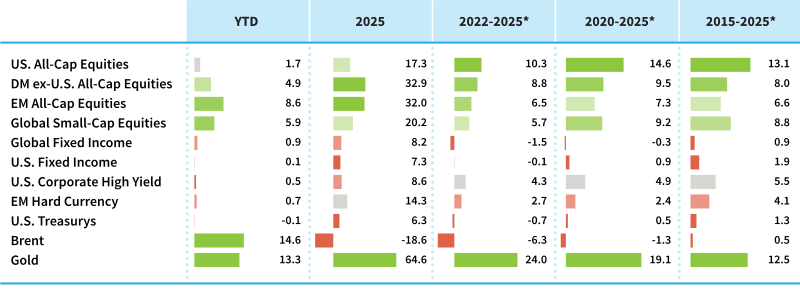
Source: Macrobond, as of 1/31/26. For 2022-2025, 2020-2025, and 2015-2025, returns are annualized. Returns are in U.S. dollars. Index representation is as follows: U.S. all-cap equities, MSCI ACWI IMI; developed market (DM) ex-U.S. all-cap equities, MSCI ACWI ex-U.S. IMI; emerging market (EM) all-cap equities, MSCI EM IMI; global small-cap equities; MSCI ACWI Small Cap; global fixed income, Bloomberg Global Aggregate Index; U.S. fixed income, Bloomberg U.S. Aggregate Index; U.S. corporate high yield, Bloomberg U.S. Corporate High Yield Index; EM hard currency, J.P. Morgan EMBI Global Diversified; U.S. Treasurys, Bloomberg U.S. Treasury Index. Past performance is historical and not indicative of future returns. A direct investment in an unmanaged index is not possible.
What’s changing? One change is the industry composition of returns. Leading sectors—including semiconductors, hardware, machinery, mining and metals, and industrial conglomerates—are asset-heavy industries. Many underperformed for years and were largely overlooked. Country-level performance shows a similar pattern. Jurisdictions with strong exposure to building and industrial capacity are rising in the rankings. It appears we are in the early innings of a structural shift.
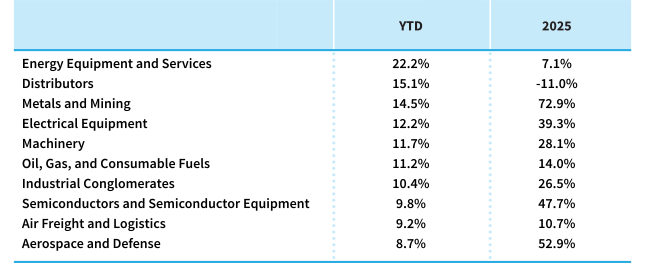
Source: Macrobond, as of 1/31/26. Returns are in U.S. dollars. Past performance is historical and not indicative of future returns. A direct investment in an unmanaged index is not possible.
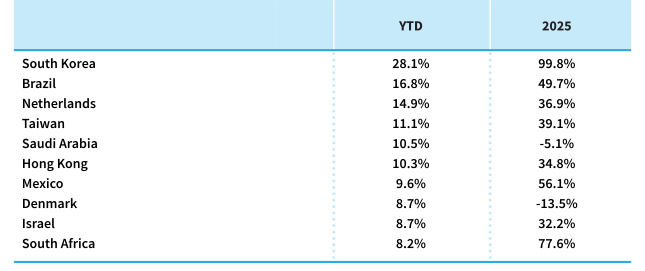
Source: Macrobond, as of 1/31/26. Returns are in U.S. dollars. Past performance is historical and not indicative of future returns. A direct investment in an unmanaged index is not possible.
What is happening, and how long could it persist? Two forces appear to be acting together to drive this change: technological transformation and geopolitics.
On the technology side, AI has moved from concept to programming to infrastructure buildout. Across the world (though primarily in the United States and China), we are seeing a tremendous buildout of the AI infrastructure. Massive data centers are being built across geographies, and we’ll need to build even more of them as technology becomes a larger portion of everyday life. These facilities will require semiconductors, cooling systems, power infrastructure, and connectivity. They also require roads, airports, transmission lines, and energy supply. This is not confined to one country or region; the scale is global. And the buildout has a long runway; it is measured in years and even decades, not quarters.
The second force is geopolitical. Many countries are now pursuing greater economic autonomy. This is really a response to America First policies, which did not start with the current administration. The shift began a decade ago; the current administration has simply made it more explicit and taken more concrete steps to implement it.
In geostrategic parlance, the shift is toward every country for itself. It’s about abandoning the post-World War II global integrationist order and ensuring the ability to go it alone. In practice, that means every country that is now capable is trying to figure out how to bulletproof their national economies. Policymakers are prioritizing national resilience in defense, energy, and supply chains.
Economic autonomy is really about physical growth, so the practical result is increased public and private investment in physical infrastructure and industrial capacity. As governments negotiate trade agreements, fund defense and energy projects, and lower barriers within regional blocs, we’re seeing growth in more places. Canada, Australia, Japan, and much of Europe are moving in this direction at varying speeds.
Building AI capability and building national autonomy now require many of the same inputs.
This technological investment and geopolitical reprioritization are reinforcing each other. Building AI capability and building national autonomy now require many of the same inputs. Modern defense is less about legacy hardware and more about drones, remotely operated systems, and software-enabled platforms. Supporting those systems requires the underlying industrial stack: critical minerals, electric and magnetic motors, and the full range of components that power electrified and autonomous technologies.
Those same inputs extend beyond defense. The infrastructure needed for autonomous logistics, robotics, and advanced manufacturing—such as drones delivering customers’ Amazon and Walmart packages—relies on the same electric and digital backbone. We need factories and robots, but also software that connects it all, and a lot more copper, silver, and rare earths. The prominence of metals and mining in recent performance reflects that linkage.
When mapped onto a traditional industries-and-countries framework, the resulting investment opportunities appear widely dispersed across regions. Defense-related spending is becoming more compelling in places such as Germany and Japan. Technology hardware and semiconductors remain concentrated in established hubs such as Taiwan and South Korea, with Japan also participating. Metals and mining continue to be anchored in many emerging markets, including Mexico, South Africa, and Chile, particularly in copper.
Lastly, as growth strengthens and investment accelerates, yield curves typically steepen, creating a more favorable environment for financial institutions. Banks, as the conduit for capital flows, tend to participate broadly in such cycles, and this environment is unlikely to be an exception.
Markets are now grappling with several key questions.
The first is the economics of AI infrastructure. Hyperscale technology companies are investing heavily in data centers and related capacity. Will future revenues and profits justify this investment? Or will business models evolve in ways that reduce cash generation? These companies have been central to market performance for years, and the answer will matter for valuations and capital allocation.
The second is the future of software. Demand for software will undoubtedly rise as AI capabilities expand. The question is who will deliver it. Will incumbent providers adapt their existing platforms, or will new entrants capture a meaningful share of the opportunity? Hyperscalers may choose to move further up the stack, embedding applications and workflows into their ecosystems. The allocation of these profit pools remains highly uncertain.
The third is the definition of a “national builder.” As countries pursue economic autonomy, which companies will be allowed to participate in key projects? Will domestic firms be favored, or will suppliers from allied jurisdictions benefit? Legal, financial, and geopolitical considerations will shape access to markets and profits. These decisions will influence which companies capture value from the current investment cycle.
The common thread across these developments is construction—of infrastructure, supply chains, and industrial capacity. Markets are reflecting that shift. Performance leadership is broadening beyond the narrow set of winners that defined the previous decade. The combination of technological investment and geopolitical priorities suggests that this phase may persist. For investors, periods of dislocation often create opportunity. The current environment appears to be one of those periods.
Olga Bitel, partner, is the chief investment strategist at William Blair.
The Bloomberg Global Aggregate Index is a broad, market-capitalization-weighted benchmark of global investment-grade fixed-income markets, including government, corporate, and securitized bonds across developed and emerging markets. The Bloomberg U.S. Aggregate Index is a A flagship benchmark for the U.S. investment-grade bond market, covering Treasuries, government-related, corporate, mortgage-backed, and asset-backed securities. The Bloomberg U.S. Corporate High Yield Index is a market-value-weighted index that tracks the performance of U.S.-dollar-denominated, below-investment-grade corporate bonds issued in the United States. The Bloomberg U.S. Treasury Index: A benchmark tracking the performance of United States Treasury securities across maturities, including bills, notes, and bonds, in the domestic fixed-income market. The J.P. Morgan EMBI Global Diversified measures total returns for U.S.-dollar-denominated sovereign and quasi-sovereign emerging-market bonds, with country weights capped and redistributed to reduce concentration. The MSCI ACWI ex-U.S. IMI is a global equity index that tracks large-, mid-, and small-cap stocks across developed and emerging markets outside the United States. The MSCI ACWI IMI is a global equity index that tracks large-, mid-, and small-cap stocks across developed and emerging markets, representing the broad opportunity set of publicly listed equities worldwide. The MSCI ACWI Small Cap is a global equity index that tracks small-cap stocks across developed and emerging markets. The MSCI EM IMI is an equity index that measures the performance of large-, mid-, and small-cap stocks across EMs. The MSCI AC World Index is a market-capitalization-weighted index that tracks large- and mid-cap equities across developed and emerging markets globally.
View Fund:
https://im.williamblair.com/investments/sicav-funds/lu0995405593-emerging-markets-leaders-fund
View Fund:
https://im.williamblair.com/investments/sicav-funds/lu1397782274-emerging-markets-small-cap-growth-fund
View Strategy:
https://im.williamblair.com/investments/separate-accounts/emerging-markets-growth
View Strategy:
https://im.williamblair.com/investments/separate-accounts/emerging-markets-leaders
View Strategy:
https://im.williamblair.com/investments/separate-accounts/emerging-markets-small-cap-growth
Want the latest insights on the economy and other forces shaping the investment landscape?
Subscribe to our Investing Insights newsletter.
Any investment or strategy mentioned herein may not be appropriate for every investor. There can be no assurance that investment objectives will be met. Products and services listed are available only to residents of this jurisdiction and may only be available to certain categories of investors. The information on this website does not constitute an offer for products or services, or a solicitation of an offer to any persons outside of this jurisdiction who are prohibited from receiving such information under applicable laws and regulations. Nothing on this webpage should be construed as advice and is therefore not a recommendation to buy or sell shares.
Please carefully consider the Funds’ investment objectives, risks, charges, and expenses before investing. This and other information is contained in the Funds’ prospectus and summary prospectus, which you may obtain by calling 1-800-742-7272. Read the prospectus and summary prospectus carefully before investing. Investing includes the risk of loss.
The William Blair Funds and William Blair ETFs are distributed by William Blair & Company, L.L.C., member FINRA/SIPC.
The William Blair SICAV is a Luxembourg investment company with variable capital registered with the Commission de Surveillance du Secteur Financier (“CSSF”) which qualifies as an undertaking for collective investment in transferable securities (“UCITS”). The Management Company of the SICAV has appointed William Blair Investment Management, LLC as the investment manager for the fund.
Please carefully consider the investment objectives, risks, charges, and expenses of the William Blair SICAV. This and other important information is contained in the prospectus and Key Investor Information Document (KIID). Read these documents carefully before investing. The information contained on this website is not a substitute for those documents or for professional external advice.
Information and opinions expressed are those of the authors and may not reflect the opinions of other investment teams within William Blair Investment Management, LLC, or affiliates. Factual information has been taken from sources we believe to be reliable, but its accuracy, completeness or interpretation cannot be guaranteed. Information is current as of the date appearing in this material only and subject to change without notice. Statements concerning financial market trends are based on current market conditions, which will fluctuate. This material may include estimates, outlooks, projections, and other forward-looking statements. Due to a variety of factors, actual events may differ significantly from those presented.
Investing involves risks, including the possible loss of principal. Equity securities may decline in value due to both real and perceived general market, economic, and industry conditions. The securities of smaller companies may be more volatile and less liquid than securities of larger companies. Investing in foreign denominated and/or domiciled securities may involve heightened risk due to currency fluctuations, and economic and political risks. These risks may be enhanced in emerging markets and frontier markets. Investing in the bond market is subject to certain risks including market, interest rate, issuer, credit, and inflation risk. High-yield, lower-rated, securities involve greater risk than higher-rated securities. Different investment styles may shift in and out of favor depending on market conditions. Diversification does not ensure against loss.
Past performance is not indicative of future returns. References to specific companies are for illustrative purposes only and should not be construed as investment advice or a recommendation to buy or sell any security.
William Blair Investment Management, LLC is an investment adviser registered with the U.S. Securities and Exchange Commission.
Issued in the United Kingdom by William Blair International, Ltd., authorized and regulated by the Financial Conduct Authority (FCA), and is only directed at and is only made available to persons falling within articles 19, 38, 47, and 49 of the Financial Services and Markets Act of 2000 (Financial Promotion) Order 2005 (all such persons being referred to as "relevant persons").
Issued in the European Economic Area (EEA) by William Blair B.V., authorized and supervised by the Dutch Authority for the Financial Markets (AFM) under license number 14006134 and also supervised by the Dutch Central Bank (DNB), registered at the Dutch Chamber of Commerce under number 82375682 and has its statutory seat in Amsterdam, the Netherlands. This material is only intended for eligible counterparties and professional clients.
Issued in Switzerland by William Blair Investment Services (Zurich) GmbH, Talstrasse 65, 8001 Zurich, Switzerland ("WBIS"). WBIS is engaged in the offering of collective investment schemes and renders further, non-regulated services in the financial sector. WBIS is affiliated with FINOS Finanzomubdsstelle Schweiz, a recognized ombudsman office where clients may initiate mediation proceedings pursuant to articles 74 et seq. of the Swiss Financial Services Act ("FinSA"). The client advisers of WBIS are registered with regservices.ch by BX Swiss AG, a client adviser registration body authorized by the Swiss Financial Market Supervisory Authority ("FINMA"). WBIS is not supervised by FINMA or any other supervisory authority or self-regulatory organization. This material is only intended for institutional and professional clients pursuant to article 4(3) to (5) FinSA.
Issued in Australia by William Blair Investment Management, LLC (“William Blair”), which is exempt from the requirement to hold an Australian financial services license under Australia's Corporations Act 2001 (Cth). William Blair is registered as an investment advisor with the U.S. Securities and Exchange Commission (“SEC”) and regulated by the SEC under the U.S. Investment Advisers Act of 1940, which differs from Australian laws. This material is intended only for wholesale clients.
Issued in Singapore by William Blair International (Singapore) Pte. Ltd. (Registration Number 201943312R), which is regulated by the Monetary Authority of Singapore under a Capital Markets Services License to conduct fund management activities. This material is intended only for institutional investors and may not be distributed to retail investors.
Issued in Canada by William Blair Investment Management, LLC, which relies on the international adviser exemption, pursuant to section 8.26 of National Instrument 31-103 in Canada.


The content contained in this site is intended as informational or educational in nature and does not constitute investment advice or a recommendation of any investment strategy or product for a particular investor. Investment advice and recommendations can be provided only after careful consideration of an investor’s objectives, guidelines, and restrictions. Investors should consult a financial professional/financial consultant or investment adviser before making any investment decisions. Investing includes the risk of loss.
Copyright © 2026 William Blair. William Blair is a registered trademark of William Blair & Company, L.L.C. “William Blair” refers to William Blair Investment Management, LLC and affiliates.

