January 23, 2026 | Cross-Team
China: Repositioning for the Next Phase of Global Industrialization

Portfolio Manager

Portfolio Manager
January 23, 2026 | Cross-Team
Portfolio Manager
Portfolio Manager
View Fund:
https://im.williamblair.com/investments/sicav-funds/lu2093699408-emerging-markets-debt-local-currency-fund
View Fund:
https://im.williamblair.com/investments/sicav-funds/lu2879845290-emerging-markets-frontier-debt-fund
View Fund:
https://im.williamblair.com/investments/sicav-funds/lu2093691256-emerging-markets-debt-hard-currency-fund

In 2025, China’s economic policy reached an inflection point, actively encouraging technology and manufacturing companies to move up the value chain while taking a more hands-off approach to the property market and domestic consumption.
As a result, China’s exports of these industries surged in 2025, helping Chinese equity markets outperform other major markets.
We asked two of our China investment experts—Vivian Lin Thurson, CFA, partner, and Clifford Chi-wai Lau, CFA—to discuss their outlook for 2026.
Vivian: The biggest change is that the Chinese government has begun to decisively support innovation and technological advancement in areas such as AI, electric vehicles (EVs), and automation. The era of restrictions on China’s major internet and technology companies appears to be over.
This is a strategic move to upgrade China’s position in the economic value chain from labor-intensive to innovation- and technology-led industries. This will likely be an ongoing, longer-term initiative, and U.S. trade pressure on China has further catalyzed these efforts as China realizes it needs to become more technologically self-reliant. China also understands that as its economy gets bigger, growth will slow structurally, and the country needs new growth engines.
By contrast, government support for other parts of the economy has been rather muted. The country’s broad-based economy continues to struggle, whether you look at consumption, the property market, or domestic infrastructure and manufacturing investments. The government has taken relatively minor steps to support these areas but not nearly enough to make a major impact.
Despite a resumption of the U.S.-China trade war, Chinese exports on a global basis have continued to rise as China broadens its exports to other regions. U.S. export volume is still large in absolute terms, but the growth has been coming from exports to the rest of the world. Strong exports have helped alleviate pressure on the domestic side of the economy.
Clifford: Reading between the lines of the new five-year plan the Chinese government issued in October 2025, the government seems set on reallocating resources from low-value manufacturing to high-value technology and services. I expect more capital expenditure to be directed towards building out advanced chip technology, for example. This could be the leading driver of Chinese economic activity in the next few years.
With consumer confidence depressed, the government has undertaken some short-term initiatives to encourage spending—subsidizing upgrades to electrical appliances and smart phones, for example. These types of measures are not very sustainable, whereas a longer-term policy to transition to a higher-value-added position in the value chain could be.
China also understands that as its economy gets bigger, growth will slow structurally, and the country needs new growth engines. – Vivian Lin Thurston, CFA, Partner
Vivian: In China’s property market, we’ve seen some stabilization in tier 1[1] cities and certain outlying regions. However, overall demand for property remains weak. Youth unemployment also remains a problem, and consumer confidence is still low.
Given the weakness in the broader economy, you could ask why the government has not been more aggressive with stimulus. Again, I think they are encouraging a structural rebalancing of the economy, pushing it higher up the value chain and trying to find new pillars of growth such as innovation and technology. If the property market can’t support China’s economy as it did in the past, why stimulate it?
At the same time, the broad-based China economy continues to face deflationary pressures; producer prices have experienced their longest streak of monthly declines since China’s market reforms of the late 1970s and early 1980s.
China’s growing dominance in the global EV market is just one example of the country’s momentum in innovation- and technology-led manufacturing.
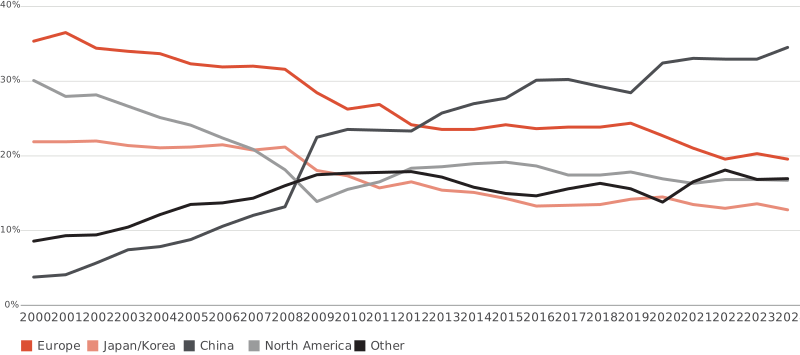
Sources: BofA Global Research, National Bureau of Statistics of China, Bloomberg, and William Blair, as of December 2024.
At the same time, the broad-based China economy continues to face deflationary pressures; producer prices have experienced their longest streak of monthly declines since China's market reforms of the late 1970s and early 1980s.
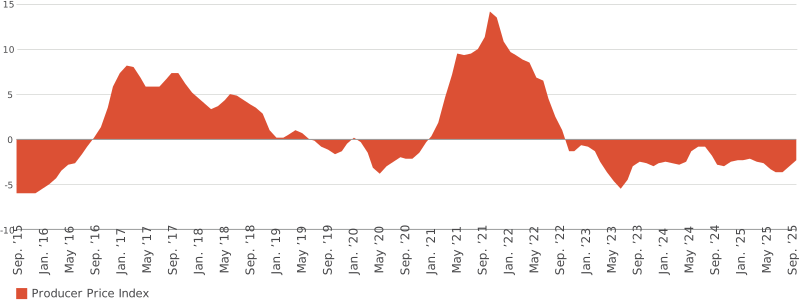
Sources: BofA Global Research, National Bureau of Statistics of China, Bloomberg, and William Blair, as of December 2024.
Clifford: As China pursues its goal of rebalancing the economy to higher-value manufacturing, it’s doubtful that policy makers will look to push for aggressive growth.
The government’s unofficial gross domestic product (GDP) growth target is 5%, and we’ve reduced our own expectations and set a lower bound of 4.5%. It’s more realistic and gives the government more space to operate while executing this rebalancing act.
Vivian: It’s possible real GDP growth could hit 5% in 2025 as exports have accelerated, with some trade being pulled forward because of the trade war. Exports may decelerate a bit in 2026, but they should remain a strong growth driver.
We’re less sure about the strength of China’s domestic economy, but base effect should start getting better. Over the next 5 to 10 years, China’s annual GDP growth will likely decline to 3.5% to 4.0%, which is a natural development as absolute GDP gets bigger.
If the property market can’t support China’s economy as it did in the past, why stimulate it? – Vivian Lin Thurston, CFA, Partner
Vivian: The United States is still one of China’s largest trading partners, with gross trades reaching approximately $650 billion in 2024, but Chinese exports to the United States have been in decline since the first U.S.-China trade war in 2018. However, China’s gross exports to the rest of the world have increased over 40% during the same period.
EVs provide a prime example of how China is globalizing its high-value industrialization. Chinese manufacturers have come up with technologically advanced, user friendly, and aesthetically appealing EVs at affordable prices and are now leading global EV development. These EVs are an especially good solution for emerging countries. And we’re seeing similar trends in Europe, with Chinese EVs accounting for approximately 13% of the EV market in Western Europe.
Given the weakness of the domestic economy, Chinese companies have had to seek growth outside China. The government is encouraging them to go abroad to support exports and take up the slack in the domestic economy.
Vivian: Chinese equity markets have outperformed other major markets. The MSCI China Index[2]— mainly Hong Kong-listed ADRs and some China A shares—was up around 37% year-to-date as of mid-November 2025. This compares to about 15.7% for the S&P 500 Index[3], 19% for the MSCI World Index[4], and 32% for the MSCI Emerging Markets (EM) Index[5].
We’re seeing a long-overdue rerating of Chinese equities. You can point to several catalysts—inflows sparked by distressed valuations and a weak U.S. dollar, benign monetary and fiscal policy, government support for innovation, and the headlines from DeepSeek in January 2025, which is when global investors started to recognize China’s AI progress. We’ve also seen an improvement in tech and internet company fundamentals and earnings.
The U.S.–China trade war is another factor. Chinese equities sold off sharply after the so-called “Liberation Day” at the beginning of April but have outperformed since. This could be a reflection that investors are betting that President Trump’s harsh anti-China rhetoric is mainly a negotiating position. The October 30, 2025, meeting between President Trump and President Xi, the first in six years, seemed amicable, and it looks as if there was agreement in several key areas.
Vivian: Our focus is on innovation and technology. I believe AI will likely continue to be the key global investment theme. In our view, we're still in the early innings in China, but recently, we’ve seen companies such as Alibaba, ByteDance, and Tencent—which are becoming Chinese hyperscalers—step up AI spending. We expect their stock prices to benefit, first through sentiment and momentum and then through earnings traction.
E-commerce continues to be very competitive, so it’s important to pick winners and losers carefully. Alibaba, for example, is starting to turn around its e-commerce business, helped by improved regulatory backdrop, its AI capabilities, and a new CEO who is implementing some encouraging initiatives.
EVs provide a prime example of how China is globalizing its high-value industrialization. – Vivian Lin Thurston, CFA, Partner
We’re also looking at AI-related tech hardware on two fronts: companies servicing the global AI supply chain, supplying Nvidia or global hyperscalers such as Google and Meta, and domestic AI development. China is likely to decouple from the rest of the world in AI systems, partly because of restrictions placed on companies such as Huawei, and thus has had to develop its own domestic supply chain.
The EV supply chain is another focus area for us. There are interesting developments in autonomous driving, and although EV growth remains a compelling top-down story, intense competition continues to pressure margins, especially for the EV original equipment manufacturers (OEMs). Bottom-up, it’s harder to find strength, but we believe there could be some winners along the value chain, such as EV battery maker Contemporary Amperex Technology Co. Limited (CATL).
It is the largest global EV battery producer with world-leading technology and agnostic to any EV manufacturer, which puts it in a strong position.
We also like biotech, specialty pharma, and contract research development and manufacturing organizations (CRDMOs). Chinese companies in this space have been out of favor for the last few years, but as policy and geopolitical risk has declined and demand picked up in the global industry, they are starting to show tremendous earnings recovery. They have showcased to the world how much progress China has made on cutting-edge cancer drugs.
Clifford: It has not been an especially exciting year for the Chinese government bond (CGB) market. The 10-year CGB is now yielding 1.5%, which is not particularly attractive, especially when there is no reason to expect a sharp increase in economic activity.
I don’t believe the government is concerned about inflation, so we do not expect interest rates to go much higher, and yields are likely to be range-bound. There may be some steepening in the yield curve, both from natural pressure to normalize and selling activity from local investors reducing fixed-income allocations to catch the rally in Chinese equities.
In this environment, we believe there may be opportunities to trade the range if the yield curve steepens or the market consolidates or corrects, but these shifts would likely be minor. In general, we believe investors should consider limiting CGB holdings and turn those allocations to higher-beta or higher-yielding Asian or EMs.
Chinese government bond yields are among the lowest of all major EMs. Low yields are likely to remain as long as China’s domestic economy remains soft and deflationary pressures prevail.
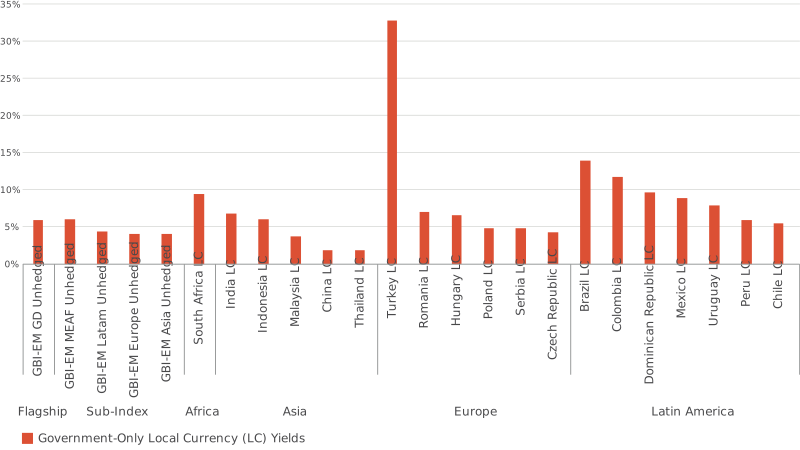
Sources: J.P. Morgan and William Blair, as of October 2025. Local currency yields are represented by the J.P. Morgan Government Bond Index—Emerging Markets (GBI-EM) suite of indices, which track local-currency sovereign bonds issued by EM countries. (Index information has been obtained from sources believed to be reliable but J.P. Morgan does not warrant its completeness or accuracy. The indices are used with permission. The indices may not be copied, used, or distributed without J.P. Morgan’s prior written approval. Copyright 2024, JPMorgan Chase & Co. All rights reserved.)
Clifford: We expect the renminbi to remain fairly stable versus other currencies. There is no pressure on the government to devalue because exports have been doing fine without this intervention.
There may be modest technical upside as China continues its efforts to build a currency bloc with EM countries and promote the renminbi as an alternative reserve currency. The share of global trade settled in renminbi has been rising, but it is a very long way from the scale of a reserve currency such as the U.S. dollar, which is incredibly liquid, highly transparent, and without capital controls. It is unlikely China can match that, especially not now.
Vivian Lin Thurston, CFA, partner, is a portfolio manager on William Blair’s global equity team.
Clifford Lau, CFA, is a portfolio manager on William Blair’s emerging markets debt team.

Part 1 | Protectionism, Policy Shifts, and the New Economic Reality
Part 2 | EM Equity Outlook 2026: From Rebound to Rotation
Part 3 | EM Debt Outlook 2026: Momentum Continues
Part 4 | China: Repositioning for the Next Phase of Global Industrialization
[1] In China, a tier 1 city refers to the country’s most economically developed, internationally connected, and influential urban centers such as Beijing, Shanghai, Guangzhou, and Shenzhen. [2] The MSCI China Index captures large- and mid-cap representation across China A shares, H shares, B shares, Red chips, P chips, and foreign listings (such as ADRs). [3] The Standard & Poor’s (S&P) 500 Index tracks the performance of 500 large companies listed on stock exchanges in the United States. [4] The MSCI World Index measures the performance of large- and mid-cap stocks across 23 developed markets, representing about 85% of their total market capitalization. [5] The MSCI Emerging Markets (EM) Index captures large- and mid-cap representation across 27 EMs.
View Strategy:
https://im.williamblair.com/investments/separate-accounts/emerging-markets-debt-hard-currency
View Strategy:
https://im.williamblair.com/investments/separate-accounts/emerging-markets-debt-local-currency
View Strategy:
https://im.williamblair.com/investments/separate-accounts/emerging-markets-frontier-debt
Want the latest insights on the economy and other forces shaping the investment landscape?
Subscribe to our Investing Insights newsletter.
Any investment or strategy mentioned herein may not be appropriate for every investor. There can be no assurance that investment objectives will be met. Products and services listed are available only to residents of this jurisdiction and may only be available to certain categories of investors. The information on this website does not constitute an offer for products or services, or a solicitation of an offer to any persons outside of this jurisdiction who are prohibited from receiving such information under applicable laws and regulations. Nothing on this webpage should be construed as advice and is therefore not a recommendation to buy or sell shares.
Please carefully consider the William Blair Funds’ investment objectives, risks, charges, and expenses before investing. This and other information is contained in the Funds’ prospectus and summary prospectus, which you may obtain by calling 1-800-742-7272. Read the prospectus and summary prospectus carefully before investing. Investing includes the risk of loss.
The William Blair Funds are distributed by William Blair & Company, L.L.C., member FINRA/SIPC.
The William Blair SICAV is a Luxembourg investment company with variable capital registered with the Commission de Surveillance du Secteur Financier (“CSSF”) which qualifies as an undertaking for collective investment in transferable securities (“UCITS”). The Management Company of the SICAV has appointed William Blair Investment Management, LLC as the investment manager for the fund.
Please carefully consider the investment objectives, risks, charges, and expenses of the William Blair SICAV. This and other important information is contained in the prospectus and Key Investor Information Document (KIID). Read these documents carefully before investing. The information contained on this website is not a substitute for those documents or for professional external advice.
Information and opinions expressed are those of the authors and may not reflect the opinions of other investment teams within William Blair Investment Management, LLC, or affiliates. Factual information has been taken from sources we believe to be reliable, but its accuracy, completeness or interpretation cannot be guaranteed. Information is current as of the date appearing in this material only and subject to change without notice. Statements concerning financial market trends are based on current market conditions, which will fluctuate. This material may include estimates, outlooks, projections, and other forward-looking statements. Due to a variety of factors, actual events may differ significantly from those presented.
Investing involves risks, including the possible loss of principal. Equity securities may decline in value due to both real and perceived general market, economic, and industry conditions. The securities of smaller companies may be more volatile and less liquid than securities of larger companies. Investing in foreign denominated and/or domiciled securities may involve heightened risk due to currency fluctuations, and economic and political risks. These risks may be enhanced in emerging markets and frontier markets. Investing in the bond market is subject to certain risks including market, interest rate, issuer, credit, and inflation risk. High-yield, lower-rated, securities involve greater risk than higher-rated securities. Different investment styles may shift in and out of favor depending on market conditions. Diversification does not ensure against loss.
Past performance is not indicative of future returns. References to specific companies are for illustrative purposes only and should not be construed as investment advice or a recommendation to buy or sell any security.
William Blair Investment Management, LLC is an investment adviser registered with the U.S. Securities and Exchange Commission.
Issued in the United Kingdom by William Blair International, Ltd., authorized and regulated by the Financial Conduct Authority (FCA), and is only directed at and is only made available to persons falling within articles 19, 38, 47, and 49 of the Financial Services and Markets Act of 2000 (Financial Promotion) Order 2005 (all such persons being referred to as "relevant persons").
Issued in the European Economic Area (EEA) by William Blair B.V., authorized and supervised by the Dutch Authority for the Financial Markets (AFM) under license number 14006134 and also supervised by the Dutch Central Bank (DNB), registered at the Dutch Chamber of Commerce under number 82375682 and has its statutory seat in Amsterdam, the Netherlands. This material is only intended for eligible counterparties and professional clients.
Issued in Switzerland by William Blair Investment Services (Zurich) GmbH, Talstrasse 65, 8001 Zurich, Switzerland ("WBIS"). WBIS is engaged in the offering of collective investment schemes and renders further, non-regulated services in the financial sector. WBIS is affiliated with FINOS Finanzomubdsstelle Schweiz, a recognized ombudsman office where clients may initiate mediation proceedings pursuant to articles 74 et seq. of the Swiss Financial Services Act ("FinSA"). The client advisers of WBIS are registered with regservices.ch by BX Swiss AG, a client adviser registration body authorized by the Swiss Financial Market Supervisory Authority ("FINMA"). WBIS is not supervised by FINMA or any other supervisory authority or self-regulatory organization. This material is only intended for institutional and professional clients pursuant to article 4(3) to (5) FinSA.
Issued in Australia by William Blair Investment Management, LLC (“William Blair”), which is exempt from the requirement to hold an Australian financial services license under Australia's Corporations Act 2001 (Cth). William Blair is registered as an investment advisor with the U.S. Securities and Exchange Commission (“SEC”) and regulated by the SEC under the U.S. Investment Advisers Act of 1940, which differs from Australian laws. This material is intended only for wholesale clients.
Issued in Singapore by William Blair International (Singapore) Pte. Ltd. (Registration Number 201943312R), which is regulated by the Monetary Authority of Singapore under a Capital Markets Services License to conduct fund management activities. This material is intended only for institutional investors and may not be distributed to retail investors.
Issued in Canada by William Blair Investment Management, LLC, which relies on the international adviser exemption, pursuant to section 8.26 of National Instrument 31-103 in Canada.


The content contained in this site is intended as informational or educational in nature and does not constitute investment advice or a recommendation of any investment strategy or product for a particular investor. Investment advice and recommendations can be provided only after careful consideration of an investor’s objectives, guidelines, and restrictions. Investors should consult a financial professional/financial consultant or investment adviser before making any investment decisions. Investing includes the risk of loss.
Copyright © 2026 William Blair. William Blair is a registered trademark of William Blair & Company, L.L.C. “William Blair” refers to William Blair Investment Management, LLC and affiliates.
.png%3Fh%3D600%26iar%3D0%26w%3D800&w=1920&q=75)
