January 15, 2026 | Emerging Markets Debt
EM Debt Outlook 2026: Momentum Continues

Head of the Emerging Markets Debt Team, Portfolio Manager
January 15, 2026 | Emerging Markets Debt
Head of the Emerging Markets Debt Team, Portfolio Manager
View Fund:
https://im.williamblair.com/investments/sicav-funds/lu2093691256-emerging-markets-debt-hard-currency-fund
View Fund:
https://im.williamblair.com/investments/sicav-funds/lu2093699408-emerging-markets-debt-local-currency-fund
View Fund:
https://im.williamblair.com/investments/sicav-funds/lu2879845290-emerging-markets-frontier-debt-fund
View Strategy:
https://im.williamblair.com/investments/separate-accounts/emerging-markets-debt-opportunities

Momentum continues in emerging markets (EM) debt, and we believe the forces behind it haven’t faded. Solid growth, improving balance sheets, attractive real yields, and renewed inflows have carried strength from 2025 into the year ahead. But first let’s look back at 2025.
EM debt had a strong year in 2025. The asset class delivered robust returns across the board, with credit spreads in hard currency corporates and sovereigns tightening and yields moving lower. In the local currency space, EM currencies appreciated while local interest rates declined. And throughout the year, EM debt benefited from a combination of resilient fundamentals, strong technical conditions, and supportive valuations. All this resulted in strong performance across sub-asset classes.
Despite rising concerns about potential impacts from global trade tensions driven by U.S. policies and ongoing geopolitical conflicts, the overall fundamental backdrop remains resilient, and we believe this resilience should persist into 2026.
We believe EM economies will grow at approximately 3.7% on a gross domestic product (GDP)-weighted basis next year, as shown in the chart below, broadly in line with 2025’s estimated 3.9%, which exceeded expectations following concerns raised by the April 2025 U.S. tariff announcements.
Although risks related to U.S. tariff policy and global trade are ongoing, EMs have become increasingly insulated.
This solid economic growth should continue to anchor fiscal and debt dynamics across most EMs, where we anticipate stable fiscal positions and debt-to-GDP ratios. Furthermore, AI-related productivity gains should further support growth dynamics in many EMs.
External accounts are a particularly bright spot, where we believe persistent capital flows, strong direct foreign investment, and healthy current account surpluses will lead to robust balance-of-payments positions. The inflationary backdrop is benign, which should allow EM central banks to continue cutting rates, providing additional support going forward.
We expect EM GDP growth to remain steady across regions, holding near 4% through the forecast period. Asia and Africa continue to lead. While growth moderates slightly from 2025 onward, the trajectory remains stable, reinforcing the resilience of EM economies.
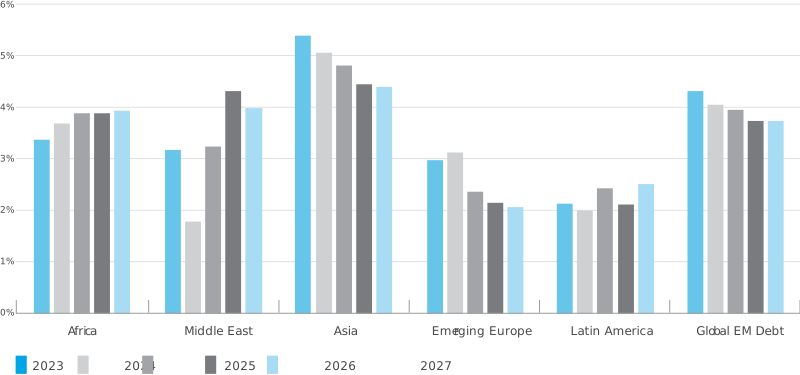
Sources: Oxford Economics, J.P. Morgan, and William Blair, as of October 31, 2025. Years 2025, 2026, and 2027 are forecasts.
In 2025, the effective U.S. tariff rate on imported goods saw one of its largest increases in more than a century. However, by the end of 2025 the impact was less severe than many had forecast in April, and reciprocal tariffs announced were softened by exemptions for critical goods and subsequent adjustments. Although risks related to U.S. tariff policy and global trade are ongoing, EMs have become increasingly insulated, with intra-EM trade now accounting for more than 50% of total EM trade, up from roughly 25% in the early 2000s, as shown in the chart below. This significantly reduces EM reliance on advanced economies, particularly the United States.
While global growth may decelerate due to softer conditions in developed markets, we believe EM fundamentals are resilient enough to withstand this gradual deceleration and credit default risk is expected to remain well contained. Overall, we view EM fundamentals as constructive for continued strong performance.
Intra-EM trade now accounts for more than 50% of total EM trade, up from roughly 25% in the early 2000s. This significantly reduces EM reliance on advanced economies, particularly the United States.
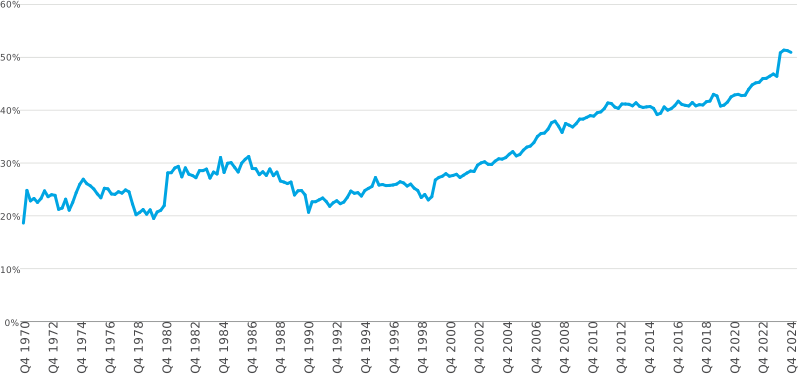
Sources: Direction of Trade Statistics (DOTS) and William Blair. Data is from March 31, 1970, through June 30, 2025, quarterly. DOTS presents the value of merchandise exports and imports disaggregated according to a country’s primary trading partners. Area and world aggregates are included in the display of trade flows between major areas of the world. Reported data is supplemented by estimates whenever such data is not available or current. Imports are reported on a cost, insurance and freight (CIF) basis and exports are reported on a free on board (FOB) basis, with the exception of a few countries for which imports are also available FOB. Time series data includes estimates derived from reports of partner countries for non-reporting and slow-reporting countries.
We expect technical conditions to remain supportive. Net new debt issuance should stay contained, below historical averages, and bilateral and multilateral institutions should continue to provide ample and affordable funding to EMs, reducing the need for issuance of new debt. At the same time, 2025 marked a shift in flows, with EM debt posting its first year of inflows since 2021. Global fixed-income investors remain underinvested in the asset class, creating room for increased allocations. Looking ahead, we anticipate a favorable backdrop for continued allocations into dedicated EM debt strategies in 2026.
Valuations across EM debt remain supportive as we head into 2026.
In hard currency, credit spreads are tight but yields remain above long-term averages. We expect overall index-level spreads to tighten toward the 250-basis-point mark, driven primarily by further narrowing in high-yield credits. We believe this backdrop, combined with an expected decline in U.S. Treasury yields (we expect the 10-year to reach 3.5% over the next 12 months), should support compelling returns for the J.P. Morgan Emerging Markets Bond Index (EMBI) Global Diversified.
In local currency, we believe investors are underestimating the potential for further monetary easing and see significant value in local rates. Attractive valuations suggest room for currency appreciation, as the U.S. dollar remains in overvalued territory. We expect EM currencies to perform well against the dollar and currencies of other developed markets. Spot rates versus purchasing power parity and real yields (as shown in the charts below) continue to highlight opportunities.
EM currencies appear undervalued relative to the U.S. dollar based on PPP deviations, while most developed market currencies hover near fair value or slightly overvalued. We expect EM currencies to perform well against the dollar and those of other developed markets.
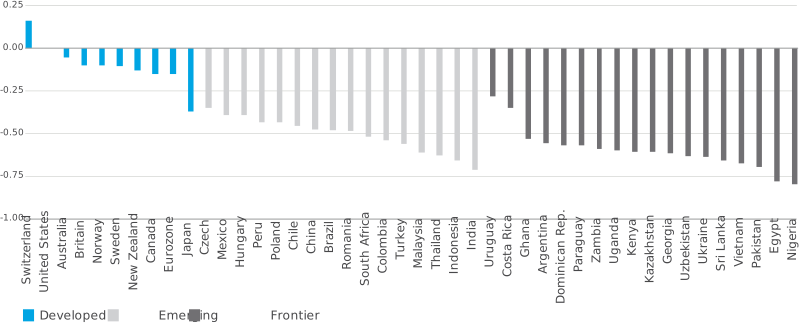
Sources: Bloomberg, Oxford Economics, and William Blair, as of October 31, 2025.
Emerging and frontier markets generally exhibit substantially higher trailing and forecast real yields compared to developed markets, where real yields remain near zero or negative. This disparity highlights a potential advantage for investors seeking positive real returns, as EM and frontier economies may offer more attractive income opportunities relative to developed markets.
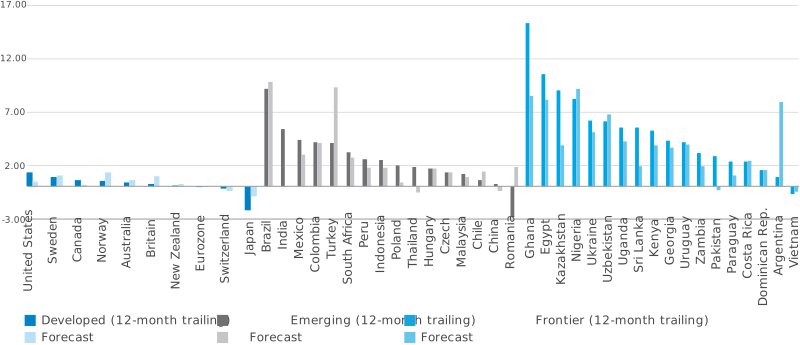
Sources: Bloomberg, Oxford Economics, and William Blair, as of October 31, 2025.
We also believe frontier markets remain attractive, supported by resilient fundamentals, high real yields, and ongoing foreign exchange adjustments.
While the potential for further rate cuts is generally limited after aggressive easing in 2025, select countries—including Egypt, Ghana, Zambia, and Kenya—have room for additional monetary easing as inflation moderates and external balances improve. In Nigeria, we believe further cuts are likely to be gradual and data-dependent rather than substantial. While the potential for further rate cuts elsewhere is more limited, strong carry, improving fiscal dynamics, and robust external accounts—especially among commodity exporters—should sustain investor interest.
Despite tighter spreads and concentrated positioning in a few markets, we believe the risk/reward profile is still positive, with most frontier debt offering a meaningful spread pickup over sovereign and developed market peers, and systemic risks contained by resilient fundamentals.
We also believe EM corporate credit continues to offer myriad investment opportunities at incremental spreads to sovereign credit at specific durations.
Issuance in 2025 rebounded to its highest level since 2021, still driven by supply outside of China. Expectations are for issuance to increase modestly into 2026, with net financing still marginally negative. Default expectations of 3% rise modestly for next year but are still below historical norms. With top-level credit metrics only marginally weaker, but still stronger than those of developed markets, we believe it is unlikely systemic risks will occur as fundamentals remain resilient.
Lastly, while the index-level valuation conundrum continues, with historically low spreads but still attractive all-in yield, corporate credit continues to offer a spread pickup when compared to its country of risk.
In 2025 oil markets were pressured by constant oversupply expectations and global trade concerns, with bouts of geopolitics providing price spikes. Prices are closing the year at about $65 per barrel, the lower end of the yearly range.
Demand for crude is expected to grow by approximately 1 million barrels per day in 2025, a bit lower than historical levels, but still decent, although some of this demand went into strategic inventories in China. Supply created an imbalance, with additional barrels coming from U.S. shale, Brazil, Guyana, Canada, Norway, and the Organization of the Petroleum Exporting Countries (OPEC).
Visible inventories have been built, and floating storage seems to be absorbing sanctioned barrels, which eventually will need to hit the market. So, in 2026, fundamentals point to an oversupplied market. With expectations of more than 2 million barrels per day of oversupply, prices should remain under pressure even as demand remains steady.
Given this, we remain cautious on oil-related investments, but also note that low-visibility events such as geopolitics or OPEC’s (and others’) reactions to much lower prices could offset the visible imbalance and provide some price support. Moreover, a resolution or escalation of geopolitical conflicts—such as those in Ukraine, Iran, or Venezuela—would likely impact global oil markets.
Notably, recent updates to longstanding forecasts propose steadier crude demand growth into the foreseeable future, with some even suggesting a supply crunch stemming from decline rates (the natural rate at which production declines from an existing oil or gas field) and the investment cycle later this decade.
We experienced an exceptional year for metals in 2025, with precious metals leading the charge. Gold and silver reached all-time highs driven by investor flows amid geopolitical uncertainty and Fed rate cuts. Gold was also supported by central bank purchases and silver by liquidity squeezes resulting from tariff concerns and inventory builds in the United States. Platinum benefited from gold’s gravitational pull, illiquidity in non-U.S. markets, and supply tightness.
Meanwhile, 2025 industrial metal performance was more diverse as copper outperformed on strong energy transition demand and supply downturns while aluminum gains were more modest given the metal's ample supply. Nickel’s oversupply woes continued throughout the year.
Pragmatism from U.S. policymakers and steady global engagement reinforce our view that the opportunities outweigh the risks.
For 2026 we believe that precious metals will remain supportive, driven by the Fed rate-cut cycle, geopolitical uncertainty, and fiscal deficits. In our opinion, gold should continue to benefit from ongoing central-bank buying, which we view as a more structural source of demand. Meanwhile, silver’s liquidity concerns could ease if tariff risks subside for the metal.
Industrial metals, meanwhile, could see continued momentum from major themes such as electrification and the expansion of AI and data centers, and cyclical demand might return. We remain cautious on Chinese demand growth in 2026 due to policy changes and economic uncertainty. However, nickel’s supply-demand balance could improve if the Indonesian government follows through on scaling back supply incentives and energy allocation shifts toward other metals, such as aluminum.
All in all, we anticipate another strong year for EM debt in 2026. While risks remain—stemming from U.S. policy uncertainty, trade tensions, and ongoing geopolitical conflicts—we believe these risks should stay relatively well contained.
A constructive backdrop for performance stems from resilient fundamentals anchored by solid GDP growth, stable fiscal positions, and benign inflation; valuations supported by attractive real yields and currency upside; and technical conditions reinforced by contained net new debt issuance and asset class inflows.
Pragmatism from U.S. policymakers and steady global engagement reinforce our view that the opportunities outweigh the risks, and we are positioned accordingly to capture upside potential across both hard and local currency markets.
Marcelo Assalin, CFA, partner, is the head of William Blair’s emerging markets debt team, on which he also serves as a portfolio manager.
Part 1 | Protectionism, Policy Shifts, and the New Economic Reality
Part 2 | EM Equity Outlook 2026: From Rebound to Rotation
Part 3 | EM Debt Outlook 2026: Momentum Continues
Part 4 | China: Repositioning for the Next Phase of Global Industrialization
The J.P. Morgan Emerging Markets Bond Index (EMBI) Global Diversified tracks total returns for U.S. dollar–denominated sovereign and quasi-sovereign EM debt while capping individual country weights to enhance diversification.
View Strategy:
https://im.williamblair.com/investments/separate-accounts/emerging-markets-debt-hard-currency
View Strategy:
https://im.williamblair.com/investments/separate-accounts/emerging-markets-debt-local-currency
View Strategy:
https://im.williamblair.com/investments/separate-accounts/emerging-markets-frontier-debt
Want the latest insights on the economy and other forces shaping the investment landscape?
Subscribe to our Investing Insights newsletter.
Any investment or strategy mentioned herein may not be appropriate for every investor. There can be no assurance that investment objectives will be met. Products and services listed are available only to residents of this jurisdiction and may only be available to certain categories of investors. The information on this website does not constitute an offer for products or services, or a solicitation of an offer to any persons outside of this jurisdiction who are prohibited from receiving such information under applicable laws and regulations. Nothing on this webpage should be construed as advice and is therefore not a recommendation to buy or sell shares.
Please carefully consider the Funds’ investment objectives, risks, charges, and expenses before investing. This and other information is contained in the Funds’ prospectus and summary prospectus, which you may obtain by calling 1-800-742-7272. Read the prospectus and summary prospectus carefully before investing. Investing includes the risk of loss.
The William Blair Funds and William Blair ETFs are distributed by William Blair & Company, L.L.C., member FINRA/SIPC.
The William Blair SICAV is a Luxembourg investment company with variable capital registered with the Commission de Surveillance du Secteur Financier (“CSSF”) which qualifies as an undertaking for collective investment in transferable securities (“UCITS”). The Management Company of the SICAV has appointed William Blair Investment Management, LLC as the investment manager for the fund.
Please carefully consider the investment objectives, risks, charges, and expenses of the William Blair SICAV. This and other important information is contained in the prospectus and Key Investor Information Document (KIID). Read these documents carefully before investing. The information contained on this website is not a substitute for those documents or for professional external advice.
Information and opinions expressed are those of the authors and may not reflect the opinions of other investment teams within William Blair Investment Management, LLC, or affiliates. Factual information has been taken from sources we believe to be reliable, but its accuracy, completeness or interpretation cannot be guaranteed. Information is current as of the date appearing in this material only and subject to change without notice. Statements concerning financial market trends are based on current market conditions, which will fluctuate. This material may include estimates, outlooks, projections, and other forward-looking statements. Due to a variety of factors, actual events may differ significantly from those presented.
Investing involves risks, including the possible loss of principal. Equity securities may decline in value due to both real and perceived general market, economic, and industry conditions. The securities of smaller companies may be more volatile and less liquid than securities of larger companies. Investing in foreign denominated and/or domiciled securities may involve heightened risk due to currency fluctuations, and economic and political risks. These risks may be enhanced in emerging markets and frontier markets. Investing in the bond market is subject to certain risks including market, interest rate, issuer, credit, and inflation risk. High-yield, lower-rated, securities involve greater risk than higher-rated securities. Different investment styles may shift in and out of favor depending on market conditions. Diversification does not ensure against loss.
Past performance is not indicative of future returns. References to specific companies are for illustrative purposes only and should not be construed as investment advice or a recommendation to buy or sell any security.
William Blair Investment Management, LLC is an investment adviser registered with the U.S. Securities and Exchange Commission.
Issued in the United Kingdom by William Blair International, Ltd., authorized and regulated by the Financial Conduct Authority (FCA), and is only directed at and is only made available to persons falling within articles 19, 38, 47, and 49 of the Financial Services and Markets Act of 2000 (Financial Promotion) Order 2005 (all such persons being referred to as "relevant persons").
Issued in the European Economic Area (EEA) by William Blair B.V., authorized and supervised by the Dutch Authority for the Financial Markets (AFM) under license number 14006134 and also supervised by the Dutch Central Bank (DNB), registered at the Dutch Chamber of Commerce under number 82375682 and has its statutory seat in Amsterdam, the Netherlands. This material is only intended for eligible counterparties and professional clients.
Issued in Switzerland by William Blair Investment Services (Zurich) GmbH, Talstrasse 65, 8001 Zurich, Switzerland ("WBIS"). WBIS is engaged in the offering of collective investment schemes and renders further, non-regulated services in the financial sector. WBIS is affiliated with FINOS Finanzomubdsstelle Schweiz, a recognized ombudsman office where clients may initiate mediation proceedings pursuant to articles 74 et seq. of the Swiss Financial Services Act ("FinSA"). The client advisers of WBIS are registered with regservices.ch by BX Swiss AG, a client adviser registration body authorized by the Swiss Financial Market Supervisory Authority ("FINMA"). WBIS is not supervised by FINMA or any other supervisory authority or self-regulatory organization. This material is only intended for institutional and professional clients pursuant to article 4(3) to (5) FinSA.
Issued in Australia by William Blair Investment Management, LLC (“William Blair”), which is exempt from the requirement to hold an Australian financial services license under Australia's Corporations Act 2001 (Cth). William Blair is registered as an investment advisor with the U.S. Securities and Exchange Commission (“SEC”) and regulated by the SEC under the U.S. Investment Advisers Act of 1940, which differs from Australian laws. This material is intended only for wholesale clients.
Issued in Singapore by William Blair International (Singapore) Pte. Ltd. (Registration Number 201943312R), which is regulated by the Monetary Authority of Singapore under a Capital Markets Services License to conduct fund management activities. This material is intended only for institutional investors and may not be distributed to retail investors.
Issued in Canada by William Blair Investment Management, LLC, which relies on the international adviser exemption, pursuant to section 8.26 of National Instrument 31-103 in Canada.


The content contained in this site is intended as informational or educational in nature and does not constitute investment advice or a recommendation of any investment strategy or product for a particular investor. Investment advice and recommendations can be provided only after careful consideration of an investor’s objectives, guidelines, and restrictions. Investors should consult a financial professional/financial consultant or investment adviser before making any investment decisions. Investing includes the risk of loss.
Copyright © 2026 William Blair. William Blair is a registered trademark of William Blair & Company, L.L.C. “William Blair” refers to William Blair Investment Management, LLC and affiliates.

