September 24, 2026 | Global Equity
Japan’s Next Chapter

Chief Investment Strategist
Featured Funds
LU0995405759
Global Leaders Fund
View Fund
View Fund:
https://im.williamblair.com/investments/sicav-funds/lu0995405759-global-leaders-fund
September 24, 2026 | Global Equity
Chief Investment Strategist
View Fund:
https://im.williamblair.com/investments/sicav-funds/lu0995405759-global-leaders-fund
View Fund:
https://im.williamblair.com/investments/mutual-funds/wgfix-global-leaders-fund
View Fund:
https://im.williamblair.com/investments/mutual-funds/wilix-international-leaders-fund
View Fund:
https://im.williamblair.com/investments/mutual-funds/bigix-international-growth-fund
View Strategy:
https://im.williamblair.com/investments/separate-accounts/global-leaders

For much of the past three decades, Japanese capital has flowed overseas, drawn by stronger nominal growth and more attractive returns in other markets. But that dynamic may be changing.
A new cycle of domestic investment and reflation could pull capital back onshore, support the yen, and create opportunities across capital-intensive sectors, such as defense, AI infrastructure, and broader industrials and financials. A stronger currency would lower the cost of Japan’s food and energy imports, helping ease pressure on household purchasing power.
The result could be an investment environment that looks very different from the Japan of the past 30 years.
An important starting point is Japan’s position as a significant net creditor. The country has substantial financial assets that can help finance an expansion in domestic capital spending.
Japan’s net creditor position, supported by substantial household financial assets, provides a potential source of funding for a new capital spending cycle.
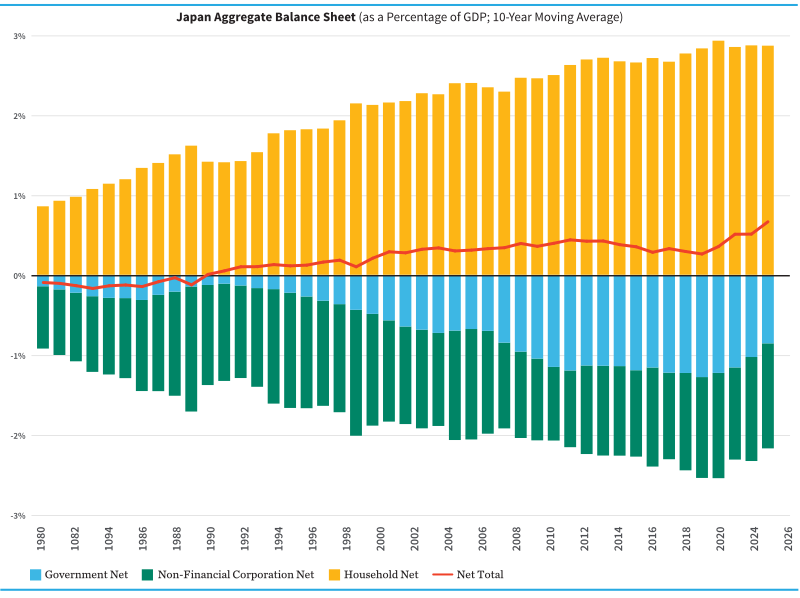
Source: Japanese Cabinet Office, as of January 2024.
Those resources are not evenly distributed. The government and corporate sectors are debtors, while much of Japan’s financial wealth resides with households. But taken together, the country has considerable capacity to fund investment internally.
Policymakers are pushing for greater investment across a wide range of strategic areas. Japan’s consensus-driven policymaking process can be slow, but once priorities are established, implementation tends to be swift and successful.
For investors, the question is where that capital ultimately goes—and which companies are positioned to benefit.
In recent decades, Japanese corporations and pension funds have invested heavily abroad, in part because interest-rate differentials and stronger nominal growth made overseas markets more attractive.
A sustained domestic reflation and investment cycle could begin to reverse that pattern. As investment opportunities improve at home, more corporate and institutional capital could remain in Japan or return from overseas, and that repatriation could provide structural support for the yen.
The potential impact extends beyond currency markets. Japan imports the vast majority of its fossil fuels and is also a significant food importer. A stronger yen would reduce the local cost of those imports, helping alleviate some of the pressure higher prices have placed on household purchasing power.
In that sense, the thesis forms a reinforcing cycle: domestic investment draws capital home, capital repatriation supports the yen, and a stronger yen helps improve consumers’ real purchasing power.
This changing backdrop could also reshape the Japanese equity market. Historically, it has behaved differently from other developed equity markets, tending to be more value-oriented, and traditional factor models have not always worked in the same way they do elsewhere. But that may be changing as Japan moves toward a more conventional environment of stronger nominal growth, rising demand for capital and higher interest rates.
Financials are among the clearest potential beneficiaries, in our view, but the opportunity extends well beyond financials.
Financials are among the clearest potential beneficiaries, in our view. Greater demand for capital and higher rates could create a more supportive environment for banks and the financial sector broadly.
But the opportunity extends well beyond financials. Japanese companies play important roles throughout global industrial and technology supply chains, including in many of the areas attracting substantial investment today. Potential beneficiaries span AI and technology infrastructure; robotics; defense; energy and infrastructure; nuclear power; software; and electrical and electronic technology and components.
Japan’s industrial base makes the country a significant supplier and component manufacturer across many of these areas. As domestic investment accelerates, those capabilities may become increasingly important at home as well as abroad.
This differs from the Japan story of recent decades. In the past, many of the country’s major corporate winners created value by deploying capital abroad and building global franchises. The emerging opportunity is more focused on capital formation within Japan—and the companies positioned to finance, supply, and participate in that investment.
In Japan’s case, rates are rising because prices are rising and economic growth is accelerating. The Bank of Japan may remain cautious, particularly after decades in which policymakers became accustomed to deflation and negative rates. But the longer end of the Japanese yield curve is increasingly responding to underlying demand for capital, stronger economic fundamentals and sustained domestic price increases rather than simply to changes in the policy rate. Japanese rates may have further to rise if the domestic investment cycle gains momentum.
This is not a thesis about the next quarter or two; we believe it’s a roadmap for the coming several years.
Japan’s policymaking process can take time as consensus is built, but implementation can move relatively quickly once priorities are established. Policymakers have already identified numerous areas in which they want to encourage domestic investment.
If those initiatives are accompanied by stronger nominal growth and private-sector capital spending, Japan could enter a markedly different economic regime: one characterized by more investment at home, higher demand for capital and potentially stronger currency dynamics.
For equity investors, that would change the Japan opportunity as well. Rather than relying principally on the global success of Japanese companies investing overseas, the next chapter may increasingly be about the companies helping build Japan itself.
Olga Bitel, partner, is the chief investment strategist at William Blair.
View Strategy:
https://im.williamblair.com/investments/separate-accounts/international-leaders
View Strategy:
https://im.williamblair.com/investments/separate-accounts/international-growth
Want the latest insights on the economy and other forces shaping the investment landscape?
Subscribe to our Investing Insights newsletter.
Any investment or strategy mentioned herein may not be appropriate for every investor. There can be no assurance that investment objectives will be met. Products and services listed are available only to residents of this jurisdiction and may only be available to certain categories of investors. The information on this website does not constitute an offer for products or services, or a solicitation of an offer to any persons outside of this jurisdiction who are prohibited from receiving such information under applicable laws and regulations. Nothing on this webpage should be construed as advice and is therefore not a recommendation to buy or sell shares.
Please carefully consider the William Blair Funds’ investment objectives, risks, charges, and expenses before investing. This and other information is contained in the Funds’ prospectus and summary prospectus, which you may obtain by calling 1-800-742-7272. Read the prospectus and summary prospectus carefully before investing. Investing includes the risk of loss.
The William Blair Funds are distributed by William Blair & Company, L.L.C., member FINRA/SIPC.
The William Blair SICAV is a Luxembourg investment company with variable capital registered with the Commission de Surveillance du Secteur Financier (“CSSF”) which qualifies as an undertaking for collective investment in transferable securities (“UCITS”). The Management Company of the SICAV has appointed William Blair Investment Management, LLC as the investment manager for the fund.
Please carefully consider the investment objectives, risks, charges, and expenses of the William Blair SICAV. This and other important information is contained in the prospectus and Key Investor Information Document (KIID). Read these documents carefully before investing. The information contained on this website is not a substitute for those documents or for professional external advice.
Information and opinions expressed are those of the authors and may not reflect the opinions of other investment teams within William Blair Investment Management, LLC, or affiliates. Factual information has been taken from sources we believe to be reliable, but its accuracy, completeness or interpretation cannot be guaranteed. Information is current as of the date appearing in this material only and subject to change without notice. Statements concerning financial market trends are based on current market conditions, which will fluctuate. This material may include estimates, outlooks, projections, and other forward-looking statements. Due to a variety of factors, actual events may differ significantly from those presented.
Investing involves risks, including the possible loss of principal. Equity securities may decline in value due to both real and perceived general market, economic, and industry conditions. The securities of smaller companies may be more volatile and less liquid than securities of larger companies. Investing in foreign denominated and/or domiciled securities may involve heightened risk due to currency fluctuations, and economic and political risks. These risks may be enhanced in emerging markets and frontier markets. Investing in the bond market is subject to certain risks including market, interest rate, issuer, credit, and inflation risk. High-yield, lower-rated, securities involve greater risk than higher-rated securities. Different investment styles may shift in and out of favor depending on market conditions. Diversification does not ensure against loss.
Past performance is not indicative of future returns. References to specific companies are for illustrative purposes only and should not be construed as investment advice or a recommendation to buy or sell any security.
William Blair Investment Management, LLC is an investment adviser registered with the U.S. Securities and Exchange Commission.
Issued in the United Kingdom by William Blair International, Ltd., authorized and regulated by the Financial Conduct Authority (FCA), and is only directed at and is only made available to persons falling within articles 19, 38, 47, and 49 of the Financial Services and Markets Act of 2000 (Financial Promotion) Order 2005 (all such persons being referred to as "relevant persons").
Issued in the European Economic Area (EEA) by William Blair B.V., authorized and supervised by the Dutch Authority for the Financial Markets (AFM) under license number 14006134 and also supervised by the Dutch Central Bank (DNB), registered at the Dutch Chamber of Commerce under number 82375682 and has its statutory seat in Amsterdam, the Netherlands. This material is only intended for eligible counterparties and professional clients.
Issued in Switzerland by William Blair Investment Services (Zurich) GmbH, Talstrasse 65, 8001 Zurich, Switzerland ("WBIS"). WBIS is engaged in the offering of collective investment schemes and renders further, non-regulated services in the financial sector. WBIS is affiliated with FINOS Finanzomubdsstelle Schweiz, a recognized ombudsman office where clients may initiate mediation proceedings pursuant to articles 74 et seq. of the Swiss Financial Services Act ("FinSA"). The client advisers of WBIS are registered with regservices.ch by BX Swiss AG, a client adviser registration body authorized by the Swiss Financial Market Supervisory Authority ("FINMA"). WBIS is not supervised by FINMA or any other supervisory authority or self-regulatory organization. This material is only intended for institutional and professional clients pursuant to article 4(3) to (5) FinSA.
Issued in Australia by William Blair Investment Management, LLC (“William Blair”), which is exempt from the requirement to hold an Australian financial services license under Australia's Corporations Act 2001 (Cth). William Blair is registered as an investment advisor with the U.S. Securities and Exchange Commission (“SEC”) and regulated by the SEC under the U.S. Investment Advisers Act of 1940, which differs from Australian laws. This material is intended only for wholesale clients.
Issued in Singapore by William Blair International (Singapore) Pte. Ltd. (Registration Number 201943312R), which is regulated by the Monetary Authority of Singapore under a Capital Markets Services License to conduct fund management activities. This material is intended only for institutional investors and may not be distributed to retail investors.
Issued in Canada by William Blair Investment Management, LLC, which relies on the international adviser exemption, pursuant to section 8.26 of National Instrument 31-103 in Canada.


The content contained in this site is intended as informational or educational in nature and does not constitute investment advice or a recommendation of any investment strategy or product for a particular investor. Investment advice and recommendations can be provided only after careful consideration of an investor’s objectives, guidelines, and restrictions. Investors should consult a financial professional/financial consultant or investment adviser before making any investment decisions. Investing includes the risk of loss.
Copyright © 2026 William Blair. William Blair is a registered trademark of William Blair & Company, L.L.C. “William Blair” refers to William Blair Investment Management, LLC and affiliates.

