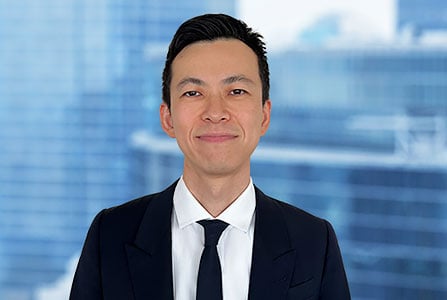
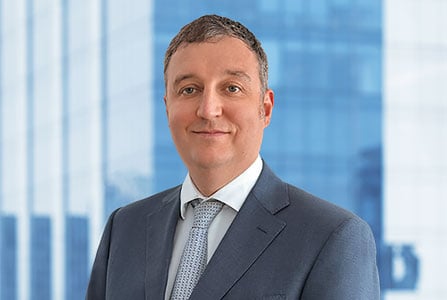
Several analysts on our global equity team—Pierre Horvilleur, Siuchoon Koay, Matt Sykes, and Frank Wedekind—recently sat down to share their perspectives on the trends, disruptions, and opportunities shaping their sectors. Pierre and Siuchoon cover industrials and technology hardware, respectively, while Matt focuses on healthcare and Frank on financials.
Below, they share insights on what they believe drives long-term growth, how they cut through short-term market noise, and the frameworks they use to identify high-conviction investment ideas.
What key areas are you focused on, and what forces are driving disruption in your sector?
Matt: It’s worth a reminder that while equities have broadly been in a bull market for years, healthcare really hasn’t. Earnings revisions over the past three years have been sharply negative, and the healthcare sector sits at one of the lowest percentage levels of the S&P 500 Index[1] and other key global indices. However, valuations appear attractive on a historical basis. That’s part of why we think this is an interesting moment for healthcare.
In addition, when you talk about disruption in healthcare, it’s hard not to talk about AI. But we have a somewhat different take. Most of the attention has been on AI-driven drug discovery, which has been a challenging space to be for public market investors.
Where we do see AI having a potential near-term impact is in efficiency and areas such as supply chains, clinical trial design, and diagnostics. That is where we see AI already driving meaningful cost savings and productivity gains.
While AI-driven drug discovery will likely be a powerful driver of growth in the future, I believe we are still years away from that impacting drug companies’ revenue streams.
“We’re short-term cautious but long-term optimistic.” – Frank Wedekind
Frank: The financials sector feels increasingly delicate right now. It’s late cycle in many areas, and in some cases, the cycle has already turned, with some business models facing technological disruption. Because of that, we’re stepping more carefully than usual.
In insurance, for example, the downcycle has set in, so we’re currently monitoring the space for an inflection point to re-engage. And in banks, particularly in developed markets (DMs), it feels late cycle, so we’re cautious, especially regarding valuations; emerging markets (EMs), meanwhile, look somewhat more attractive.
Platform and capital-light businesses, which are traditionally the best business models in the sector, appear to look inexpensive, but that’s assuming their business models will not be materially impaired by AI disruption. That risk to business models is very real, and we’re taking a more cautious approach.
Previously, I would have been encouraged by a cycle such as this one and the opportunity to buy high-quality, structurally growing businesses at a discount. But AI is the complicating factor, creating a broader range of outcomes into what has historically been an attractive setup. My view is that many of these businesses will ultimately endure the implementation of AI and the impacts on their businesses, but the market doesn’t have to agree in the short term.
That said, from a longer-term perspective, I believe it’s an exciting time. New business models are emerging, currently led by opportunities in the United States. Overall, we’re short-term cautious but long-term optimistic. We believe this environment is creating opportunities that will yield attractive returns for years to come.
“Tesla’s Optimus program is currently among the most advanced humanoid robots globally.” – Pierre Horvilleur
Pierre: Within industrials, the most prominent area of anticipated disruption is humanoid robotics. During my time in China in 2025, I spent time with humanoid developers to gain a clearer view of the underlying progress. China remains deeply embedded in the global robotics supply chain, including the production of key components used in Tesla’s Optimus program, which is currently among the most advanced humanoid robots globally.
The challenge, however, lies in valuation. In several cases, companies are being priced as though humanoid robotics already contribute a meaningful amount of earnings, even though these initiatives are generating zero commercial revenue today. In our view, paying such elevated premiums at this early stage of the industry’s development introduces an unattractive level of risk and reward.
In contrast, the most tangible impact from AI thus far is emerging in the global expansion of power and energy infrastructure. Data centers require exceptionally high levels of electricity, which is driving demand for gas turbines, liquefied natural gas (LNG), transformers for power distribution, and shipping capacity to transport the LNG. Supply across all these areas remains extremely tight, and we expect the related investment cycle to persist for at least the next decade.
This theme has led us into sectors where we have historically had little exposure, such as shipbuilding. Korean shipyards, for example, are positioned to benefit from increased LNG transport needs as well as rising defense-related demand—another secular growth trend. Global defense spending continues to increase on a long-term basis, and even in the event of reduced geopolitical tensions, we do not expect this trajectory to reverse as the need for self-sufficiency requires a multi-year supply investment.
Siuchoon: One of the biggest trends in technological hardware right now is cost reduction. AI servers are incredibly expensive to deploy, and ultimately, whoever can bring costs down the fastest wins. Today, there are a few dominant camps—Nvidia, Google, and Amazon—competing aggressively, with Broadcom playing a key role alongside Google.
Historically, the playbook centered around shrinking the chip. Smaller chips enabled more circuitry which improved performance, and lower power consumption, which improved cost of ownership. But that model has limits in the short term. Shrinking chips is incredibly expensive and difficult. And the performance gains required are several orders of magnitude higher.
As a result, innovation is spilling out beyond the chip itself to the broader hardware stack: memory, substrate, packaging, connectors, networking, and the rack itself. In many cases, those parts of the supply chain are innovating faster than the chip. That is where we’re most interested in as these “content growers” can continue to compound by increasing their share of system cost.
“Innovation is spilling out beyond the chip itself to the broader hardware stack.” – Siuchoon Koay
As fundamental analysts, how do you balance long-term earnings growth with short-term market noise, and how does that feed into your sector analysis?
Frank: Ultimately, we can only take advantage of the investment opportunities that the market presents to us. But I still seek to identify companies that are mispriced and have real growth runway.
From there, we strive to close the gap between what we believe and what the market believes in terms of valuation and expectations. The challenge is timing. Early in my career, I learned that you can be right on fundamentals but still underperform for years if the market regime isn’t on your side. Therefore, I always pay close attention to the viewpoint of the broader market. For example, if the market is risk-on, or in an expansionary mode, but I’m positioned defensively, those stock picks will likely underperform.
Second, I try to run a more balanced portfolio until the regime is clearer. Once the regime confirms itself, you can size up and swing the bat harder.
Lastly, I prefer to optimize my recommendations in a balanced, risk-efficient way so that we can benefit from any abrupt changes in the market. A balanced portfolio approach can provide a higher degree of certainty while also enabling us to be nimbler and take advantages of opportunities as they are presented.
Matt: One thing I assumed when I was on the sell side was that long-only investors can sit through volatility and wait for the long-term payoff. I think that’s changed.
I’d love a stock to work over 1, 3, 5, or even 10 years, or see a small-cap name grow into a large-cap position. But if you don’t get the catalyst path correct in the first 3 to 6 months, the path to delivering performance becomes much more challenging.
For me, every stock I recommend must have both a compelling long-term growth story and a clear near-term validation point—whether that’s earnings or a data readout—that provides me a high degree of confidence. This kind of early confirmation helps establish a thesis, even if the full value takes much longer to play out.
“Every stock I recommend must have both a compelling long-term growth story and a clear near-term validation point.” – Matt Sykes
Pierre: For me, the focus is on understanding the real drivers of intrinsic value. It’s about determining what a company is truly worth—not simply relying on what a model outputs—and gaining a deep grasp of the factors that underpin its performance. From there, the key is aligning that assessment with a clear view of potential catalysts.
I also avoid chasing overhyped stocks. But if I identify a company trading at a discount to its intrinsic value, led by a strong management team and supported by a compelling secular growth trajectory over the next 5 to 10 years, I’m willing to make that bet. Ultimately, it’s about balancing risk and reward and capturing meaningful upside while minimizing exposure to outsized downside.
What best practices or ways of thinking have you brought from past jobs and experiences to William Blair and the global equity team?
Matt: At Goldman Sachs, I started out as a generalist in sales and trading, where I covered all sectors. That experience helped shape my view on the buyside because as a generalist, you must learn to be comfortable with the discomfort of never knowing everything about a company.
What matters most is having the confidence that the work you’ve done is sufficient and avoiding going down rabbit holes that delay decisions as waiting too long can mean missing alpha.
Pierre: Cycles tend to repeat, a concept Ray Dalio emphasizes in his book, Principles. A critical aspect of investing is recognizing these patterns and understanding which type of cycle you are entering.
Some cycles are relatively short. For example, selling cars during the pandemic created a straightforward, 12-to-24-month opportunity. Others unfold over much longer periods, such as the grid modernization and buildout that’s underway today—a theme that will likely play out over a decade or more. I believe the real skill lies in identifying the type of cycle you’re in and, equally important, knowing when to exit.
Another core strength I bring stems from beginning my investing career at William Blair. The firm’s quality growth philosophy, which links growth, return on invested capital (ROIC), and economic value creation, instilled a disciplined fundamental lens. That framework has helped me navigate cycles without getting swept up in speculative excess, while allowing me to identify long term winners early.
“I believe the real skill lies in identifying the type of cycle you’re in and, equally important, knowing when to exit.” – Pierre Horvilleur
Siuchoon: Prioritization within the portfolio. Markets move quickly, and some ideas have strong near-term positives but a murkier longer-term outlook, whether due to tech risk or design changes. On the other end, there are ideas with very attractive terminal value but a bumpier path in the short term.
From my perspective, it’s about putting a framework around how we rank these ideas. The key concept I’ve emphasized is runway: not just good news over the next few months, but ideally, visibility over the next year to year and a half. That matters because you don’t want to be the last buyer into a trade.
Frank: Throughout my career, I have learned a few key lessons: first, you don’t have to be a genius to succeed in this business; second, the more effort you put in, the more you get out; and third, having a simple, consistent investment framework that continuously tilts the odds in your favor can potentially result in outperformance.
I was fortunate to be able to develop a framework such as this, one that is flexible and repeatable, and I’ve brought that with me to William Blair.
Siuchoon Koay is a research analyst on William Blair's global equity team.
Frank Wedekind is a research analyst on William Blair's global equity team.
Matt Sykes is a research analyst on William Blair's global equity team.
Pierre Horvilleur is a research analyst on William Blair's global equity team.
[1] The S&P 500 is a market-capitalization-weighted stock market index that tracks the performance of 500 of the largest publicly traded companies in the United States.